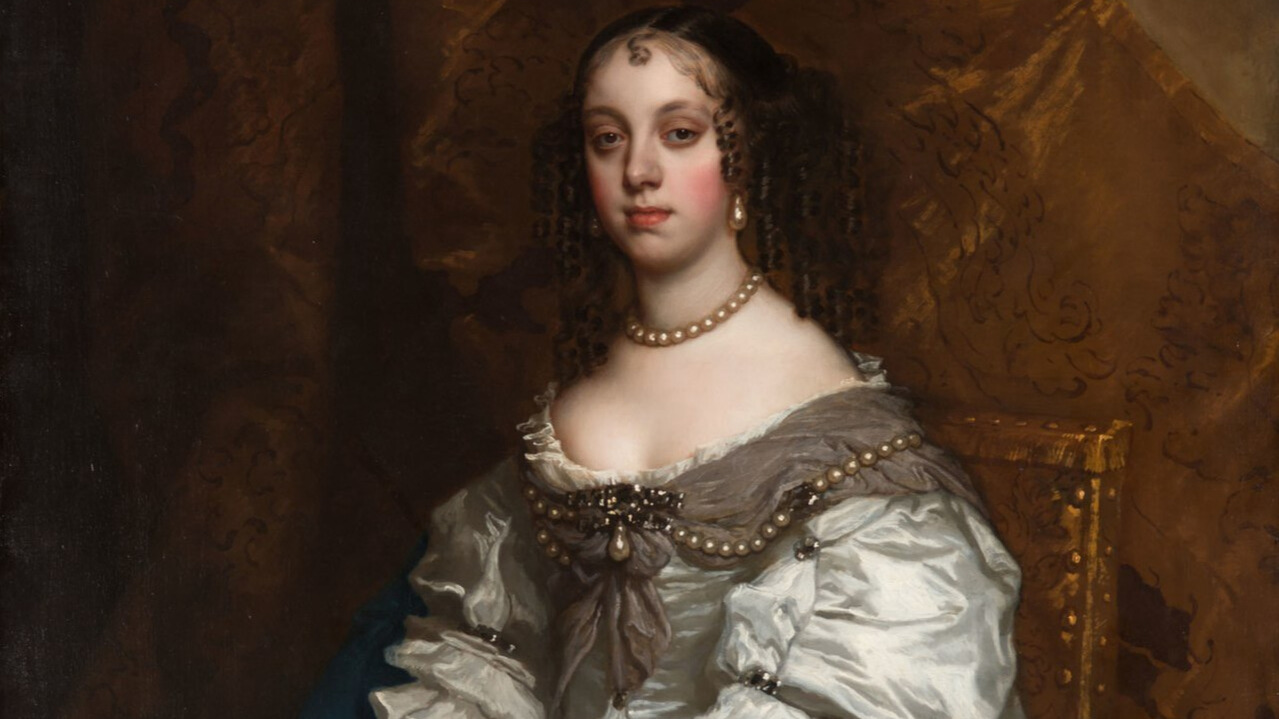
This is Part Eight of the series Women Behind the Throne, focusing on Catherine of Braganza and following Anne of Austria as we continue our exploration of women whose power was exercised through endurance, image, and survival rather than formal rule.
A Queen Arrives in a Country That Does Not Want Her
Catherine of Braganza enters English history with a problem that has nothing to do with personality and everything to do with fear. She is foreign, visibly Portuguese, and openly Catholic in a kingdom that has learned—through civil war, revolution, and restoration—to treat Catholicism not merely as a religion, but as a political threat. Before she speaks a word of English, she is already a symbol. And symbols, in a paranoid age, are rarely given mercy.
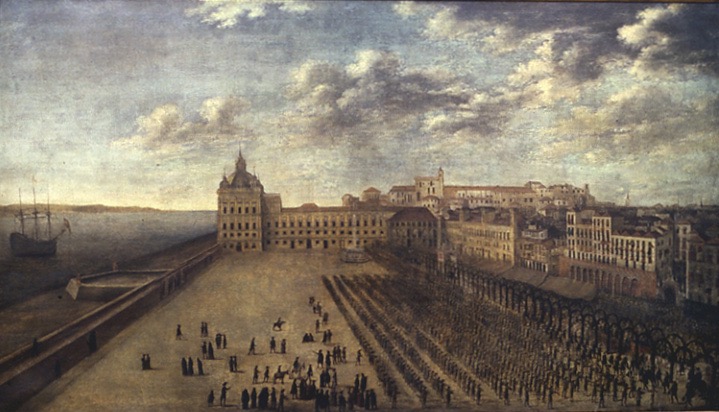
Her marriage to Charles II in 1662 is not a romantic story. It is a strategic treaty wrapped in lace. England receives a dowry with real geopolitical weight: Tangier, Bombay, and trading advantages that reach into the future of empire. Portugal receives what it needs most—support against Spain and protection for a newly restored dynasty that has only recently broken free of Iberian domination.
Catherine is brought to England not because England loves her, but because England wants what she carries.
Marriage as Theatre, Survival as Reality
Charles II is charming, witty, and fundamentally unfaithful. Catherine is devout, sheltered, and raised in a court culture shaped by convent discipline and formal restraint. It is a mismatch in temperament and in expectations, made worse by politics. She is a Catholic queen in a Protestant nation, and her husband’s court thrives on spectacle—on mistresses, on jokes, on scandal.
Catherine’s early years are marked by isolation. Language separates her from her surroundings; religion separates her from public acceptance; court culture separates her from her husband’s world. And then comes the humiliation that turns private pain into public ritual: Charles insists that one of his most prominent mistresses be formally placed near the queen.
What Catherine experiences is not simply marital betrayal. It is the public demonstration of her powerlessness. Yet the remarkable thing about Catherine is not that she suffers this—it is that she survives it without becoming either a saintly caricature or a bitter political weapon.
She learns, slowly, that the only form of control available to her is self-control.
No Heir, No Shield
The English monarchy expects an heir. Catherine cannot provide one. Miscarriages are not only personal tragedy; in royal politics they become evidence, accusation, and ammunition. The absence of children weakens her position and intensifies the whispers that she is somehow “wrong” for England—not merely foreign, but dangerous.
And still, Charles does not divorce her.
This is one of the most revealing paradoxes of the marriage. Catherine does not rule Charles, and she does not command him. Yet her presence creates a boundary the court cannot fully cross. Charles may love other women, but he does not allow the queen to be discarded. She remains queen, and that fact matters. In a court where women are often treated as replaceable, Catherine becomes a fixed point—not through power, but through the king’s refusal to treat her as disposable.
Her influence is not dramatic. It is structural. She stays.
The Popish Plot and the Politics of Fear
If Catherine’s marriage is a private battlefield, the Popish Plot is her public trial. In the late 1670s, anti-Catholic hysteria rises into something close to mass political delirium. Accusations spread like infection. A Catholic queen becomes the most convenient target imaginable.
The charges against her are extreme, theatrical, and ultimately impossible to sustain. Yet for a time she is genuinely in danger. The point is not whether the accusations are true; the point is that, in an age of fear, truth is less important than usefulness. Catherine is useful as a symbol of the enemy within.
This is where her survival becomes its own kind of authority. She does not meet hysteria with hysteria. She does not start factions or seek revenge. She relies on what she has always relied on: composure, dignity, and the king’s protection. Charles intervenes decisively, and the worst danger passes—but the lesson remains. Catherine understands that in England she can never be merely a queen consort. She is always, to some, a threat.
Faith as a Fortress
Catherine’s Catholicism is the most obvious reason she is mistrusted, but it is also the reason she endures. She treats faith not as political performance but as private refuge. Her religious life becomes a fortress—a space where she can retain identity in a world that constantly tries to rewrite her.
Over time, her quiet steadiness reshapes her image. She never becomes beloved in the way a Protestant queen might have been, but she becomes harder to demonize. She is not a conspirator. She is not a seductress. She does not behave like the stereotype her enemies want. And in a culture that expects Catholic women to be agents of intrigue, her restraint is its own form of resistance.
Even her moments of cultural presence—court entertainments, patronage, tastes carried from Portugal—are not acts of domination, but signs that she is still alive inside a world that tried to erase her.
Widowhood and a Different Kind of Power
When Charles II dies in 1685, Catherine’s position changes overnight. The performance ends. The court reorganizes. A queen without children becomes, in many systems, irrelevant.
But Catherine does not vanish.
She remains in England through the reign of James II and even into the new order created after the Glorious Revolution. She becomes a figure of continuity, someone who has seen regimes change and learned how to survive them. Her power now is not influence over policy; it is the authority of endurance, the legitimacy of having outlasted what was supposed to destroy her.
And then she returns to Portugal.
Back in her homeland, the story shifts again. Catherine is no longer merely a consort. In Portugal, she serves as regent during her brother’s absences. The woman once treated as politically suspect in England becomes, in the end, a stabilizing figure at home—proof that royal women may be underestimated for decades, only for history to reveal what they were actually doing: surviving until survival becomes power.
What Catherine Represents in This Series
Catherine of Braganza is not a ruler in the traditional sense. Her life is not a story of commanding armies or writing laws. It is a story of staying upright under pressures designed to bend and break.
In Women Behind the Throne, she represents a specific kind of hidden power: the power of presence that does not collapse, even when the world insists it should. She arrives as a bargain, becomes a target, and remains—quietly, stubbornly, unmistakably.
Not all power looks like control.
Sometimes power is simply refusing to disappear.
- Открадната история: Операция „МАРАТОН“ и кражбата на „История славянобългарска“

- Открадната история: Как от Лувъра изчезнаха бижута за 88 милиона евро за 8 минути

- Открадната история: редки книги за 3,2 милиона долара, сред които първи издания на Галилей и Нютон, са открити в къща в Румъния
- Открадната история: нюйоркски колекционер връща 180 артефакта от 11 държави на стойност 70 милиона долара

- Христо Кръстев: сред победителите във въздушния бой на 1 август 1943 г.

- Петър Бочев: последният полет на един български летец

Вашият коментар