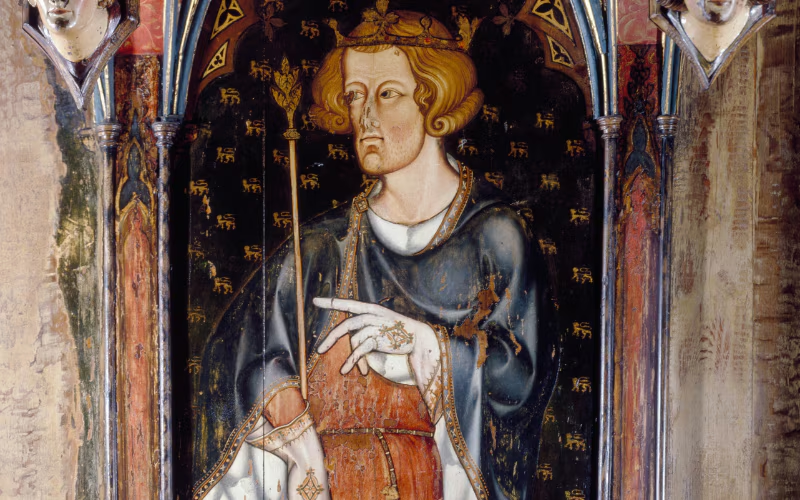
On April 20, 1290, Edward I staged what might be called the medieval world’s ultimate publicity event—a grand “Round Table” tournament near Winchester. At first glance, it looked like pure spectacle: knights in gleaming armor, crowds roaring with excitement, and contests of skill that blended danger with drama. But beneath the surface, this was something far more calculated. It was a masterclass in political storytelling, where myth and power intertwined, and where the legend of King Arthur became a tool for shaping authority.
When Kings Put on a Show
Long before modern media strategies and campaign rallies, rulers understood the value of spectacle. Edward I was no exception. If he had lived today, he might have been a master of viral moments. Instead of hashtags and livestreams, he used tournaments—lavish, public, and unforgettable.
The event near Winchester was not just a competition; it was a full-scale performance. Nobles and knights gathered from across England, each eager to display prowess and honor. The atmosphere would have been electric: the clash of steel, the thunder of hooves, the cheers of the crowd. It wasn’t just entertainment—it was narrative in motion.
Edward wasn’t simply hosting a tournament. He was telling a story in which he stood at the center, surrounded by symbols that elevated him beyond the ordinary.
Arthur – More Than a Legend
To modern audiences, King Arthur belongs to myth and literature. But in the 13th century, he occupied a very different space. He was not merely a character—he was an ideal.
Arthur represented unity, justice, and noble kingship. His court, with its famed Round Table, symbolized equality among knights and loyalty to a just ruler. In a fragmented and often turbulent medieval world, such an image carried enormous weight.
Edward I understood this perfectly. Rather than claiming greatness outright, he aligned himself with Arthur’s legacy. By invoking that legend, he allowed others to draw the comparison. It was subtle, effective, and deeply persuasive.
Politics in Armor
Medieval politics was anything but simple. It was a constant balancing act between authority, loyalty, and resistance. Edward I ruled during a time when consolidating power was an ongoing challenge.
So how does a king convince people he deserves to rule?
Force is one way. Law is another. But narrative—story—is often more powerful than both.
By associating his reign with Arthurian ideals, Edward elevated his authority beyond the immediate and the practical. He positioned himself as part of a timeless tradition, not just a temporary ruler.
It was a quiet but powerful message: he was not just a king—he was a continuation of a legend.
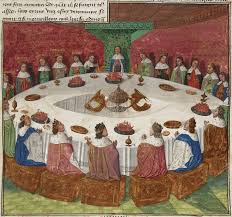
Knights as Performers
The knights who took part in the tournament were more than competitors—they were performers in a grand production.
Every duel and display of skill reinforced the ideals of chivalry. Honor, courage, and loyalty were not abstract values; they were enacted in front of the audience. These moments turned belief into experience.
And while it may sound romantic, there was a strategic edge to it all. This was propaganda—but not the blunt kind. It was elegant, inspiring, and emotionally engaging.
People didn’t feel persuaded. They felt inspired.
The Crowd and the Crown
The common people played a crucial role in this spectacle. For them, the tournament was more than a rare break from everyday hardship. It was a shared cultural moment.
In witnessing these events, they weren’t just observers—they became participants in a broader narrative. They saw the ideals of their society brought to life and reaffirmed.
This reinforced the existing social order. The king stood at the top, surrounded by noble warriors, all bound by a code that seemed both noble and natural.
And in that moment, the structure of society felt justified.
Myth as Political Strategy
Why do myths hold such power?
Because they resonate. They simplify complex realities into compelling stories. They connect the past to the present and give meaning to authority.
Edward’s use of Arthur was not accidental. It was strategic. Instead of building legitimacy from scratch, he tapped into an already powerful cultural symbol.
It was like borrowing credibility from a legend everyone already trusted.
And it worked remarkably well.
Strength or Insecurity?
This raises an important question. When rulers align themselves with myths, does it signal strength—or insecurity?
The answer is not straightforward.
On one hand, it demonstrates awareness and intelligence. Edward understood the cultural landscape of his time and used it to his advantage.
On the other hand, the need to draw on myth suggests that authority alone may not have felt sufficient. There may have been underlying uncertainty—an awareness that power needs reinforcement.
But that doesn’t necessarily imply weakness. It reflects a deeper truth about leadership: authority is not just enforced—it is constructed.
The Darker Reality of 1290
Yet 1290 was not defined solely by spectacle and symbolism. In the same year, Edward I issued the Edict of Expulsion (1290), forcing the entire Jewish population of England to leave the kingdom.
This decision reveals a stark contrast. While the tournament projected ideals of unity and chivalry, the expulsion exposed the harsher realities of medieval rule.
For decades, Jewish communities in England had faced heavy taxation, legal restrictions, and widespread prejudice. By 1290, they had become politically vulnerable. Expelling them allowed Edward to satisfy powerful interests, align with religious pressures, and consolidate control.
It was not a symbolic act—it was a decisive and consequential policy.
A King of Contradictions
The juxtaposition is striking. On one hand, Edward presents himself in the image of King Arthur—a ruler of justice and unity. On the other, he enacts a policy that uproots an entire community.
This duality is not unusual in history. Leaders often operate in the space between ideal and necessity, image and action.
Edward’s reign reflects this tension. He could inspire through myth while governing through pragmatism. He could embody legend while making decisions shaped by pressure and power.
Lasting Impact
The Round Table tournament had consequences that extended far beyond its immediate moment. It helped reinforce and popularize Arthurian legend across medieval Europe.
Stories spread, evolved, and took root in cultural memory. Over time, they became part of a shared heritage that outlived the king himself.
This is the enduring power of narrative. A well-crafted story does not fade—it grows.
The Art of Medieval Power
Ultimately, Edward I’s tournament was more than an event—it was a demonstration of how power can be shaped through perception.
He showed that ruling is not only about control, but also about meaning. Authority must be seen, understood, and believed.
By combining spectacle, symbolism, and strategy, he created something far more effective than force alone.
Final Reflection
The story of Edward I reminds us that leadership has always depended on more than laws or armies. It depends on ideas, symbols, and the stories people choose to believe.
Myths can legitimize power just as effectively as institutions. They can unite societies—or mask their contradictions.
And whether in the Middle Ages or today, one truth remains constant: those who shape the narrative often shape reality itself.
- Открадната история: Операция „МАРАТОН“ и кражбата на „История славянобългарска“
- Открадната история: Как от Лувъра изчезнаха бижута за 88 милиона евро за 8 минути
- Открадната история: редки книги за 3,2 милиона долара, сред които първи издания на Галилей и Нютон, са открити в къща в Румъния
- Открадната история: нюйоркски колекционер връща 180 артефакта от 11 държави на стойност 70 милиона долара
- Христо Кръстев: сред победителите във въздушния бой на 1 август 1943 г.

- Петър Бочев: последният полет на един български летец

Вашият коментар