The Spanish Threat and the European Balance of Power
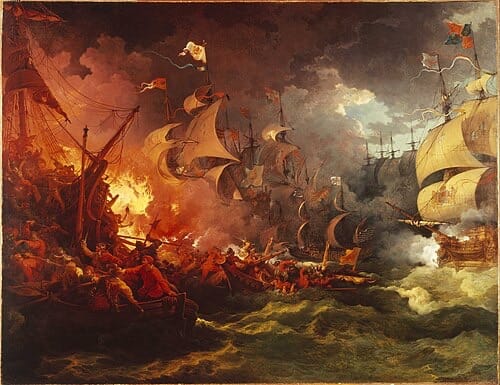
The summer of 1588 brought Europe to a moment of extraordinary tension. Rising over the horizon was one of the greatest fleets ever assembled: the Spanish Armada. Conceived by King Philip II as the weapon that would topple Elizabeth I and restore Catholic rule in England, it quickly became a symbol of imperial ambition. Yet as the events unfolded, the legendary expedition known as the Spanish Armada 1588 revealed how power, strategy, and fate can collide in unexpected ways.
Spanish Armada Grand Design
Spain’s plan was bold. The Armada was meant to secure the passage of the Duke of Parma’s 27,000 battle-hardened soldiers from Flanders to the Kent coast. Once ashore, their advance to London would be swift, meeting minimal resistance from England’s inadequate defenses. Many historians agree that if Parma’s men had landed as intended, the collapse of Elizabeth’s government was more than likely. England at the time was religiously divided, militarily underprepared, and lacking the standing army required to repel a seasoned European force. The consequences of a Spanish victory could have dramatically altered the continent’s future and erased the idea of a British Empire before it ever began.
England’s Weak Defenses Against the Spanish Invasion
The reality of England’s defensive capacity in 1588 is often overshadowed by later patriotic myths. In truth, the country was dangerously vulnerable. No permanent army existed. The majority of its militia consisted of undertrained men who often possessed little more than farm tools, aging bows, or rusted swords. Many coastal fortifications were in ruins or obsolete, built for a different era of warfare. Even strategic locations such as the Isle of Wight and the Thames Estuary relied on a handful of guns and limited stores of gunpowder. Should Parma’s veterans have made landfall, England’s ability to fight them off was doubtful.
The Navy: Strength and Illusion
The English fleet, often portrayed as the decisive factor in the Armada’s defeat, was in reality hampered by severe shortages. Elizabeth’s treasury was nearly empty, forcing commanders to ration gunpowder from the outset. Although English ships were more maneuverable and their crews highly experienced, they lacked the ammunition to destroy the Armada outright. For nine days, English captains harassed the Spanish fleet up the Channel, but their guns could not deliver a fatal blow. The famous duel at sea was less a triumph of naval superiority than a prolonged game of pursuit that England might not have won under different circumstances.
Spain’s Miscalculations
While Spain possessed immense naval might, the Armada carried structural weaknesses into the campaign. Communication between the fleet and Parma’s forces broke down almost immediately, undermining the entire invasion plan. The Armada, majestic in size, was not built for the unpredictable winds and narrow waters of the English Channel. Shifting weather patterns disrupted formations and forced constant maneuvering. The English fireship attack at Gravelines ignited panic among the Spanish commanders, scattering the tightly packed vessels and robbing the Armada of the discipline and cohesion on which its strategy relied.
The Wrath of the North Atlantic
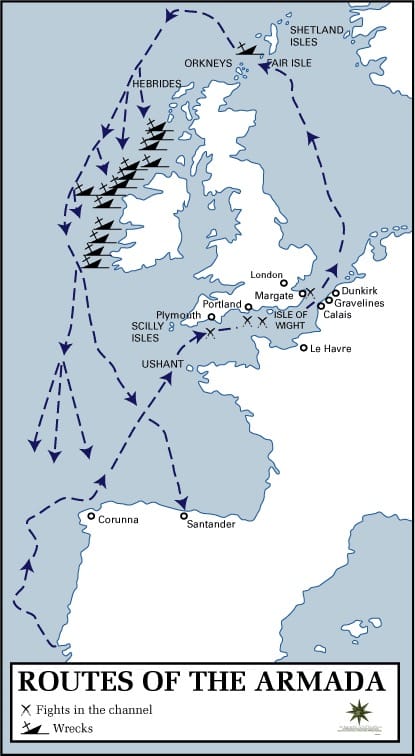
After the chaos at Gravelines, the Armada’s attempt to return home became a desperate struggle against nature. The northern Atlantic unleashed violent storms that no fleet of the sixteenth century could withstand. Spanish ships were hurled against the cliffs of Ireland and Scotland; masts splintered, hulls shattered, and sailors drowned by the hundreds. Those who survived shipwrecks succumbed to starvation, disease, or exhaustion. By the time the remnants of the Armada limped back to Spain, the fleet that had set out to conquer England was all but destroyed.
A Victory Claimed by England—but Earned by the Wind
England celebrated the Armada’s defeat as evidence of divine favor, and Elizabeth’s reign was immortalized through portraits and proclamations of triumph. Yet behind the pageantry lay a more sober truth. The English navy, though skilled, lacked the resources to annihilate the Armada. Had the weather not intervened, Parma’s troops might have reached England, and the outcome could have been catastrophic for the Tudor monarchy. The decisive victors of 1588 were not the English ships but the winds and storms of the North Atlantic.
The Legacy of 1588
The failed invasion carried profound consequences. Spain’s aura of maritime invincibility evaporated, altering the balance of power in Europe. England, by contrast, emerged more confident and increasingly aware of its naval potential. The country’s Protestant identity solidified, shaping its political and cultural development for centuries. As England’s naval power strengthened, the foundations of its future empire began to take form.
A Moment That Could Have Changed Everything
The Spanish Armada 1588 endures as one of history’s great turning points. It is also one of its greatest “what ifs.” A slight change in wind direction, a clearer line of communication, or a more aggressive Spanish strategy might have rewritten the fate of England and Europe. Instead, storms shattered an empire’s ambition, and the course of history shifted with the tide.
- Стоян Стоянов: защитникът на София, който стана екскурзовод в Рилския манастир

- Чудомир Топлодолски: от защитник на българското небе до строител на стадион „Васил Левски“

- Жените до трона: Кераца Петрица – майката на Йоан Александър, до която писа папата

- Българските земи през 1437 година: разказът на един баварски бенедиктински монах
- Съкровище от Мурано край Бургас? Загадката на стотици венециански стъклени съдове от Черно море

- Старозагорският лъв: загадката на средновековните релефи
Вашият коментар