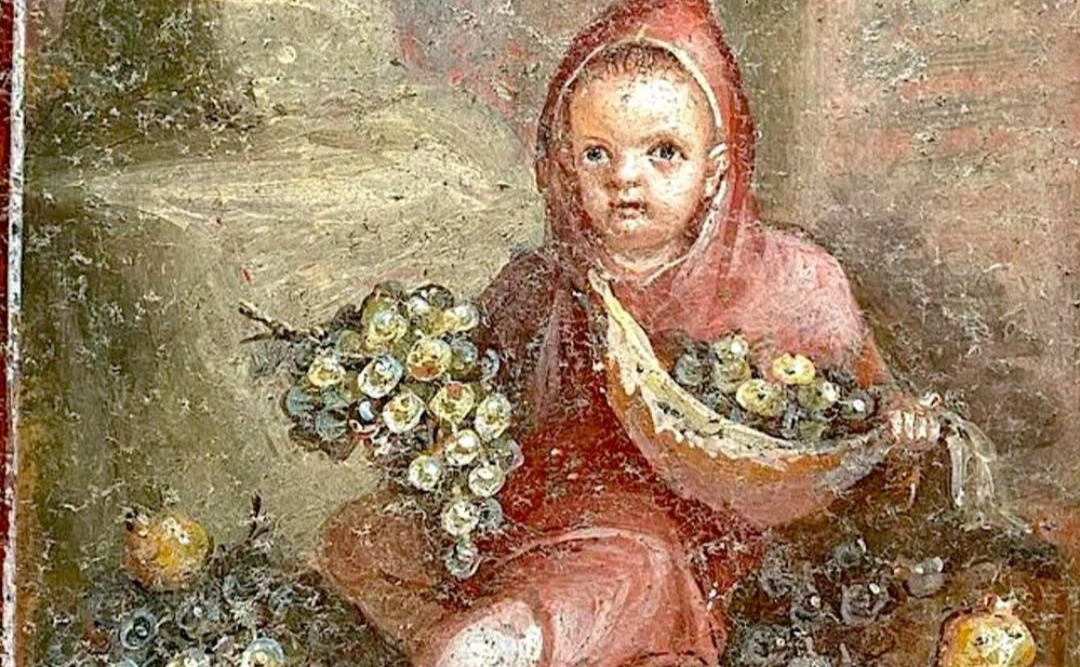
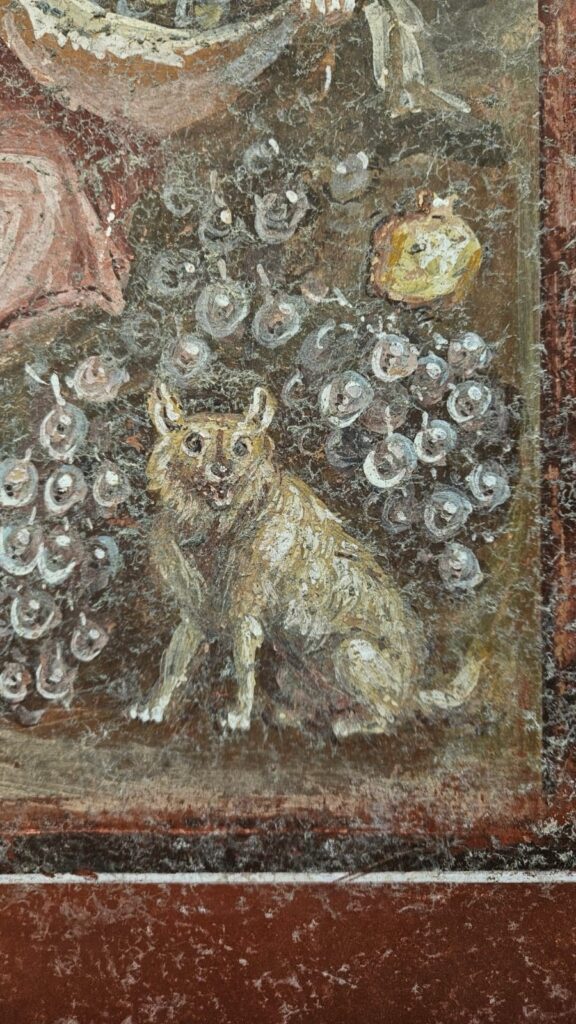
At first glance, there is something strangely familiar about the little figure painted on a wall in Pompeii. A small child sits surrounded by enormous bunches of grapes and pomegranates. A reddish hood covers his head and a traveler’s cloak wraps around his body. Beside him sits a tiny dog, looking almost like the beloved pet of a modern child.
To twenty-first-century eyes, the image can immediately evoke Little Red Riding Hood. But the resemblance is an accident separated from the famous European fairy tale by many centuries. This child was painted in ancient Pompeii, before the eruption of Mount Vesuvius buried the city in AD 79.
And archaeologists still do not know exactly who he is.
The painting is particularly intriguing because it does not appear to fit neatly into the familiar repertoire of art discovered around Vesuvius. The Archaeological Park of Pompeii describes it as a highly unusual scene, without known parallels in Vesuvian painting. One possibility raised by the Park is remarkably personal: the hooded figure may represent a son of the household who had died young.
If that interpretation is correct, what looks at first like a charming ancient scene may actually preserve the memory of a family’s lost child.
A Child Among Gods and Heroes
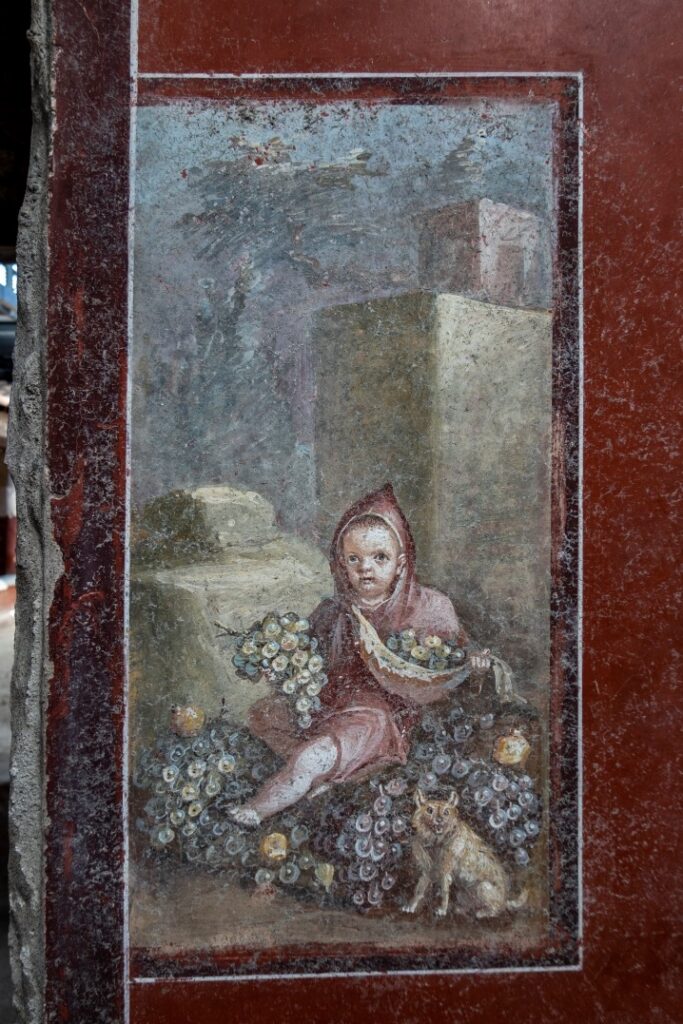
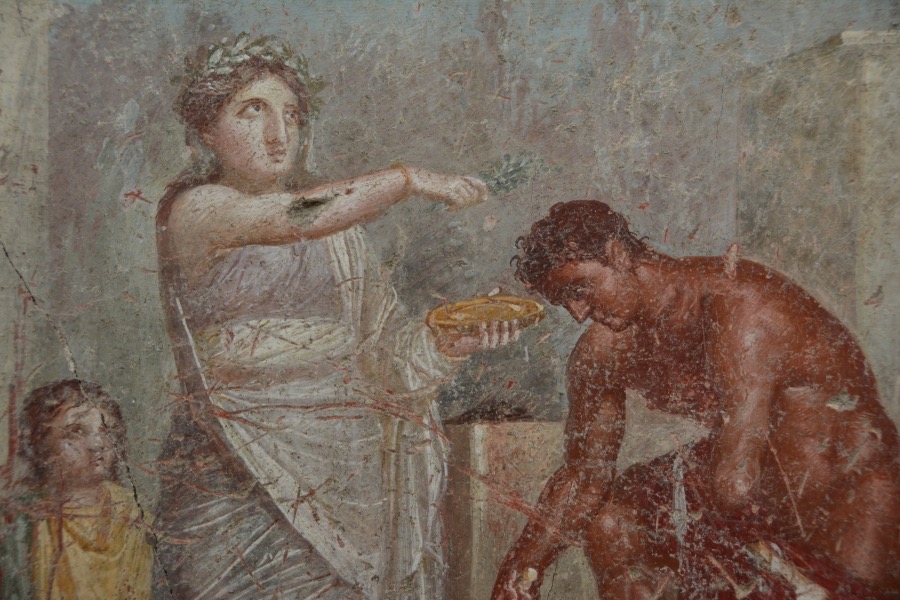
The mysterious painting was uncovered in the House of the Painters at Work, within the Insula of the Chaste Lovers along Pompeii’s famous Via dell’Abbondanza. The house has provided archaeologists with something remarkable: not merely another luxurious Roman interior, but a home whose decoration appears to have been interrupted by catastrophe.
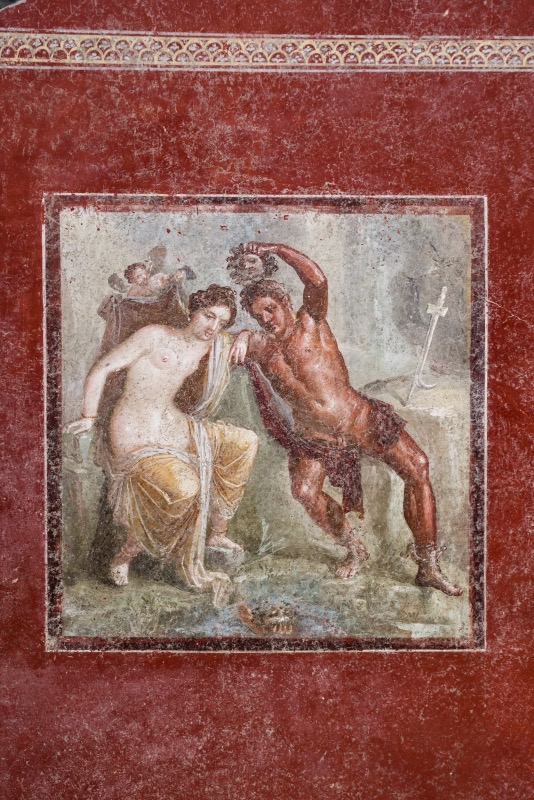
The room containing the child was richly decorated in Pompeii’s Fourth Style, the elaborate form of wall painting fashionable during the final decades of the city’s existence. Above the walls appeared fantastic creatures including centaurs, sirens and griffins. They framed images of gods that archaeologists have identified as Aphrodite, Apollo and Dionysus, together with another deity whose identity is obscured by damage to the wall.
The larger painted panels continued the mythological world. On one side, Perseus and Andromeda appear together. Elsewhere is an enigmatic scene interpreted as the purification of a hero.
Then, on another wall, the atmosphere changes.
Instead of another easily recognizable hero or god, there is the little hooded boy.
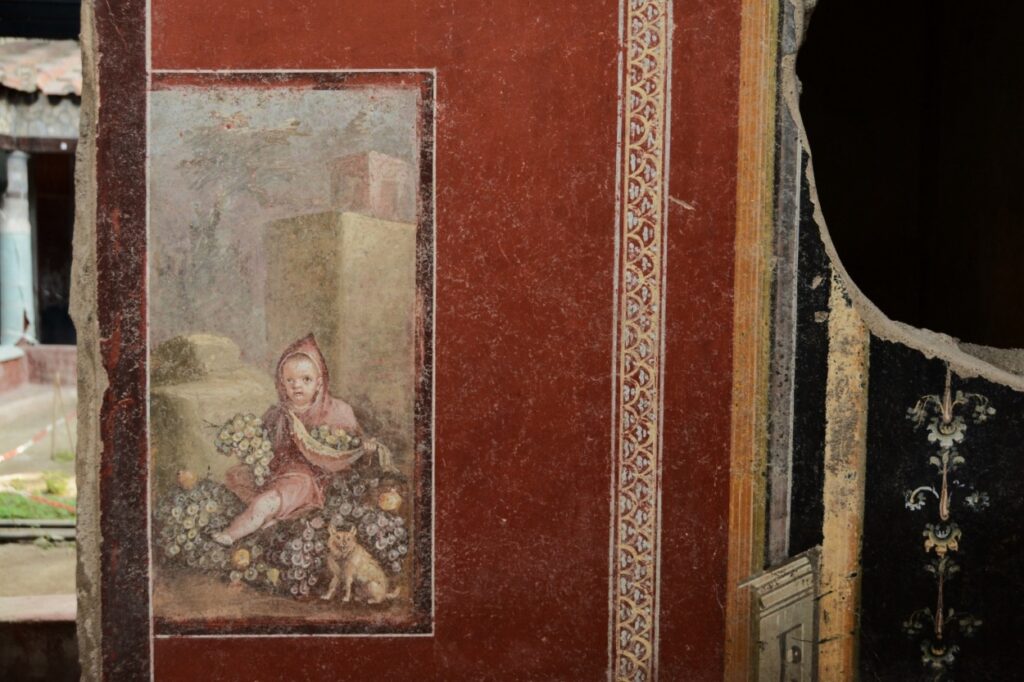
He wears what the archaeologists describe as a traveler’s hood and cloak. Huge clusters of grapes and pomegranates surround him. At his side is a puppy. The painting was positioned near an entrance overlooking a three-sided portico and garden, and its composition was designed to create a visual relationship with that garden beyond.
It is an intimate little image placed inside a much grander mythological world.
And that raises the obvious question: why?
Grapes, Pomegranates and a Possible Clue
Nothing about the scene should be interpreted too confidently. There is no surviving inscription telling us the child’s name, and no ancient explanation survives to tell us what the family intended the painting to mean.
Yet its details invite questions.
The enormous bunches of grapes are particularly striking because Dionysus—the god associated above all with wine and the vine—appears elsewhere in the decoration of the same room. That does not prove that the child is a Dionysian figure, but it makes the visual context difficult to ignore.
Then there are the pomegranates.
Across the ancient Mediterranean, the pomegranate could carry multiple meanings and associations, including fertility and abundance but also death and the world beyond. The fruit appears famously in the myth of Persephone, whose consumption of pomegranate seeds bound her partly to the Underworld and became intertwined with ideas of disappearance and return.
If the boy really was a deceased child of the household, the combination of fruit, mythological surroundings and youthful figure becomes tantalizing.
Perhaps the family was not attempting to create an ordinary portrait at all. They may have wanted the child represented within a symbolic world in which mythology, nature, death and renewal overlapped.
But there is an important boundary between what archaeology tells us and what we would like the image to tell us.
We simply do not know.
The identification of the boy as a deceased son is a possibility raised by the Archaeological Park, not an established fact.
And strangely, that uncertainty makes the painting even more compelling.
And Then There Is the Little Dog
Among all the symbolic possibilities surrounding the fruit and mythology, perhaps the most emotionally immediate element is also the smallest.
A puppy sits beside the boy.
To a modern viewer, it is almost impossible not to imagine a relationship between them. Was this an actual pet? Was the dog included because the child loved it? Was it symbolic? Or was it simply part of a conventional artistic composition whose meaning has been lost?
Again, we cannot know.
But if the figure does portray a real child who died, the possibility that the animal preserves the memory of his companion is extraordinarily moving. Ancient Roman families lived with animals just as people do today, and Pompeii itself has preserved numerous traces of dogs, from mosaics and paintings to the physical remains of animals killed in the eruption.
That tiny animal therefore does something important to the image.
The gods and heroes surrounding the room belong to mythology.
The puppy makes the scene feel personal.
A House Where the Painters Never Finished Their Work
The name House of the Painters at Work sounds almost poetic today, but it describes something much more haunting.
The house appears to have been undergoing redecoration when Vesuvius erupted. That unfinished work is the reason archaeologists gave the building its modern name.
Imagine the scene before the disaster.
Craftsmen and painters were transforming the rooms. Walls were being prepared and decorated. Mythological compositions were being created. The household was changing the appearance of its home, perhaps expecting to enjoy the completed rooms for years.
Then, in AD 79, Vesuvius erupted.
The painters never finished.
Recent excavation of one room revealed how violent the destruction was: the space was entirely devastated by the pyroclastic flow. Archaeologists and restorers had to mechanically remove hardened volcanic deposits before cleaning and stabilizing the surviving painted surfaces.
The eruption did more than interrupt the decoration.
It killed people trying to survive inside the complex.
Two People Tried to Hide
Excavations uncovered the remains of two older victims, a man and a woman, near the entrance of the House of the Painters at Work.
They appear to have entered a small access corridor that initially remained relatively free of the lapilli raining down during the first phase of the eruption. For a time, the confined space may have seemed like shelter.
It was not.
More volcanic material accumulated, and the two people died there.
We do not know whether they belonged to the household. Nor can we connect them directly with the mysterious child in the painting.
But their presence transforms the way we see the house.
This was not simply an archaeological collection of attractive Roman frescoes. It was a place where people lived, decorated rooms, walked through gardens, perhaps raised children—and ultimately tried to survive one of antiquity’s most famous disasters.
And elsewhere within the same block, archaeologists have found something that brings us unexpectedly close to Pompeii’s children themselves.
The Children Who Drew Gladiators on the Walls
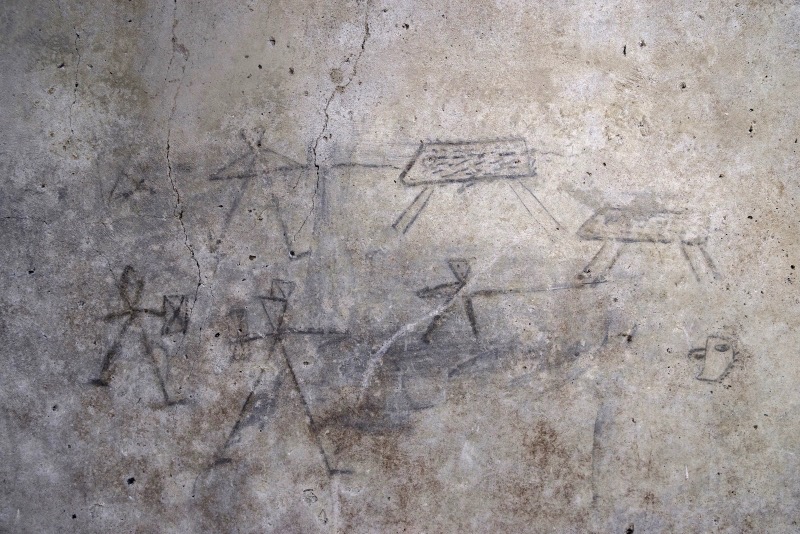
Not far away, in the House of the Colonnaded Cenaculum, archaeologists discovered a series of charcoal drawings on walls near a service courtyard.
They are nothing like the polished paintings of Perseus, Andromeda or the mysterious hooded boy.
The lines are crude. The bodies are simplified. The proportions are awkward.
They look like children’s drawings because archaeologists believe that is precisely what they are.
Researchers studying their execution, simplicity and iconography concluded that they were probably created by a child, perhaps one who had climbed onto scaffolding erected while work was being performed on the house. One preserved scene depicts two gladiators fighting. Another apparently shows a venatio, the Roman arena spectacle in which men fought animals: two figures armed with long spears confront what may be wild boars. Nearby is the head of a bird of prey, perhaps an eagle.
The Archaeological Park has even partnered with specialists from the Department of Child Neuropsychiatry at Federico II University of Naples to study the drawings and what they may reveal about childhood in the Roman world.
Their conclusions open a remarkable window onto children’s lives almost 2,000 years ago.
A Five-Year-Old at the Roman Arena?
The Park’s director, Gabriel Zuchtriegel, has explained that researchers believe the gladiatorial scenes were probably inspired by first-hand experience rather than copies of other images.
In other words, the child who drew them may actually have watched gladiators fight.
The drawings appear consistent with the work of very young children, estimated in the research at roughly five to seven years old. The simple human forms resemble developmental patterns still seen in children’s drawings today.
That gives the crude charcoal figures a darker significance.
Roman arenas did not offer simulated violence. Gladiatorial combat could produce serious injury and death. Animal hunts involved the killing of wild creatures. Public spectacles could also include executions.
A Pompeian child might have witnessed such scenes and then returned home to reproduce what he or she remembered on a wall.
Zuchtriegel describes the drawings as evidence of how spectacularized violence entered the imagination of a young child. Researchers noted something almost startlingly modern about the way the human figures were drawn: some have limbs emerging directly from the head, a form sometimes called a „cephalopod“ figure and familiar from children’s drawings today.
The culture surrounding that child was radically different from ours.
The development of the child’s hand and imagination may not have been.
Three Little Hands From Pompeii
Other discoveries make that connection even more immediate.
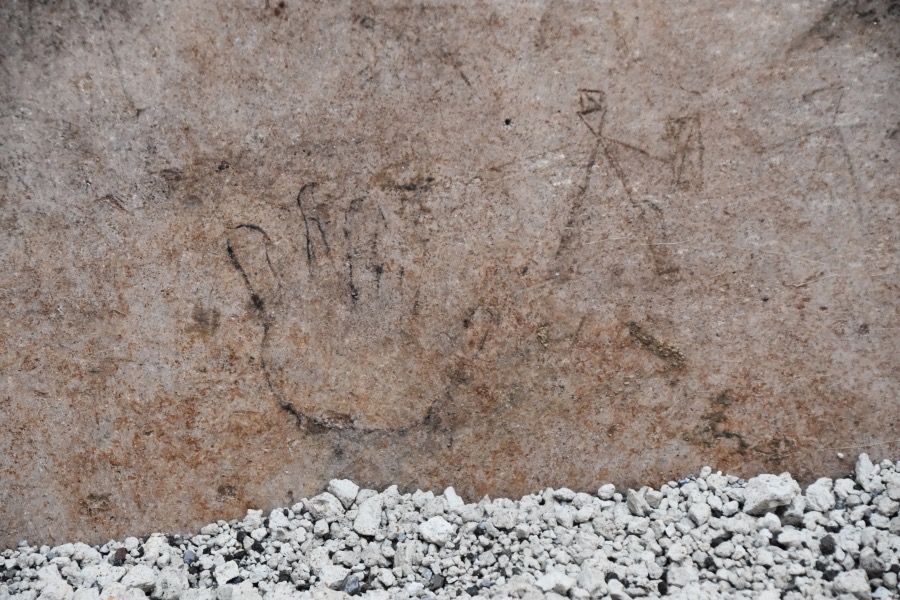
In another area used for storing or draining amphorae and for productive activities, archaeologists found more drawings low on the walls—only around 20 to 50 centimeters above the floor, comfortably within the reach of a small child.
Among them are three small hands outlined in charcoal.
There are also two more gladiatorial combats, what appears to be two figures playing with a ball, a probable wild boar, and a boxing match in which one fighter lies defeated on the ground.
The outlined hands may be among the simplest images preserved at Pompeii, yet they are also among the most powerful.
Children still make images like this.
Put a hand on a sheet of paper, trace around the fingers and remove it. The outline remains.
Almost two millennia separate us from the children who occupied these Pompeian spaces, yet suddenly that distance seems remarkably small.
We do not know their names.
We do not know what happened to them when Vesuvius erupted.
But we can still see what fascinated them.
Two Very Different Images of Childhood
And that brings us back to the child in red.
Within this part of Pompeii, archaeology has preserved two radically different ways in which children appear.
One is sophisticated and mysterious: a professionally painted young boy wrapped in a hood and cloak, surrounded by grapes and pomegranates, sitting beside a puppy within an elaborate decorative world populated by gods and heroes.
The other is almost brutally simple: charcoal marks scratched onto walls by children themselves—gladiators, animals, boxers, hands and perhaps a game with a ball.
One shows us how an adult may have chosen to represent a child.
The other shows us what children chose to draw themselves.
That contrast is extraordinary.
The official art of the Roman household gives us Aphrodite, Apollo, Dionysus, Perseus and Andromeda. The children’s walls give us fights, animals and the outlines of their own tiny hands.
And somewhere between those two worlds sits the hooded boy with his dog.
Who Was the Red-Hooded Child?
Perhaps he was a mythological figure whose precise identity has been lost.
Perhaps the grapes and pomegranates contained a symbolic message that would have been obvious to a Roman visitor but is difficult for us to reconstruct.
Or perhaps the Archaeological Park’s suggestion is correct, and we are looking at something much more intimate: a child who once belonged to the family living in this house and who died before the eruption.
If so, his family may have placed him permanently among the gods and heroes covering their walls.
The puppy may have been symbolic—or perhaps it really was his.
We should resist turning those possibilities into facts. Archaeology is most fascinating when the boundary between evidence and imagination remains visible.
But the uncertainty does not diminish the image.
It makes us look at it longer.
When Vesuvius destroyed Pompeii in AD 79, it preserved grand villas, temples, streets, shops, political slogans and extraordinary works of art. Yet some of the city’s most powerful discoveries are much smaller.
A charcoal gladiator drawn by a child.
The outline of a tiny hand.
A little dog.
And a red-hooded boy whose name disappeared almost 2,000 years ago, but whose face is still looking back at us from a wall in Pompeii.
- Чудомир Топлодолски: от защитник на българското небе до строител на стадион „Васил Левски“

- Жените до трона: Кераца Петрица – майката на Йоан Александър, до която писа папата
- Българските земи през 1437 година: разказът на един баварски бенедиктински монах
- Съкровище от Мурано край Бургас? Загадката на стотици венециански стъклени съдове от Черно море
- Старозагорският лъв: загадката на средновековните релефи
- Патриарх Йосиф II: българинът начело на Константинополската патриаршия
Вашият коментар