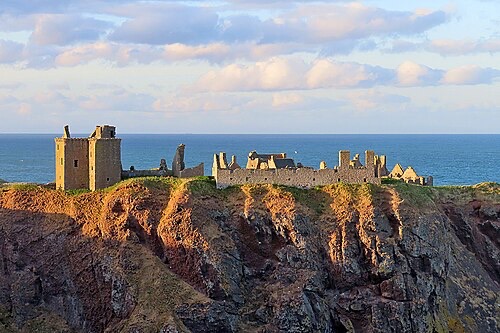
Imagine being trapped inside a castle on a cliff above the North Sea. An enemy army is closing in. Heavy artillery is on its way. And hidden somewhere behind your walls are three objects that must not be captured: the Crown, Sword and Sceptre of Scotland. This was the situation at Dunnottar Castle in the early 1650s. Oliver Cromwell’s forces were conquering Scotland, and the ancient symbols of the Scottish monarchy had been brought to this seemingly impossible fortress for protection. But when it became clear that even Dunnottar might eventually fall, an extraordinary plan was set in motion. The Crown Jewels had to disappear.
What followed involved secret journeys through enemy lines, royal papers sewn into clothing, a crown possibly hidden among ordinary goods—or, according to another account, carried away in a basket of seaweed—and finally Scotland’s royal treasures buried beneath the floor of a small church.
Yet this was only one chapter in the history of Dunnottar. Long before Cromwell, Vikings had attacked this dramatic headland. English and Scottish armies had fought over it. William Wallace became connected with its legends. Mary, Queen of Scots walked within its walls. And long after the Crown Jewels were saved, more than 160 religious prisoners would be confined in one of its dark vaults.
Few Scottish castles have a setting as spectacular as Dunnottar. Even fewer have a story to match it.
Dunnottar Castle: A Fortress Above the North Sea
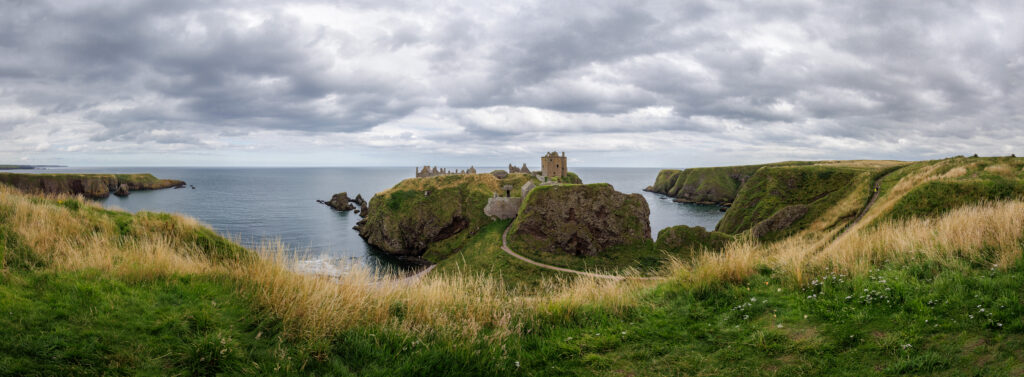
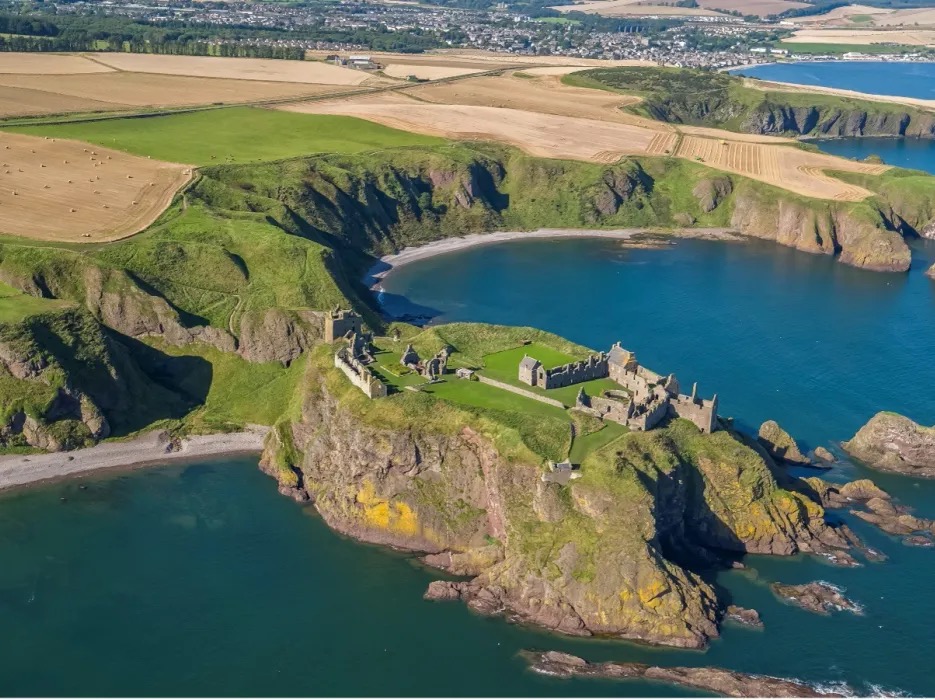
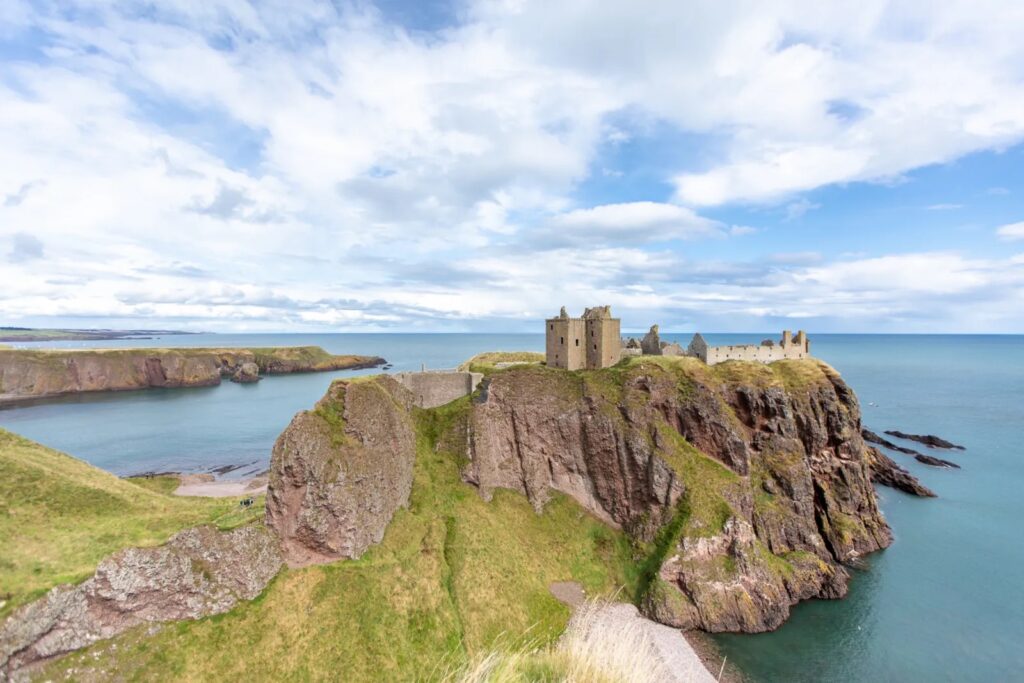
Dunnottar Castle stands on a rocky headland on Scotland’s northeast coast, around 2 miles south of Stonehaven in Aberdeenshire. The surviving buildings are mainly from the 15th and 16th centuries, although the site was important centuries earlier.
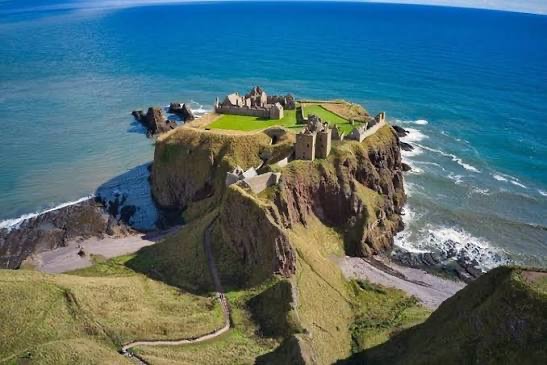
Its location explains why. The castle occupies roughly 3.5 acres, surrounded by steep cliffs dropping about 160 feet—50 metres—to the North Sea. A narrow strip of land connects the headland to the mainland, forcing anyone approaching the fortress toward a steep route and a heavily defended entrance.
The main gate was protected by a portcullis. Gun positions overlooked the approach. Once through the entrance, the passage turned sharply and continued through tunnels before emerging near the tower house. There was also another route from a rocky cove below, where a small boat could approach a sea cave and a steep path led toward a fortified postern gate.
It is the sort of landscape that seems designed for a fortress. But Dunnottar’s violent history may stretch back far beyond the ruins visible today.
Dunnottar Castle Before Scotland Was Scotland
Exactly when Dunnottar was first fortified is uncertain. Tradition associates the site with St Ninian and the foundation of a chapel in the 5th century. Early written sources record sieges of a place called Dún Foither in 681 and 694, although there is some scholarly uncertainty about the precise location of this early stronghold.
Then comes an extraordinary episode from the year 900. According to the Chronicle of the Kings of Alba, King Donald II was killed at Dunnottar during a Viking attack. Later, in 934, the English king Æthelstan campaigned deep into Scotland, with a medieval account placing his raid as far north as Dunnottar.
So centuries before the great stone castle took shape, this lonely headland was already associated with kings, invasion and war. That pattern continued during Scotland’s struggle against England.
William Wallace and the Darkest Dunnottar Legend
Dunnottar became involved in the Wars of Scottish Independence. One famous story claims that William Wallace captured Dunnottar from the English in 1297. According to the later poet Blind Harry, thousands of English soldiers sought refuge in the church, only for Wallace’s forces to set it on fire.
It is a horrifying story, but it is also one that needs to be treated carefully. The dramatic account comes from Blind Harry, who wrote long after Wallace’s lifetime, so the claim that 4,000 English prisoners were burned alive should not be treated as securely established fact.
What is certain is that Dunnottar remained strategically important during the Anglo-Scottish wars. In 1336, Edward III of England ordered eight ships, 160 soldiers and a group of masons and carpenters to Dunnottar. The partially ruined position was to be rebuilt and fortified as a forward supply base for his campaign in Scotland. Edward himself visited, but before the year was over, Scottish forces led by Sir Andrew Murray captured Dunnottar and destroyed its defences again.
Once again, the fortress had proved worth fighting over.
The Family That Made Dunnottar Castle Their Stronghold
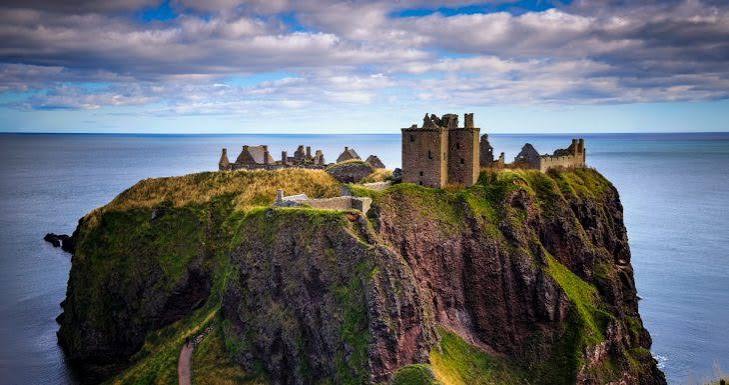
During the 14th century, Dunnottar became closely associated with the powerful Keith family. William Keith, Marischal of Scotland, acquired the barony and constructed the great tower house around the end of the century.
But even building a castle could create trouble. Keith constructed on consecrated ground connected with the parish church and was excommunicated. He eventually had to appeal to Pope Benedict XIII, who issued a papal bull lifting the excommunication in 1395.
The Keiths remained associated with Dunnottar for centuries and rose to become Earls Marischal of Scotland. Under them, Dunnottar gradually became something more than a military fortress. By the 16th century, it was also becoming a spectacular noble residence.
When Kings and Queens Came to Dunnottar Castle
Scottish monarchs visited Dunnottar. James IV arrived in 1504. The surviving account offers a wonderfully human glimpse of royal life: a child played a monochord for the king, James gave money to poor people, and his entourage included Italian musicians and an African drummer.
James V later described Dunnottar as one of the principal strongholds of his realm. Then came Mary, Queen of Scots. Mary visited Dunnottar in 1562 after the Battle of Corrichie and returned in September 1564. James VI also stayed there for ten days in 1580, during which a meeting of Scotland’s Privy Council was held at the castle.
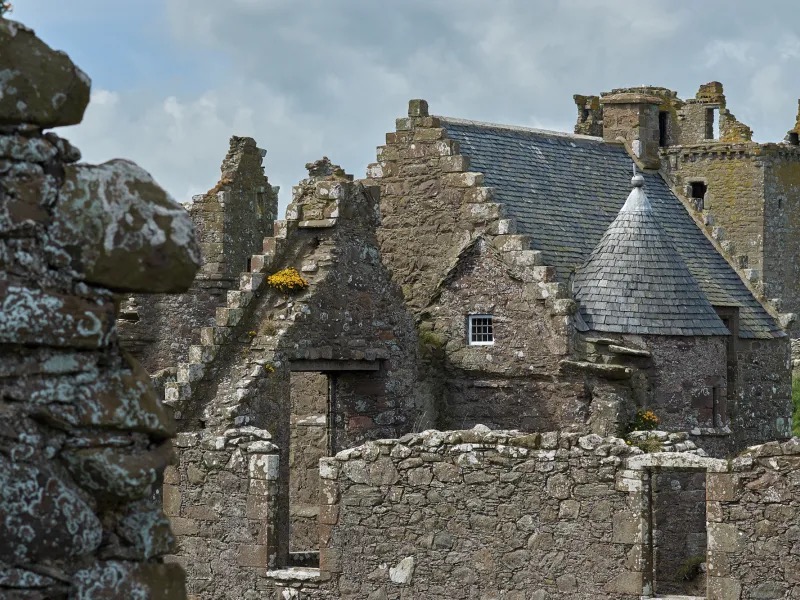
By this period, Dunnottar was changing. George Keith, 5th Earl Marischal, began a major reconstruction after succeeding in 1581. The old medieval stronghold was transformed into a more comfortable residence. A palace complex rose around a courtyard on the cliffs, providing luxurious rooms with views across the sea.
There were kitchens, storerooms, a brewhouse, bakery, apartments, a great chamber and a long gallery that once stretched around 120 feet. One room would later be remembered as the King’s Bedroom. Charles II stayed there, and his arrival in Scotland would set in motion the event for which Dunnottar Castle is remembered above all others.
Dunnottar Castle and the Crown Jewels of Scotland
In 1649, King Charles I was executed. Scotland subsequently recognized his son, Charles II, and the young king arrived there in 1650. Oliver Cromwell responded by invading Scotland.
On 1 January 1651, Charles II was crowned at Scone. During the ceremony, the ancient Scottish regalia known as the Honours of Scotland were used: the Crown, Sword and Sceptre. But Cromwell’s forces now threatened the country, and returning the Honours to Edinburgh was too dangerous.
So Scotland needed somewhere safer. The decision was made to send them to Dunnottar Castle, and their journey into the fortress was already secretive. The royal regalia were brought to Dunnottar by Katherine Drummond, hidden inside sacks of wool. Sir George Ogilvie of Barras was placed in command of the castle and entrusted with defending them.
For a time, the great cliffs and walls protected Scotland’s royal treasures. Then Cromwell’s soldiers arrived.
Cromwell’s Army Surrounds Dunnottar Castle
In November 1651, Cromwell’s forces demanded that Ogilvie surrender the fortress. He refused, and Dunnottar was blockaded. Inside were the symbols of the Scottish monarchy. Outside was an enemy determined to capture the castle.
The defenders could wait, but they could not wait forever. Eventually artillery capable of reducing the fortress would arrive. The Honours had to leave Dunnottar without the besieging army realizing what was happening.
And the plan that followed depended heavily on women.
How Scotland’s Crown Jewels Disappeared
Elizabeth Douglas, wife of Sir George Ogilvie, and Christian Fletcher, wife of the minister of nearby Kinneff Parish Church, helped plan the removal of the Honours. First came the king’s papers. Anne Lindsay, a relative of Elizabeth Douglas, managed to walk through the forces surrounding the castle with the documents sewn into her clothing.
Getting the Crown, Sword and Sceptre out was even more dangerous, and this is where the story becomes mysterious because two different accounts survive. Christian Fletcher later claimed that she visited Dunnottar several times during February and March 1652 and carried the regalia away concealed among sacks of ordinary goods.
But another account tells an even more cinematic story. According to this version, the Honours were lowered from the castle to the beach below. Fletcher’s servant collected them and carried them away hidden inside a creel—a basket filled with seaweed.
We cannot know with certainty which version captures exactly what happened. What matters is what happened next.
The Crown Jewels escaped.
But simply getting them out of Dunnottar was not enough. Cromwell’s soldiers could search for them. They needed to vanish completely.
Scotland’s Crown Was Buried Beneath a Church
Christian Fletcher and her husband took the Honours to the Old Kirk at Kinneff. There they hid them beneath the church floor. The Crown, Sword and Sceptre of Scotland—the physical symbols of royal authority—were effectively buried underground while Cromwell’s forces searched for them.
Back at Dunnottar, the siege continued. By May 1652, Colonel Thomas Morgan had finally received the heavy artillery necessary to break the fortress. On May 24, Ogilvie surrendered on the condition that his garrison would be allowed to go free.
Cromwell’s men entered Dunnottar.
The Honours were gone.
Unable to find them, the victors imprisoned Ogilvie and his wife in the castle. A false story was circulated suggesting that the royal treasures had been taken overseas. Meanwhile, the conquerors stripped property from Dunnottar, including 21 brass cannons.
The deception worked. Cromwell never obtained the Honours of Scotland.
The Crown Jewels Return
The monarchy was restored in 1660, when Charles II returned to the throne. Only then could the secret finally end. The Honours were recovered from Kinneff Church and returned to the king.
There was subsequently disagreement over who deserved the greatest credit for saving them. Christian Fletcher was awarded 2,000 merks by the Scottish Parliament.
She never received the money.
It is a strangely fitting detail in a story in which some of the most important people were not kings or generals. The Scottish Crown Jewels survived because people were willing to smuggle them through an enemy blockade and hide them beneath a church floor.
Yet Dunnottar’s darkest chapter was still to come.
Dunnottar Castle and the Whigs’ Vault
In 1685, political and religious conflict returned to Dunnottar. A group of 167 Covenanters—122 men and 45 women—were imprisoned in a cellar beneath the castle buildings after refusing to swear an oath of allegiance to the new king, James VII.
The space became known as the Whigs’ Vault. They were confined there from late May until late July. Twenty-five prisoners attempted to escape. Two fell from the cliffs and died, while fifteen were recaptured. Five prisoners died in the vault, while others eventually took the required oath and were released. Many of those who remained were sentenced to transportation across the Atlantic to Perth Amboy, New Jersey. A number died during the voyage.
The same castle that had protected Scotland’s Crown Jewels had become a prison. And political rebellion would eventually bring about Dunnottar’s decline.
The Jacobites and the Fall of Dunnottar Castle
The Keith family had controlled Dunnottar for generations. But during the Jacobite Rising of 1715, George Keith, 10th Earl Marischal, supported the rebels and led cavalry at the Battle of Sheriffmuir.
The rising failed. Keith fled to continental Europe, and in 1716 his titles and estates—including Dunnottar—were forfeited to the Crown.
A few years later, the confiscated estate was sold. The new owners dismantled much of the castle. After centuries of kings, sieges, royal visits, secret treasures and prisoners, Dunnottar began its transformation into the spectacular ruin we see today.
Dunnottar Castle: The Fortress That Saved Scotland’s Crown Jewels
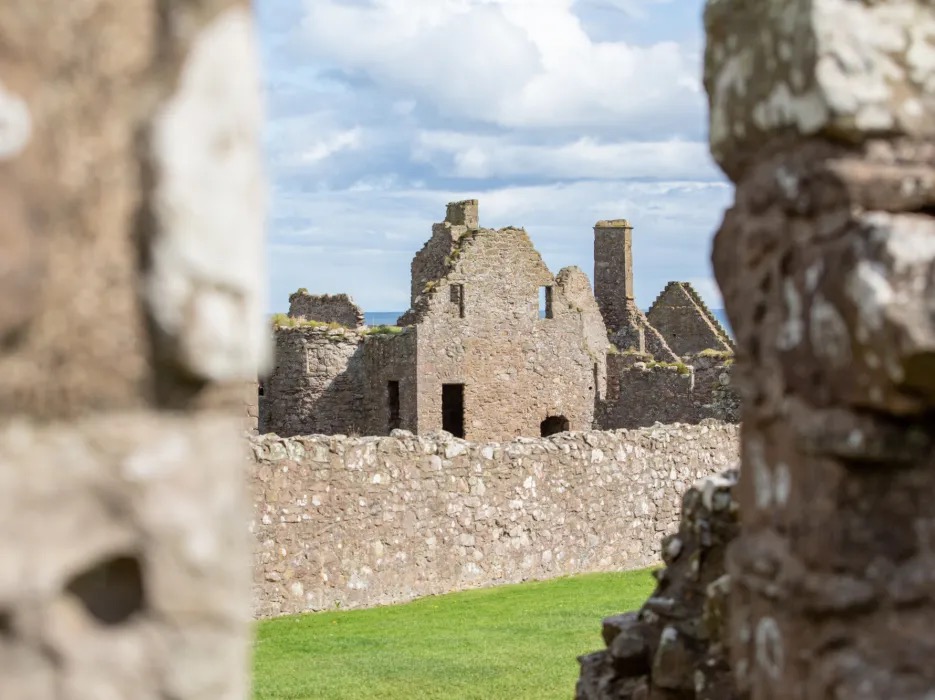
Today Dunnottar Castle is roofless and broken. The North Sea crashes beneath cliffs that once formed part of its defence. Empty windows look out from buildings that were once filled with nobles, soldiers, servants and prisoners.
But the ruins make the story almost easier to imagine. A king was killed here during a Viking attack, according to an early Scottish chronicle. English and Scottish armies fought for the headland. Mary, Queen of Scots visited. Charles II slept within its walls. Covenanters were packed into a dark vault. And when Cromwell’s army came looking for the most important symbols of Scottish monarchy, the castle became the centre of an extraordinary deception.
The soldiers eventually captured Dunnottar.
But the treasure they came for was already gone.
Somewhere beyond the walls, Scotland’s Crown, Sword and Sceptre had been carried past the enemy and buried beneath the floor of a small church.
Dunnottar Castle could fall. The Honours of Scotland would survive.
- Чудомир Топлодолски: от защитник на българското небе до строител на стадион „Васил Левски“

- Жените до трона: Кераца Петрица – майката на Йоан Александър, до която писа папата
- Българските земи през 1437 година: разказът на един баварски бенедиктински монах
- Съкровище от Мурано край Бургас? Загадката на стотици венециански стъклени съдове от Черно море
- Старозагорският лъв: загадката на средновековните релефи
- Патриарх Йосиф II: българинът начело на Константинополската патриаршия
Вашият коментар