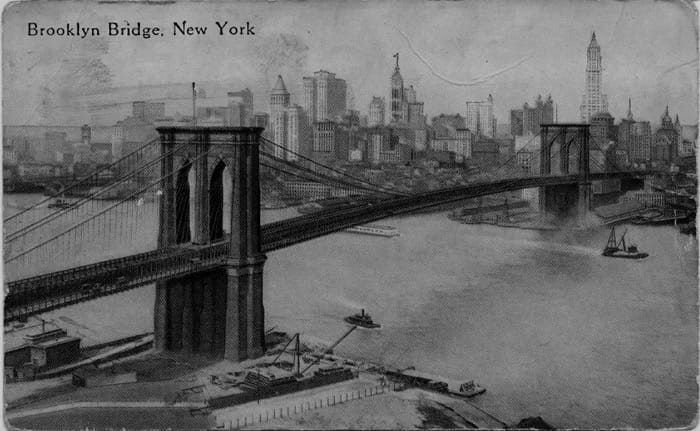
The Brooklyn Bridge is not just an iconic structure—it is a symbol of technological progress, human determination, and family dedication. Behind its construction stands the Roebling family, and a key role in its completion was played by a woman who long remained in the shadows: Emily Roebling.
John Augustus Roebling – The Visionary Engineer
John Augustus Roebling was born in Prussia and studied at the Berlin Building Academy, where he completed two semesters. Early in his career, he worked on the construction of military roads in Prussia. In 1831, he emigrated to the United States together with his brother Karl and a group of like-minded settlers.
In Pennsylvania, the brothers purchased land and founded the German settlement of Saxonburg. It was there that John Roebling launched the first steel wire rope production in the United States—an innovation that would later revolutionize bridge construction.
Roebling became one of the pioneers of suspension bridge engineering. Among his most notable projects are bridges in Pittsburgh, the bridge over Niagara Falls, and the structure connecting Cincinnati and Covington, later named the Roebling Suspension Bridge in his honor.
A Tragic Death and the Beginning of the Brooklyn Bridge
The State of New York commissioned John Roebling to design the Brooklyn Bridge—an ambitious project with a main span of 486 meters. During final survey work, however, a ferry struck his boat and severely injured his foot. After an amputation, Roebling died of tetanus just three weeks later, never seeing his greatest vision realized.
Leadership of the project passed to his eldest son, Washington Augustus Roebling.
Emily Roebling – The “Hidden Engineer” Behind the Bridge
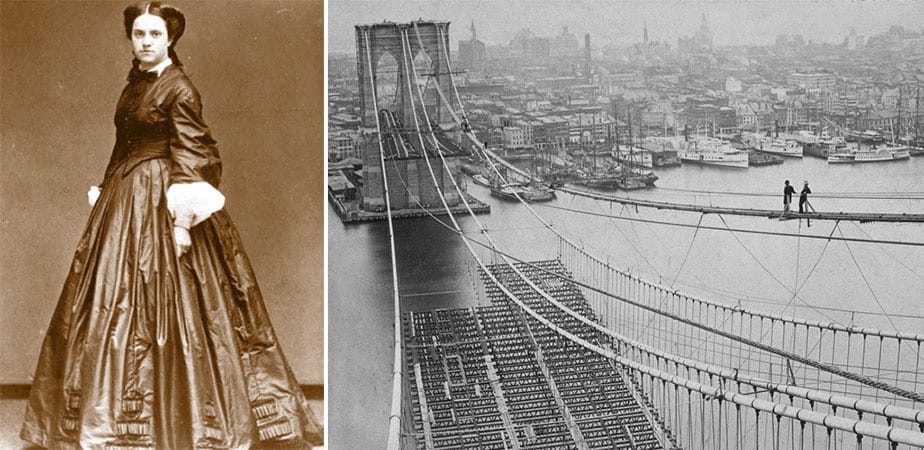
The true turning point in the story of the Brooklyn Bridge came with Emily Warren Roebling, Washington’s wife. Born in 1843, she grew up in a large family and was encouraged from an early age to pursue education.
After their marriage, Emily and Washington traveled through Europe, where he studied the latest caisson bridge technologies. Shortly after their return, tragedy struck again—Washington developed caisson disease due to frequent underwater work and became bedridden.
The Woman Who Took Charge
Although she held no formal engineering title, Emily assumed the practical management of the project. For thirteen years, she studied higher mathematics, strength of materials, and bridge engineering. She transmitted her husband’s instructions to the workers and served as the crucial link between engineers, politicians, and city officials.
When opponents attempted to remove Washington Roebling as chief engineer, Emily actively participated in meetings, defending his position with competence and authority. As a result, she is widely regarded as the first female field engineer in U.S. history.
The First Crossing and Life After the Bridge
In 1883, after fourteen years of construction, the Brooklyn Bridge officially opened. The first person to cross it by carriage was Emily Roebling, holding a rooster—a symbol of victory.
After the project’s completion, the family moved to New Jersey. Emily continued her education and earned a law degree from New York University, later becoming active in various social and civic initiatives.
A Legacy Beyond Engineering
The Brooklyn Bridge remained the longest suspension bridge in the world for twenty years and is now a National Historic Landmark of the United States. Yet beyond steel and stone lies a deeply human story—of vision, sacrifice, and a woman who proved that engineering knows no gender.
- Стоян Стоянов: защитникът на София, който стана екскурзовод в Рилския манастир
- Чудомир Топлодолски: от защитник на българското небе до строител на стадион „Васил Левски“

- Жените до трона: Кераца Петрица – майката на Йоан Александър, до която писа папата

- Българските земи през 1437 година: разказът на един баварски бенедиктински монах
- Съкровище от Мурано край Бургас? Загадката на стотици венециански стъклени съдове от Черно море

- Старозагорският лъв: загадката на средновековните релефи
Вашият коментар