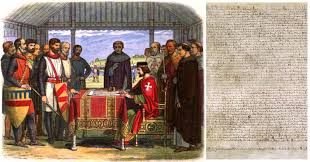
On June 15, 1215, on the marshy meadows of Runnymede, located along the River Thames near Windsor, the course of world history was altered. Pressed by a powerful and determined baronial rebellion, the English King John, remembered in the annals of history by the nickname John Lackland, was forced to attach his royal seal to Magna Carta Libertatum – the Great Charter of Liberties. This parchment was not born as the fruit of philosophical inquiries into human rights, but as a pragmatic truce agreement. It aimed to resolve a deep political crisis between a failed, authoritarian monarch and his angry feudal vassals.
King John’s reign was marked by a series of catastrophic foreign and domestic failures. After losing key ancestral territories in Normandy and Anjou during his unsuccessful wars with the French King Philip II Augustus, John earned his nickname „Lackland.“ To finance his new military campaigns, he imposed unprecedented and arbitrary taxes and fees on the aristocracy and clergy. The situation worsened further due to his open conflict with Pope Innocent III, which led to the temporary excommunication of England from the Church. Royal arbitrariness, the confiscation of property, and the brutal trampling of traditional customs exhausted the barons’ patience. When they occupied London in May 1215, the monarch was trapped. Runnymede became the arena for the first major, documented triumph of written law over absolute royal power.
The Triumph of Law Over Royal Arbitrariness
The core revolutionary idea of Magna Carta is simple yet fundamental to the evolution of human civilization: even the holder of the crown is obliged to obey the laws of the land. Until then, medieval law rested on the concept of the divine right of kings, according to which the monarch answered for his actions only to God. The Charter overturned this paradigm. It sharply limited the opportunities for financial abuse by the court and introduced the requirement of common consent through the Great Council for the imposition of new extraordinary taxes. This council later became the prototype of the modern parliament.
Even more crucial and long-lasting was the establishment of the right to a fair trial. Through the famous Clause 39, the foundations of the Habeas Corpus principle were laid. The text proclaimed that no free man could be arrested, imprisoned, disseised of his property, outlawed, exiled, or destroyed in any way, except by the lawful judgment of his peers and by the law of the land. This put an end to the practice of arbitrary imprisonment and executions at the personal whim of the ruler.
The Charter also settled a number of other practical matters. It guaranteed the freedom of the English Church from royal interference, confirmed the ancient liberties and customs of London and other major cities, and introduced uniform weights and measures for trade throughout the kingdom. To ensure compliance with the agreement, Clause 61 created a „Council of 25 Barons“ who had the right to declare war on the king and seize his property if he violated the agreement.
A Short-Lived Peace and the Ensuing War
Despite its immense historical significance, the initial lifespan of Magna Carta was extremely short. King John signed the document solely to buy time and disband the baronial armies, without any real intention of respecting clauses that turned him into a puppet of his own vassals. Immediately after the barons left Runnymede, the king sent secret envoys to Rome. He begged Pope Innocent III to release him from his oath under the pretext that the document had been signed under duress and humiliated the dignity of the crown.
The Pope, who at the time viewed John as a useful vassal, reacted sharply. In August 1215, Innocent III issued a papal bull declaring Magna Carta illegal, unjust, shameful, and void for all time, threatening excommunication for anyone who attempted to observe it. This act immediately plunged England into the First Barons’ War. The conflict was so fierce that the rebel barons offered the English crown to Prince Louis of France (the future Louis VIII), whose troops invaded the country.
The war reached a stalemate, which was unexpectedly resolved in October 1216 when King John died of dysentery during a military campaign. His successor, the 9-year-old Henry III, ascended the throne under the regency of the influential knight William Marshal. To win back the support of moderate barons and expel the French troops, the regency reissued Magna Carta in 1216 and 1217, removing some of the most radical clauses, including the Council of 25. In 1225, upon reaching his majority, King Henry III officially confirmed the charter in exchange for new taxes, permanently embedding it into English statutory law.
The Legacy That Shaped the Modern World
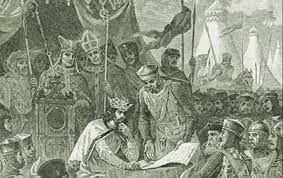
In the long run, this medieval agreement outgrew its narrow feudal context to become the most important cornerstone of global democracy. Originally intended to protect the rights and privileges of a narrow group of wealthy aristocrats, the meaning of the phrase „free man“ expanded over the centuries to encompass all citizens without exception. In the 17th century, during the struggles between Parliament and the Stuart kings, prominent jurists like Sir Edward Coke rediscovered Magna Carta, turning it into a powerful political weapon against the absolutism of Charles I.
The document’s influence quickly crossed the borders of the British Isles. It laid the conceptual and moral foundations of American justice. American colonists used the principles of the Charter to justify their rebellion against the British crown, raising the slogan „No taxation without representation.“ Texts from Magna Carta were directly integrated into the Declaration of Independence, the US Constitution, and the first ten amendments, known as the Bill of Rights.
In the 20th century, following the devastating events of World War II, the spirit of the Great Charter served as a primary inspiration for the authors of the Universal Declaration of Human Rights, adopted by the UN in 1948. Eleanor Roosevelt explicitly called this declaration „a international Magna Carta for all mankind.“
Today, more than eight centuries after the events at Runnymede, the original four surviving copies of the 1215 charter are preserved as priceless relics. This ancient medieval parchment remains the most enduring and powerful symbol of the fight against authoritarianism and a perpetual reminder that no ruler, regardless of their political might, stands above justice and the law.
Вашият коментар