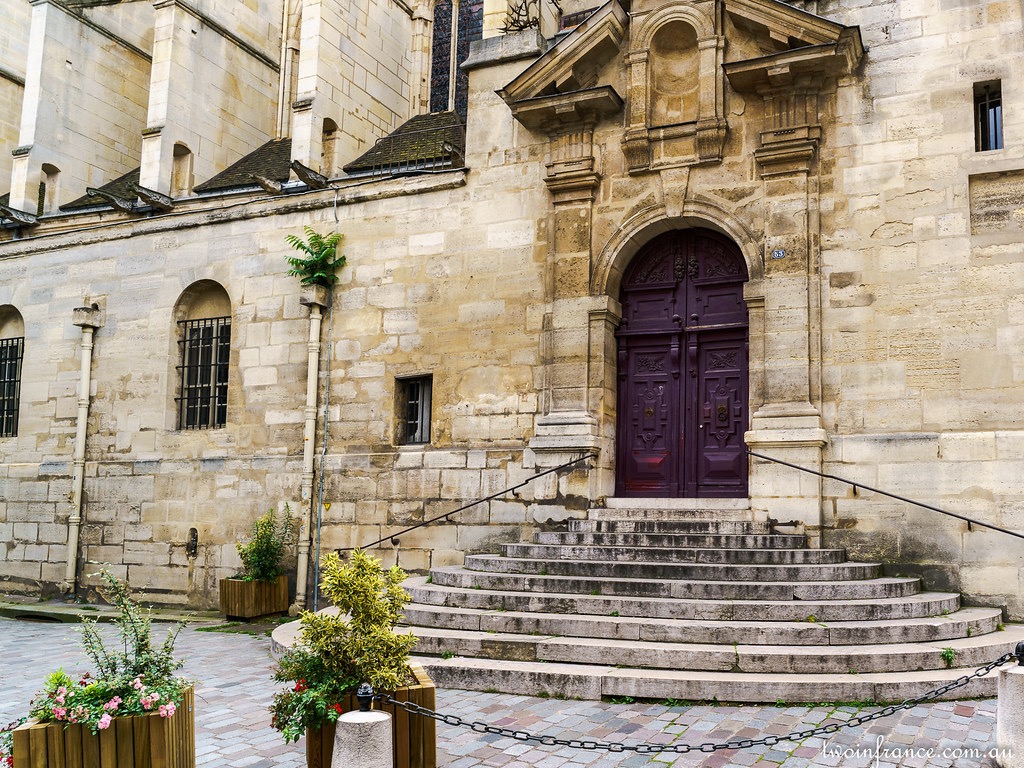
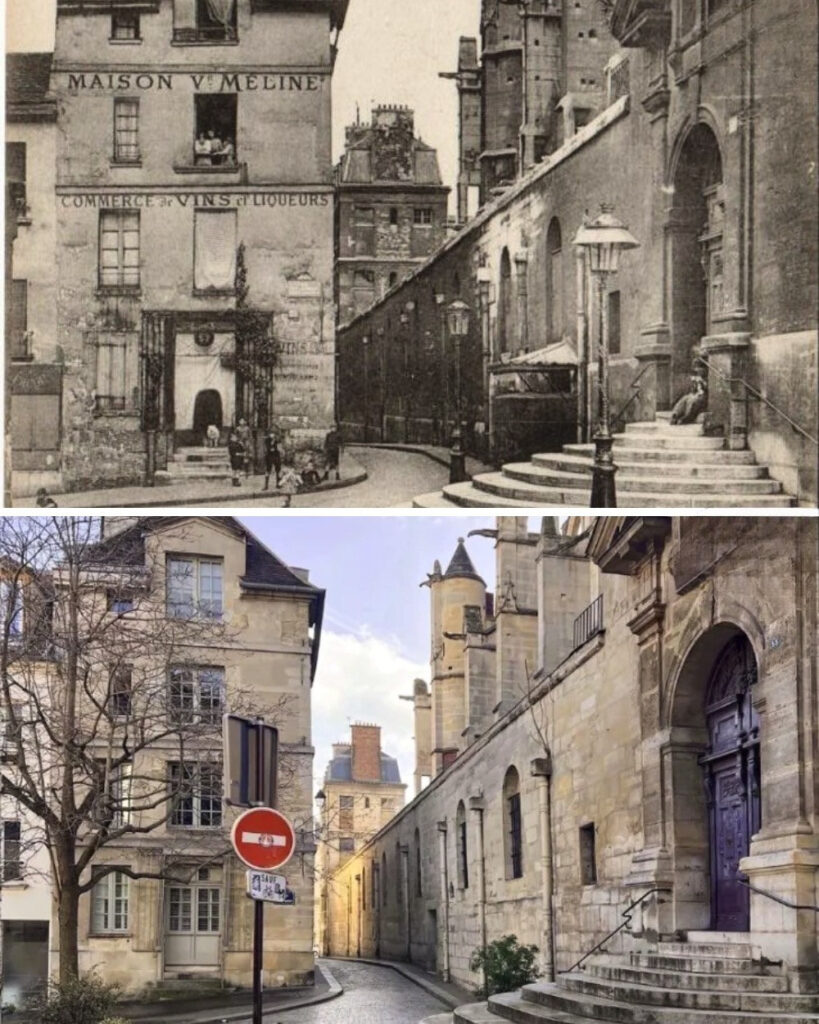
There is a place in Paris where the air vibrates differently. If you stand at the crest of Saint Genevieve’s Hill (Montagne Sainte-Geneviève), tucked just behind the imposing and austere dome of the Panthéon, you will discover an architectural anomaly that seems to belong to another world. These are the steps of the church of Saint-Étienne-du-Mont.
To the average Parisian, this is simply a beautiful building on the way to work. But for thousands of travelers—especially those arriving from the United States—this is a portal. This is where Gil Pender (played by Owen Wilson) from Woody Allen’s masterpiece „Midnight in Paris“ sat every night, waiting for the vintage Peugeot Landaulet to whisk him away to the Golden Age of the 1920s. But why here? Why has this tiny corner managed to preserve the magic that the rest of the metropolis lost in the name of modernization? The answer lies in layers of history that stretch from the 5th century to Hollywood.
An Architectural Rebellion Against Baron Haussmann
To understand why this corner is so precious, we must go back to the mid-19th century. At that time, Napoleon III and his prefect, Baron Haussmann, decided to transform Paris from a medieval labyrinth into a modern imperial city. Thousands of narrow alleys were demolished, and countless homes leveled to make way for the wide boulevards and unified limestone facades we now call “typically Parisian.”
The Latin Quarter, however, with its intellectual and slightly stubborn spirit, managed to keep pieces of its original DNA. Around Saint-Étienne-du-Mont, the streets still follow the curves of ancient Roman and medieval paths. There are no right angles here. The facades weren’t dictated by a state standard, but by the passing centuries. This is the “untidy” Paris that the American writers of the “Lost Generation” adored—precisely for its authenticity and lack of sterility.
The Church That Refused to Choose an Era
The building of Saint-Étienne-du-Mont itself is an architectural enigma. Built over more than 130 years (between 1492 and 1626), it is like a living organism that absorbed the shifts in human consciousness during the transition from the Middle Ages to the Enlightenment.
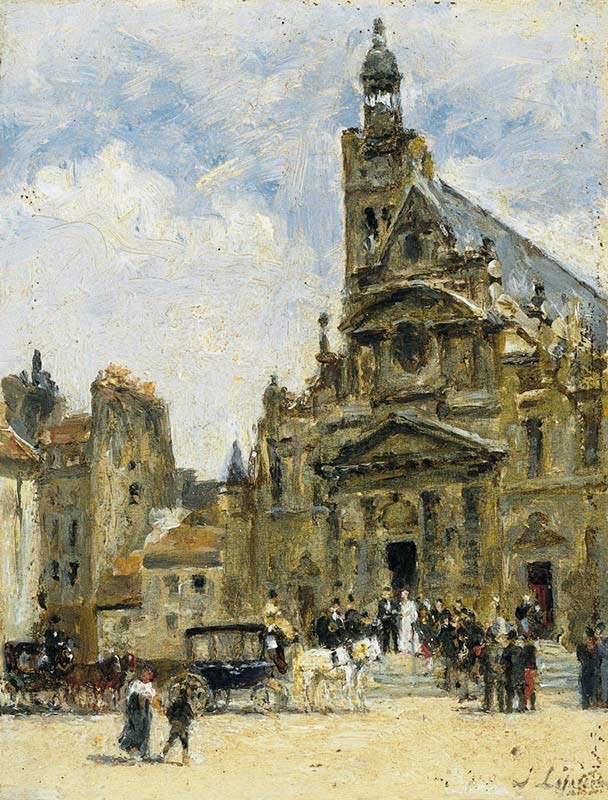
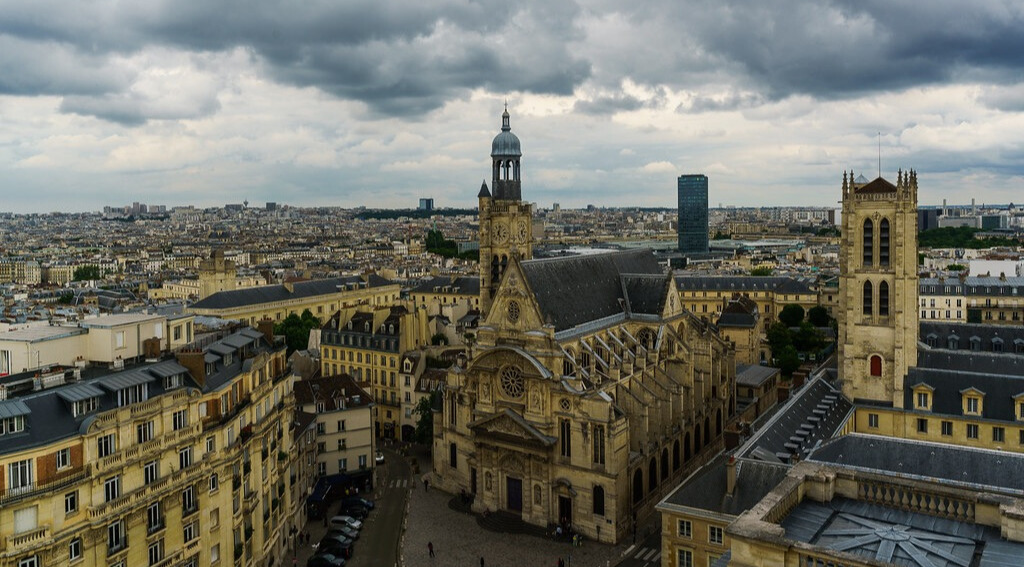
When you stand before the facade, you’ll notice something strange: it is asymmetrical and combines three different gables. The lower part is pure „Flamboyant Gothic“—tall, sharp arches pointing toward the sky with almost painful hope. But as your eyes climb higher, you see the influence of the Renaissance—classical antique columns, statues, and more rational lines. This mix is exceptionally rare. Most churches in Paris are either too „Gothic“ (like Notre Dame) or too „Classical“ (like Saint-Sulpice). Saint-Étienne is the bridge connecting the mysticism of the past with the logic of the new age.
If you step inside, your breath will catch at something you will see almost nowhere else in France—and certainly nowhere else in Paris: the Rood Screen (Jubé). This is an exquisite stone bridge that crosses the central nave of the church. Centuries ago, these structures were standard in large cathedrals, serving as a barrier separating the clergy from the common people.
During the Counter-Reformation and later the French Revolution, almost all rood screens in the country were destroyed to “democratize” the space so the faithful could see the altar. This one in Saint-Étienne, however, survived by a miracle. Its two spiral staircases, carved from white stone, look so delicate they seem made of lace rather than solid granite. For an American visitor, accustomed to the pragmatic and functional architecture of the New World, this is pure poetry in stone.
Saint Genevieve: The Woman Who Stopped Attila and Inspired a Nation
You cannot tell the story of this place without mentioning Saint Genevieve. For Americans, who value stories of individual courage against overwhelming odds, her biography is captivating. In 451 AD, as Attila and his Huns approached Paris, the residents panicked. A young woman named Genevieve convinced them not to flee, but to stay and pray. Legend has it that her prayers diverted the Hun hordes.
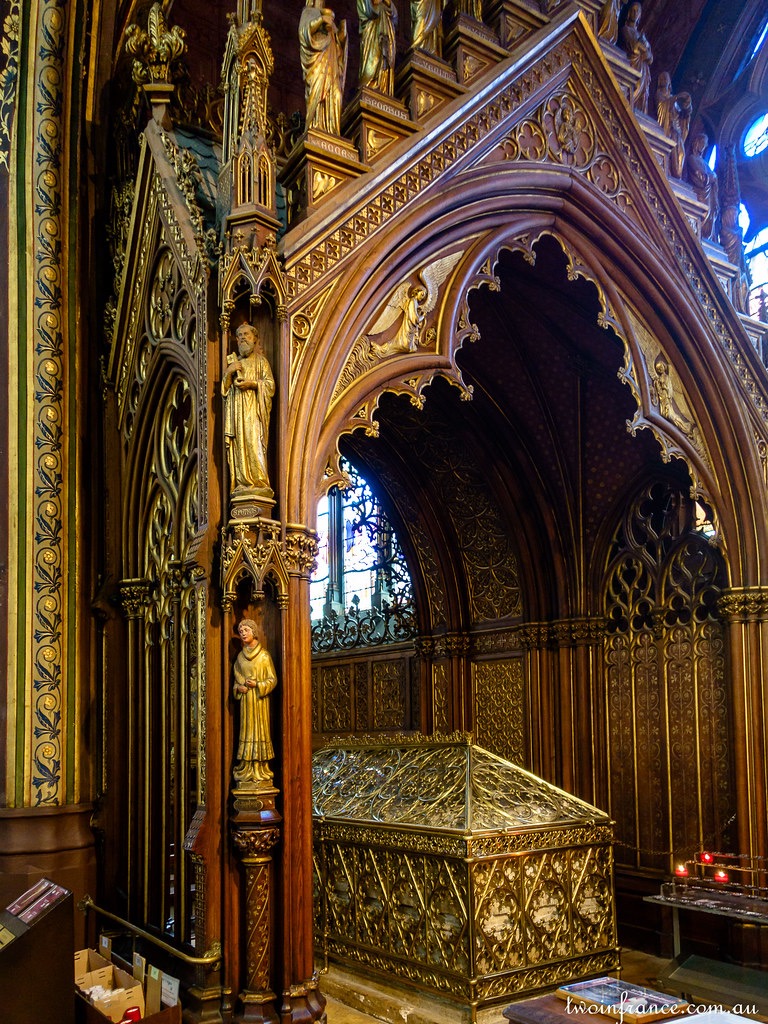
She became the eternal patron saint of Paris. Her relics were kept in the massive abbey that once stood where the Panthéon stands today. During the Revolution, mobs burned her remains, but loyal Parisians managed to save pieces of her sarcophagus. Today, they are kept right here in Saint-Étienne-du-Mont, in a gilded chapel covered with votive plaques. It is a place of deep humility that contrasts with the pomp of the neighboring Panthéon.
The Connection to the “Lost Generation”: Hemingway and Fitzgerald
Why is the Latin Quarter so dear to the American heart? The answer lies in the 1920s. After World War I, the dollar was strong, and Paris was a sanctuary of freedom. Here, Ernest Hemingway, F. Scott Fitzgerald, and Gertrude Stein laid the foundations of modern American literature.
Hemingway lived just a few blocks from these steps, at 74 Rue du Cardinal Lemoine. In his memoir, „A Moveable Feast,“ he described climbing the hill toward the Panthéon to work in small attic rooms or cafes. For him, this neighborhood was a source of raw, real energy. When Woody Allen chose the steps of Saint-Étienne for his film, he wasn’t just making a visual choice. He was quoting history. When you sit on these steps today, you are occupying the same space where the great minds of the 20th century sought inspiration in the silence of the Parisian night.
The Stained Glass: A Colorful Archive of the Renaissance
While in the church, look up at the stained glass. Dating mostly from the 16th and 17th centuries, they are considered among the most valuable in Europe. The technique used here differs from the medieval style; it looks more like oil painting on glass.
The light passing through them tells biblical parables with incredible precision. For the American tourist, who often associates old churches with darkness, Saint-Étienne is surprisingly bright and colorful. The windows here are like a 16th-century “comic book,” designed to educate and inspire people who, at the time, could not read.
A Guide for the Modern “Pilgrim”: How to Experience the Magic
To make your visit meaningful rather than just another checkmark on a list, follow these steps:
- The Midnight Visit: You don’t literally have to wait until 12 AM, but go after sunset. The yellow glow of the street lanterns creates shadows that erase modern details. The square in front of the steps (Place de l’Abbé-Basset) is one of the few with no parked cars, heightening the feeling of time travel.
- The Sorbonne and Surrounding Alleys: Don’t limit yourself to the church. Walk down Rue de la Montagne Sainte-Geneviève. It’s one of the oldest streets in Paris. Stop in a small second-hand bookstore—you can still find English editions from Hemingway’s era there.
- Shakespeare and Company: Located about a 10-minute walk away near the Seine. It is the spiritual continuation of the Latin Quarter experience. Founded by American Sylvia Beach, it was a second home to all the writers who once walked these very steps.
- The Silence Inside: Even if you aren’t religious, sit for five minutes in front of the rood screen. There are few places in Paris that offer such acoustic and visual harmony.
Why This Corner is “American Paradise” in Paris
Ultimately, the appeal of this area for Americans lies in the contrast. America is a young nation, oriented toward speed, innovation, and the future. Paris, and specifically this corner of the Latin Quarter, offers something in short supply in the New World: layers of accumulated time.
When you stand on the steps of Saint-Étienne-du-Mont, you are standing on Roman foundations, looking at a medieval tower, entering a Renaissance church, and thinking of a modern Hollywood film. It is the sense of continuity—the realization that the world existed long before us and will exist long after.
Whether you are in Paris for the first time or the hundredth, leave the Eiffel Tower to the crowds for an afternoon. Climb the hill of the Latin Quarter. Go around the Panthéon and find these quiet steps.
Saint-Étienne-du-Mont is not just an architectural monument. It is proof that the most beautiful things survive—whether it is 16th-century stone lace, the relics of a saint, or the spirit of a young American writer who once dreamed of glory here. In this quiet corner, Paris is still that “moveable feast.” And who knows? Perhaps if you sit long enough at midnight, that vintage car will pull up for you too, ready to take you to your own Golden Age.
This article was created for all the dreamers who believe that history isn’t in textbooks, but in the stones we walk on every day.
Вашият коментар