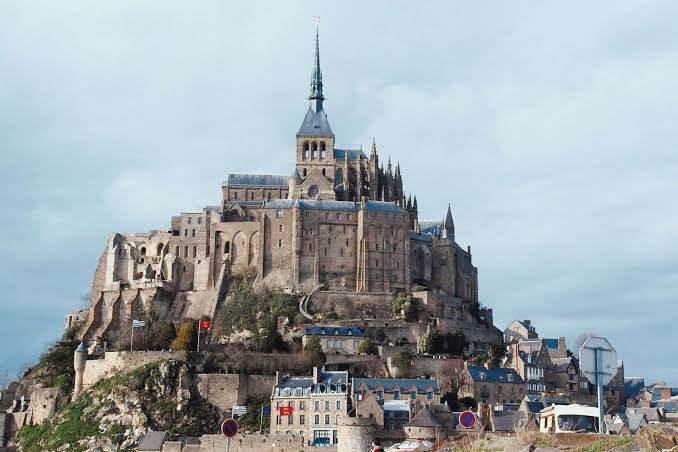
Imagine walking across an endless expanse of damp, grey sand. The air is filled with the scent of salt, seaweed, and an approaching storm. On the horizon, emerging through the mist, rises a silhouette that seems to belong more to a dream or a fantasy novel than to the real world. This is not a movie set. It is Mont Saint-Michel, one of the greatest masterpieces of medieval architecture, standing on the border between Normandy and Brittany in northwestern France. Today, more than three million visitors come here every year to admire its breathtaking beauty and witness its dramatic tides. Yet behind the souvenir shops and cafés lies a far darker story—one of faith, war, imprisonment, and survival. For more than thirteen centuries, Mont Saint-Michel has served as a sacred sanctuary, an impregnable fortress, a notorious prison, and ultimately one of France’s greatest national symbols.
In this article, we will explore its extraordinary past—from a bishop’s mysterious dream to its modern status as a UNESCO World Heritage Site.
The Dream That Changed Everything: The Birth of a Legend
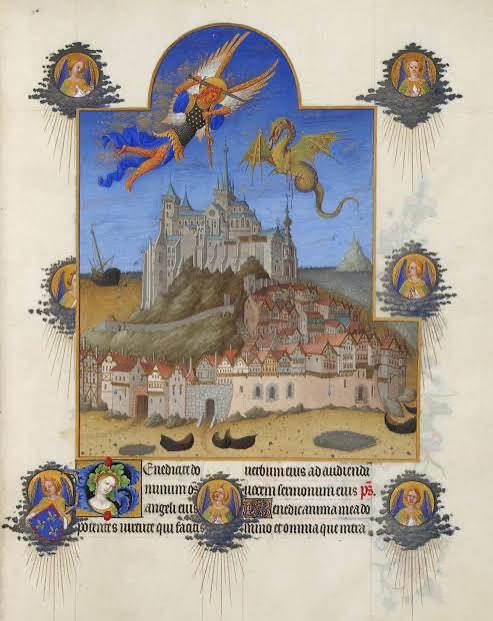
The story of Mont Saint-Michel begins not with stone and mortar, but with a dream. Before the eighth century, the site was not the famous island we know today. Instead, it was a lonely granite outcrop rising above the dense Scissy Forest. At the time it was known as Mont Tombe, meaning „The Hill of the Tomb.“ According to local Celtic traditions, the hill served as a pagan sanctuary where Druids performed religious ceremonies. Everything changed in the autumn of 708 AD.
Aubert, the Bishop of nearby Avranches, experienced an extraordinary vision during the night. According to medieval tradition, Saint Michael the Archangel—leader of Heaven’s armies and the warrior who defeated Satan in the form of a dragon—appeared before him with a clear command. The bishop was instructed to build a small church on top of Mont Tombe and dedicate it to the Archangel. Aubert, however, was unconvinced. Believing the dream to be nothing more than exhaustion—or perhaps even a deception sent by evil forces—he ignored it completely. The Archangel appeared again. His message was identical. Still, the bishop refused to act. When Saint Michael appeared for a third time, his patience had run out. According to the monastery’s chronicles, the Archangel pressed his finger firmly against Aubert’s skull, leaving a deep hole in his head. The next morning, the bishop awoke with a vivid memory of the vision—and a painful mark on his skull. This physical sign convinced him that the visions had been genuine. He immediately ordered the construction of the chapel.
Remarkably, the bishop’s skull has survived to this day and is preserved in the Basilica of Saint Gervais in Avranches. Modern medical studies suggest that the hole was most likely created by trepanation, an ancient surgical procedure performed to relieve pressure inside the skull rather than by an angelic finger. For medieval believers, however, there was no doubt. It was a miracle. Construction began almost immediately. Soon afterward, according to legend, a massive tidal wave swept across the Scissy Forest, permanently flooding the land and transforming the rocky hill into an island separated from the mainland by the sea.
The first chapel was consecrated on 16 October 709. Thus, Mont Saint-Michel was born.
Building a Miracle: The Creation of La Merveille
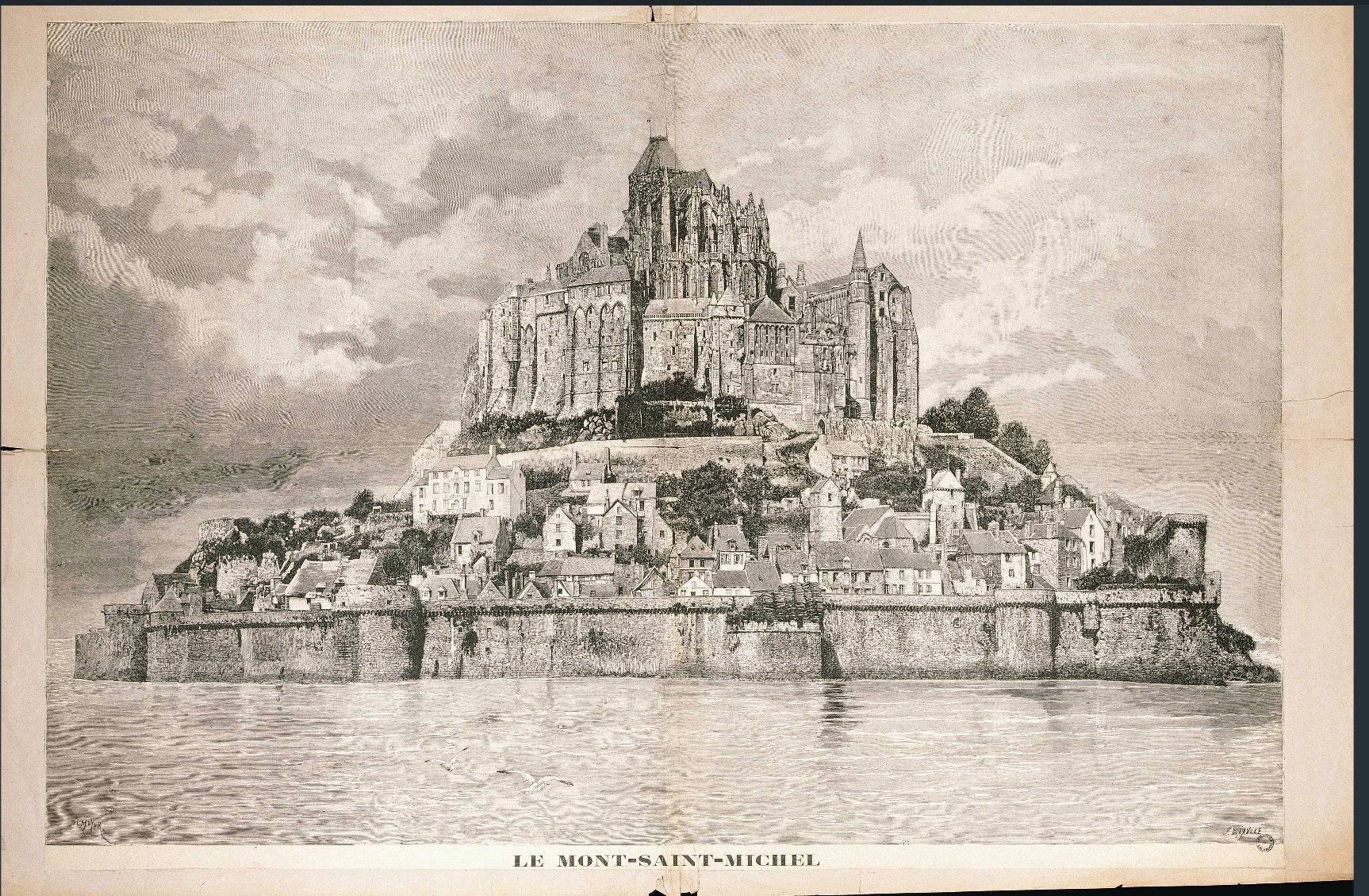
In 966, Duke Richard I of Normandy decided to elevate the importance of the sanctuary. The secular priests living on the island—accused of leading lives that had become far too worldly—were replaced by a community of Benedictine monks. Their arrival marked the beginning of Mont Saint-Michel’s golden age as both a religious sanctuary and one of medieval Europe’s leading centers of learning. Constructing such a complex on top of an isolated granite rock was an extraordinary engineering challenge. There were no roads. No bridges. No cranes. Every granite block had to be quarried—primarily from the nearby Chausey Islands—loaded onto boats, transported across unpredictable waters, and then hauled eighty meters up the steep rock by hand or with the help of pack animals.
Yet the Benedictines possessed a remarkable vision. The monastery itself was designed as a physical representation of the medieval universe. At the very bottom stood the houses of fishermen, workshops, inns, and stables—the everyday world of ordinary people. Above them were the reception halls, administrative rooms, and quarters for noble visitors and knights. At the summit stood the monastery, the monks’ cells, and the magnificent abbey church—symbolically placing God closer to Heaven than everything below. Following a devastating fire during the reign of King Philip II Augustus in the early thirteenth century, the French Crown provided generous financial support for rebuilding the damaged monastery. The result became the most spectacular part of the complex:
La Merveille—“The Marvel.“
This masterpiece of Gothic architecture consists of three remarkable levels. The lower floor housed storage rooms and the almonry, where food was distributed to pilgrims and the poor. The middle level contained the famous Hall of Knights, where monks studied and copied manuscripts, together with elegant reception rooms reserved for distinguished guests. At the very top lay the monastery’s greatest treasure: the beautiful cloister. Surrounded by delicate columns and open to the sky, it was designed to create the illusion of floating between Heaven and Earth. As monks walked silently through its galleries in prayer, they saw nothing but the endless sky above and the vast sea stretching beyond the walls. It remains one of the finest surviving examples of medieval monastic architecture.
The Unconquered Fortress: The Hundred Years’ War
During the fourteenth century, Europe was plunged into one of its longest and most devastating conflicts—the Hundred Years’ War between England and France.
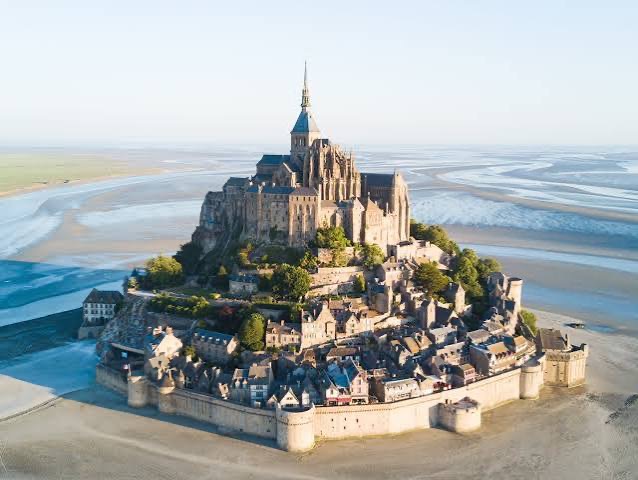
As the war spread across northern France, Mont Saint-Michel quickly transformed from a peaceful monastery into one of the kingdom’s most strategically important fortresses. Massive defensive walls, towers, battlements, and gates were constructed around the island, turning it into an almost impregnable stronghold. The English immediately recognized its importance. Whoever controlled Mont Saint-Michel would dominate a key part of Normandy and gain both a strategic military position and a powerful symbolic victory. Over the course of the war, the English launched several attempts to capture the island.
The most determined siege began in 1423 and lasted for nearly eleven years. English forces established fortified camps on the mainland and on the nearby island of Tombelaine, hoping to cut off all supplies and starve the defenders into surrender. Yet Mont Saint-Michel possessed two allies that no army could overcome: nature and faith.
The fortress was defended by Louis d’Estouteville and a small garrison of roughly 120 soldiers and local defenders. Against them stood thousands of English troops equipped with some of the most advanced siege weapons of their time. In 1434, the English launched their largest assault. Massive bombards fired enormous stone cannonballs weighing well over one hundred kilograms, smashing sections of the outer walls. For a moment, victory seemed possible.But the defenders refused to yield. From the battlements they rained stones upon the attackers, poured boiling liquids over the walls, and fought fiercely in close combat. As the English retreated, nature delivered the final blow. The tide swept into the bay with astonishing speed. Hundreds of heavily armored soldiers became trapped in the rising water. Many drowned. Others disappeared into the bay’s infamous quicksand, unable to escape under the weight of their armor. The assault ended in complete failure. Two of the English bombards were abandoned during the retreat. The French captured them as trophies, and remarkably, they still stand near the entrance to Mont Saint-Michel today. Throughout the entire Hundred Years’ War, Mont Saint-Michel was never conquered. It became one of the few places in northern France that successfully resisted English occupation. Its survival turned the island into a powerful symbol of French resistance and national identity. The victory inspired people across the kingdom—including Joan of Arc, who believed that Saint Michael himself had called upon her to liberate France from English rule.

From Sacred Sanctuary to Prison: The Dark Centuries
After the wars ended, Europe entered the Renaissance. Pilgrimage gradually declined, and the monastery’s importance began to fade. Fewer monks lived on the island, while maintaining such a vast complex became increasingly expensive. French kings introduced the system of commendatory abbots—wealthy nobles who received the monastery’s income without actually living there. Discipline weakened. Buildings fell into disrepair. The greatest tragedy came with the outbreak of the French Revolution in 1789. The revolutionary government viewed religious institutions as symbols of the old order. Monasteries across France were closed, and Mont Saint-Michel was no exception. The Benedictine monks were expelled. Its priceless medieval library was confiscated and transferred to nearby Avranches. Even the island’s name was altered. The word „Saint“ was officially removed, and it became simply Mont-Michel. Soon afterward, the former monastery was converted into a high-security state prison. It quickly earned a grim nickname:
„The Bastille of the Sea.“
The first prisoners were priests who refused to swear loyalty to the revolutionary government. Later, during Napoleon’s reign and the political upheavals of the nineteenth century, republicans, royalists, political dissidents, and ordinary criminals were all imprisoned within its walls. The magnificent monastery was transformed into a place of suffering. Monastic cells were divided into cramped prison rooms. The great dining hall became a factory where prisoners were forced to manufacture hats. The famous Hall of Knights was converted into a textile workshop. One of the most striking reminders of this period still survives today. Installed around 1820, an enormous wooden wheel dominates one of the lower chambers. Originally inspired by medieval construction cranes, it was now powered by human beings. Five prisoners at a time were forced to walk inside the wheel like hamsters, turning it with their own weight. Their labor hauled heavy sledges loaded with food, water, and supplies up the steep slope into the prison. Day after day. Year after year. Escape was virtually impossible. Anyone who somehow managed to climb over the fortress walls faced an even deadlier challenge outside. The rising tides could arrive with terrifying speed. The surrounding quicksand swallowed those who ventured into the bay without expert knowledge of the terrain. For many prisoners, Mont Saint-Michel proved to be an escape-proof prison—not because of its walls alone, but because of the sea itself.
From Ruin to National Treasure
By the middle of the nineteenth century, Mont Saint-Michel had become a shadow of its former self.
Centuries of neglect, combined with decades of use as a prison, had left the monastery in a disastrous state. Roofs leaked, Gothic sculptures had been destroyed, walls were blackened by smoke, and many of its medieval halls had been altered beyond recognition. At the very moment when the monument seemed destined to disappear, an unexpected movement began to save it. Across Europe, the Romantic movement was transforming the way people viewed the Middle Ages. Instead of seeing medieval castles and monasteries as relics of a dark past, writers and artists began celebrating them as symbols of national identity, history, and imagination. Among those who fell under Mont Saint-Michel’s spell was the great French writer Victor Hugo. When Hugo visited the island, he was horrified that one of France’s greatest architectural masterpieces had been reduced to a prison. He launched a passionate public campaign demanding its preservation.
According to Hugo, His words resonated throughout France.
He was joined by other prominent intellectuals, including Prosper Mérimée, France’s Inspector General of Historical Monuments, who argued that the monastery deserved immediate protection. Public opinion gradually shifted. Finally, in 1863, Emperor Napoleon III ordered the prison to be closed. The prisoners were transferred elsewhere, and Mont Saint-Michel began a new chapter in its history. Just eleven years later, in 1874, it was officially declared a Historic Monument of France. One of the largest restoration projects in Europe soon followed. The work was entrusted to the architect Édouard Corroyer, who spent decades repairing damaged buildings, removing prison structures, stabilizing the medieval walls, and restoring the monastery’s Gothic appearance. Perhaps the most recognizable feature of today’s skyline was added during this restoration. In 1897, a new neo-Gothic spire rose above the abbey church. At its summit stands a gilded statue of Saint Michael the Archangel, created by the sculptor Emmanuel Frémiet. Nearly 170 meters above sea level, the Archangel raises his sword while triumphing over the dragon beneath his feet. The statue serves not only as a religious symbol but also as the monument’s lightning rod, frequently struck during the storms that sweep across the bay.
The Bay: Where Nature Became the Greatest Defender
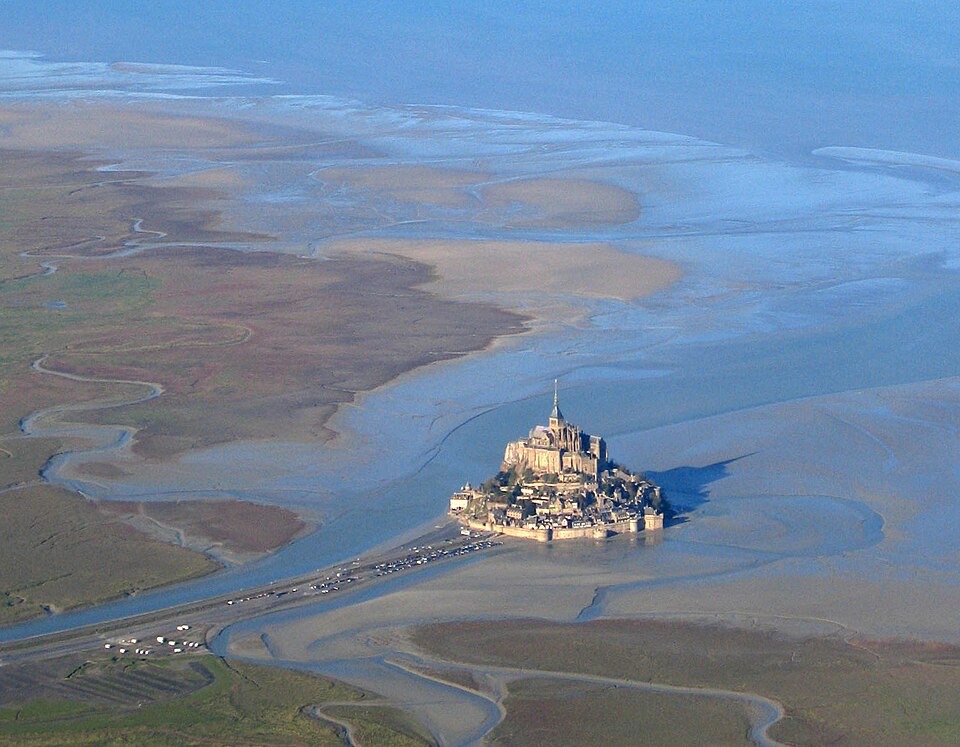
To understand Mont Saint-Michel, one must also understand the extraordinary landscape that surrounds it. The bay experiences some of the largest tides in continental Europe. During exceptional tidal events, the difference between low tide and high tide can reach 15 meters—roughly the height of a five-story building. At low tide, the sea retreats more than 15 kilometers, exposing an immense plain of sand and mud stretching toward the horizon. Hours later, everything changes. The tide returns. For centuries, local people have described it as arriving „at the speed of a galloping horse.“ Although the actual speed is closer to six or seven kilometers per hour, the danger is very real. The water does not simply advance in a straight line. Instead, it rapidly fills hidden channels throughout the bay, cutting off escape routes before many people even realize they are in danger. The second threat lies beneath the surface. Much of the bay contains quicksand. What appears to be solid ground may suddenly liquefy beneath a person’s weight. The more someone struggles, the deeper they sink. Over the centuries, countless pilgrims underestimated these dangers. Many never returned. This deadly landscape earned the monastery another medieval name: Mons Sancti Michaelis in Periculo Maris— „Saint Michael in the Peril of the Sea.“
Ironically, modern engineering almost destroyed the very feature that had protected the island for centuries. In 1879, a solid causeway was built to provide easier access for visitors. While practical, it interrupted the natural movement of the tides.
Sand gradually accumulated around the island, and Mont Saint-Michel slowly began losing its island character. By the late twentieth century, experts feared that it might eventually become permanently connected to the mainland. To prevent this, France launched one of the country’s most ambitious environmental restoration projects. Costing more than €200 million, the project removed the old causeway and replaced it with an elegant bridge supported by pillars, allowing water to flow freely beneath it. A sophisticated hydraulic dam was also built on the Couesnon River.
The system stores water during high tide and releases it forcefully during low tide, washing accumulated sand back into the sea. Thanks to these efforts, Mont Saint-Michel once again becomes a true island during the highest tides—just as it did centuries ago.
Mont Saint-Michel Today: A Living Monument
Today, Mont Saint-Michel is the second most visited historic site in France outside Paris, surpassed only by the Palace of Versailles. Every year, more than three million visitors pass through its medieval gates, drawn by its unique combination of history, architecture, and natural beauty.
Yet Mont Saint-Michel is far more than an open-air museum.
It is still a living village.
Only around thirty permanent residents live on the island today. Among them are local officials, shopkeepers, hotel owners, police officers—and once again, monks.
In 1969, nearly two centuries after the French Revolution had expelled the Benedictines, religious life returned to the abbey. Today, the monastery is home to the Monastic Fraternities of Jerusalem, whose members continue a tradition of daily prayer and worship that began more than thirteen centuries ago.
Every day, their chants echo beneath the Gothic vaults of the abbey church, reminding visitors that Mont Saint-Michel was built first and foremost as a place of faith.
Walking through the island feels like stepping back into the Middle Ages.
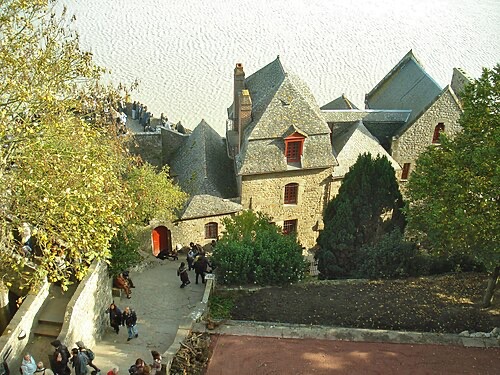
Visitors enter through the King’s Gate (Porte du Roy) before climbing the narrow, winding Grande Rue, the main street that has connected the island’s entrance to the abbey for centuries.
The street is lined with medieval stone houses, many dating from the fifteenth and sixteenth centuries. Today they contain cafés, museums, hotels, and small shops, yet much of their original character has survived.
Among the island’s most famous landmarks is La Mère Poulard, a restaurant founded in 1888 and renowned throughout the world for its enormous fluffy omelettes, prepared over an open wood fire using a closely guarded recipe.
Although many visitors come for the famous meal, the restaurant itself has become part of Mont Saint-Michel’s modern history.
As evening falls, the crowds gradually disappear.
The stone streets grow quiet.
Lights illuminate the abbey high above the village, while the golden statue of Saint Michael glows against the dark Normandy sky.
For a brief moment, the island looks almost exactly as medieval pilgrims must have seen it centuries ago.
Conclusion – A Monument to Human Determination
Few places in the world combine history, architecture, religion, warfare, and natural beauty as completely as Mont Saint-Michel. Born from a legend, shaped by faith, defended through war, transformed into a prison, rescued from ruin, and ultimately restored to its former glory, the island has survived every challenge that history placed before it. For more than 1,300 years, it has withstood invading armies, violent storms, political revolutions, and the relentless passage of time. It remains one of the greatest achievements of medieval engineering and one of the most recognizable landmarks in the world. When the tide rises and the sea surrounds the granite island once again, it becomes easy to understand why generations of pilgrims believed this place stood somewhere between Earth and Heaven.
Whether viewed as a masterpiece of Gothic architecture, an unconquered fortress, a symbol of French identity, or simply one of the most breathtaking places on Earth, Mont Saint-Michel continues to inspire millions of people every year.
It is more than a monument.
It is a testament to human imagination, perseverance, and faith—a place where history still feels alive.
Вашият коментар