Football, known as soccer in the United States, is more than a sport. It is a global language. A person can walk into a crowded street in Rio de Janeiro, a schoolyard in London, a village field in Ghana, a stadium in Tokyo, or a public park in Los Angeles and understand the basic idea immediately: a ball, two goals, and the shared desire to win. No other sport has spread so widely across continents, cultures, and social classes. Its simplicity is part of its power. Football does not require expensive equipment, perfect facilities, or a particular body type. It can be played by children with a plastic ball, by professionals in massive arenas, or by friends marking goalposts with backpacks.
In 2026, as the FIFA World Cup is being played across the United States, Canada, and Mexico, football has reached another historic moment. For American audiences especially, this tournament represents more than international competition. It shows how a sport once viewed as secondary in the American sports landscape has become a major cultural force. To understand why the 2026 World Cup matters, it is necessary to look back at the long and fascinating history of the game.
Ancient Origins of Football
The story of football begins thousands of years before modern stadiums, referees, uniforms, or television broadcasts. Ancient civilizations developed many games that involved kicking, carrying, or striking a ball. In China, one of the earliest known football-like games was called Cuju. It was played with a leather ball and required skill, balance, and control. At first, it was connected to military training, helping soldiers develop coordination and physical discipline. Over time, it became a popular form of entertainment.
Japan developed a related game called Kemari, which is still performed today in traditional settings. Unlike modern football, Kemari was not focused on defeating an opponent. Instead, players worked together to keep the ball in the air without letting it touch the ground. This made it less competitive and more ceremonial, showing that ball games could be both athletic and cultural.
Ancient Greece and Rome also had ball games that resembled early forms of football and rugby. The Greeks played games such as Episkyros, while the Romans developed Harpastum, a rougher and more physical activity often used by soldiers. These games were not football in the modern sense, but they contained important elements that would later become central to the sport: movement, teamwork, strategy, physical courage, and the use of a ball as the focus of competition.
Football in Medieval Europe
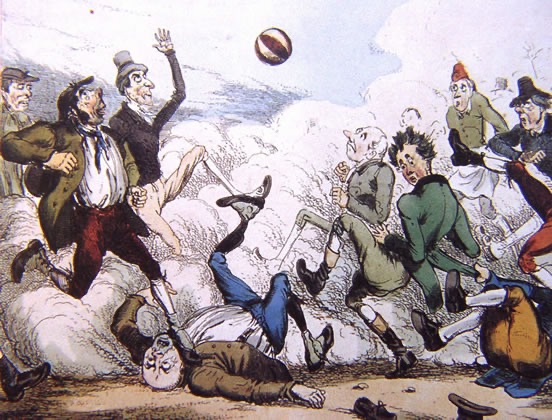
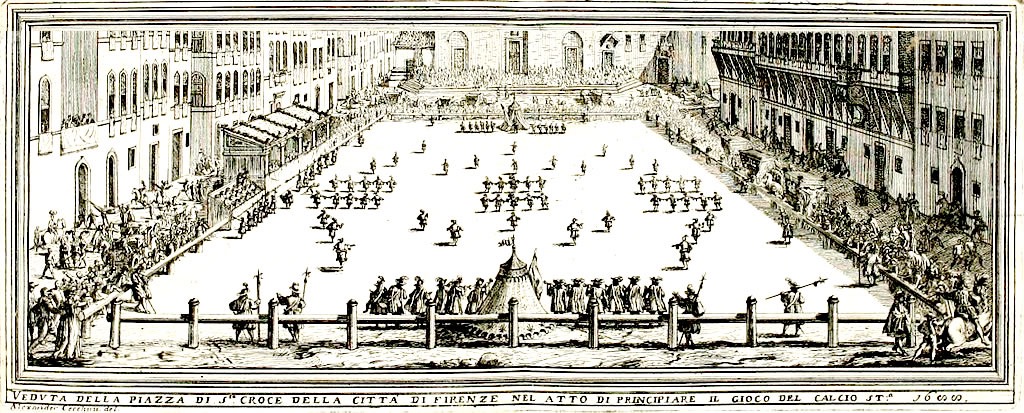
During the Middle Ages, football-like games became popular across Europe, especially in England and France. These games were often wild, chaotic, and physical. Entire villages or towns could take part. There were usually no fixed teams, no clear boundaries, and very few rules. The goal might be to move the ball from one end of a town to another, sometimes through streets, fields, rivers, and marketplaces.
The matches could last for hours and often caused damage to property. Players pushed, tackled, wrestled, and fought for the ball. Injuries were common. Because of this, medieval authorities often saw football as a public problem rather than a healthy sport. In England, King Edward II banned football in 1314 because it created disorder in the streets. Later rulers also tried to restrict or prohibit the game, partly because they wanted young men to practice archery instead of wasting time on violent ball games.
Yet these bans did not destroy football. In fact, they show how popular the game already was. People continued to play because football gave communities excitement, identity, and release. It belonged to ordinary people long before it became organized by clubs, federations, and global institutions.
England and the Birth of Modern Football
Although many civilizations played early ball games, England is recognized as the birthplace of modern football. The crucial transformation happened in the nineteenth century. During this period, British schools, universities, and clubs began organizing sports more formally. Football was especially popular in educational institutions such as Cambridge, Eton, Harrow, and Rugby. The problem was that each school had its own version of the rules.
Some schools allowed players to carry the ball with their hands. Others emphasized kicking. Some permitted rough physical contact, while others wanted a cleaner and more skillful game. This made it difficult for teams from different schools or clubs to play against each other. A shared set of rules became necessary.
In 1848, the Cambridge Rules attempted to bring order to the game. These rules helped shape the future of football by limiting the use of hands and clarifying how the ball should be played. The decisive moment came in 1863, when representatives of several clubs met in London and founded the Football Association. This meeting created the first official rules of association football.
The most important decision was to separate football from rugby. Those who wanted to carry the ball and allow heavier physical contact eventually followed the path of rugby. Those who wanted a game based mainly on kicking, passing, movement, and control created modern football. This is why 1863 is widely accepted as the birth year of the modern game.
The Rise of Organized Competition
Once the rules became clearer, football grew quickly. Clubs formed throughout England, and matches became more organized. In 1871, the Football Association created the FA Cup, the first major national football competition. It allowed clubs from different areas to compete under common rules and helped build a national football culture.
In 1872, England and Scotland played the first official international football match. The game ended 0–0, but its historical importance was enormous. Football was no longer just a local activity. It had become a sport through which nations could compete and represent themselves.
The next major step was the creation of league football. In 1888, William McGregor, a director of Aston Villa, proposed a regular competition in which clubs would play scheduled matches across a season. This led to the formation of the Football League, the first organized professional league in the world. Preston North End became the first champion and went undefeated, earning a legendary place in football history.
During this period, many features of the modern game were introduced or refined. The number of players became fixed at eleven per team. Matches were standardized at ninety minutes. Goal nets, referees, assistant referees, penalty kicks, corner kicks, and the offside rule became part of the developing structure. Football was becoming faster, fairer, more tactical, and more attractive to spectators.
Football Conquers the World
Football spread globally through the movement of British sailors, merchants, engineers, teachers, and workers. Wherever British influence reached, football often followed. The game traveled to continental Europe, South America, Africa, and Asia. Its simple rules made it easy to adopt, while its emotional intensity made it easy to love.
In South America, football became especially powerful. Argentina, Uruguay, and Brazil developed deep football cultures that combined European influence with local creativity. The game became part of national identity. Brazil, in particular, would later transform football into an art form, producing generations of players known for technical skill, rhythm, and imagination.
In Europe, football became connected to working-class communities, industrial cities, and local pride. Clubs were not just sports teams; they became symbols of neighborhoods, cities, and social identity. Supporting a football club often meant inheriting a tradition from family and community.
FIFA and the World Cup
As football spread, the need for international organization became clear. In 1904, FIFA was founded in Paris to coordinate the global game. Its mission was to bring national football associations together and create international competitions.
The greatest achievement of FIFA came in 1930, when the first World Cup was held in Uruguay. The host nation won the tournament, defeating Argentina in the final. From that moment, the World Cup became the highest stage in football. Every four years, national teams gathered to compete not only for a trophy, but for pride, history, and global recognition.
The World Cup grew into the most watched sporting event on Earth. It produced unforgettable players, matches, and moments. Pelé helped Brazil become a football superpower. Diego Maradona became a symbol of genius and controversy. Later stars such as Zinedine Zidane, Ronaldo Nazário, Ronaldinho, Lionel Messi, and Cristiano Ronaldo turned football into a truly global entertainment industry.
Football in the Modern Era
The twentieth century transformed football into a mass-media phenomenon. Radio brought matches into homes. Television turned players into international celebrities. Satellite broadcasts allowed fans across the world to watch the same match live. The internet and social media then changed the relationship between clubs, players, and supporters completely.
Modern football is now a multibillion-dollar industry. Clubs earn money from broadcasting rights, sponsorships, merchandise, ticket sales, and global tours. The biggest teams have supporters on every continent. A club in England, Spain, Italy, or Germany can have millions of fans in the United States, Asia, Africa, and South America.
Yet football remains powerful because it has not lost its basic simplicity. The professional game may involve advanced tactics, sports science, data analysis, and enormous financial investment, but the heart of the sport is still easy to understand. One moment of skill, one pass, one save, or one goal can change everything.
Football as Culture and Politics
Football has always been more than entertainment. It reflects society. It can unite people, but it can also expose tension. National teams often become symbols of hope, pride, and identity. Club rivalries can represent history, class, religion, politics, or geography.
Football has even influenced major political and social events. In some places, it has helped create moments of peace and unity. In others, it has intensified rivalries. This dual nature makes football fascinating. It is emotional because people attach meaning to it. A match is never just a match when it represents a city, a nation, a generation, or a dream.
For immigrants and diaspora communities, football often becomes a connection to home. For young people, it can be a path to opportunity. For fans, it provides belonging. That is why football stadiums feel different from ordinary sports venues. They are places of memory, identity, and collective emotion.
Soccer in the United States
In the United States, soccer has had a different path. For much of the twentieth century, American football, baseball, basketball, and hockey dominated the sports landscape. Soccer was often treated as a youth sport or an immigrant sport rather than a mainstream professional spectacle.
Still, the game never disappeared. Immigrant communities kept it alive. Schools and colleges developed strong participation. Youth soccer expanded rapidly, especially from the late twentieth century onward. The 1994 FIFA World Cup, hosted by the United States, was a major turning point. It helped create the conditions for Major League Soccer, which launched in 1996.
Since then, soccer in the United States has grown steadily. MLS has expanded, soccer-specific stadiums have been built, and American fans have become more connected to international leagues. The U.S. women’s national team has played an especially important role, achieving global success and inspiring millions of young players. Meanwhile, the men’s game has developed through stronger youth academies, more international experience, and rising stars playing in top European leagues.
The American sports audience is also changing. Younger fans are more global, more digital, and more open to following international competitions. For them, soccer is not foreign. It is part of the modern sports world.
The 2026 World Cup: A Historic Moment for North America
The 2026 FIFA World Cup is a landmark event. Hosted by the United States, Canada, and Mexico, it is the first World Cup with 48 teams, making it the largest tournament in FIFA history. For North America, it is a defining moment. For the United States in particular, it represents the arrival of soccer as a major cultural force.
The tournament is being played in massive stadiums across the continent, bringing together fans from every part of the world. American cities are experiencing the atmosphere that football creates globally: crowded streets, flags, songs, watch parties, national colors, and emotional drama. For many Americans, the 2026 World Cup is not just something to watch; it is an introduction to the full power of the global game.
This matters because the United States has the resources, population, media reach, and multicultural identity to become one of the most important football markets in the world. The World Cup gives the country a chance to connect its domestic soccer growth with the international tradition of the sport. It also introduces millions of casual viewers to the intensity of national-team football, where every match can feel historic.
The timing is significant. Football has never been more global, and America has never been more connected to the sport. The 2026 World Cup may become for soccer what previous landmark events were for other sports: a turning point that changes public perception permanently.
Why Football Endures
Football endures because it belongs to everyone. It can be played by the rich and the poor, by professionals and amateurs, by children and adults. It can be beautiful or brutal, simple or tactical, local or global. It allows individual genius, but it depends on teamwork. It creates heroes, but it also reminds everyone that no player is greater than the game itself.
The history of football is the history of a human idea that refused to disappear. Ancient people kicked balls for training, ritual, and fun. Medieval villagers turned the game into a wild community contest. English schools and clubs gave it rules. Professional leagues gave it structure. FIFA gave it a world stage. Television and the internet gave it a global audience. Now, in 2026, North America is helping write the next chapter.
Conclusion: From Ancient Fields to American Stadiums
From ancient China, Japan, Greece, and Rome to medieval Europe, from the schools of England to the stadiums of the 2026 World Cup, football has traveled farther than any other sport. It has survived bans, wars, political conflicts, commercialization, and constant change. Its form has evolved, but its spirit remains the same.
Football is a game of movement, imagination, and emotion. It is a sport where history can be made in seconds and where a single goal can become part of a nation’s memory. As the 2026 World Cup unfolds in the United States, Canada, and Mexico, the world is not simply watching another tournament. It is witnessing the continuation of a story thousands of years old — a story that began with a ball, a foot, and the universal human desire to play.
Вашият коментар