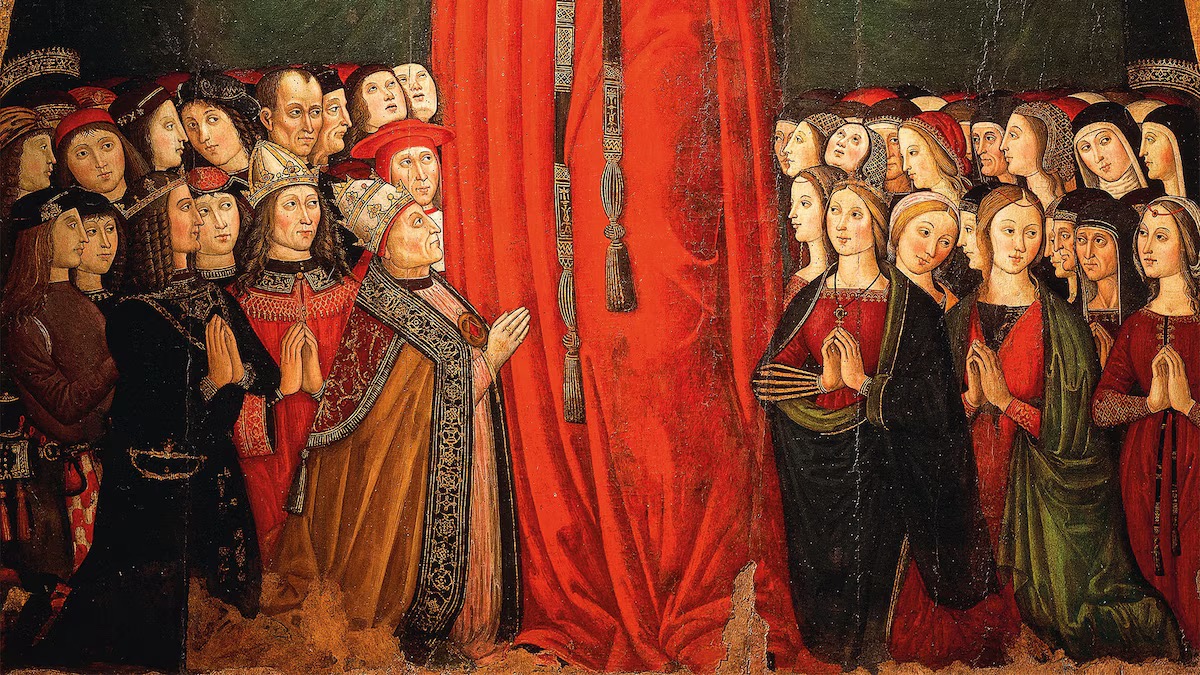
At the beginning of the 16th century, the Borgia family stood at the height of its power. Under Rodrigo Borgia, the Papacy had become not only a center of spiritual authority, but also a force deeply involved in the political struggles of Italy. Through careful alliances, calculated decisions, and the ambition of his son Cesare Borgia, the Borgias had extended their influence across central Italy.
For a brief moment, it appeared that their dominance might endure.
Yet the foundations of their power were less stable than they seemed. Much of their influence depended on the authority of the Pope himself, and on a network of alliances that could shift with little warning. In such a system, even a single event had the potential to alter the balance entirely.
That event came suddenly, and its consequences were immediate.
The Death of Alexander VI
In August 1503, Alexander VI died after a brief illness. His death marked a turning point not only for the Borgia family, but also for the political landscape of Italy.
The exact circumstances of his death have been the subject of speculation. Some later accounts suggested poisoning, a claim that has often been repeated in connection with the Borgias. However, modern historians generally consider it more likely that he died of natural causes, possibly related to illness, rather than deliberate poisoning.
Regardless of the cause, the effect was clear. The central pillar of Borgia power had been removed.
Without the authority of the Papacy, the network that supported Cesare Borgia began to weaken almost immediately.
Cesare Borgia Without the Papacy
At the time of his father’s death, Cesare Borgia was already in a vulnerable position. He had been ill, likely suffering from the same outbreak that affected his father, and was unable to respond quickly to the changing political situation.
The death of Alexander VI left him exposed. His authority had been closely tied to the Papacy, and without it, his control over his territories became uncertain.
The election of a new Pope further complicated matters. Initially, Cesare attempted to secure his position by supporting the election of a candidate who might favor him. However, the outcome did not align with his expectations.
When Julius II ascended to the papacy, the situation shifted decisively. Unlike Alexander VI, Julius II had little interest in maintaining Borgia influence. Instead, he sought to restore direct papal control over the territories that Cesare had acquired.
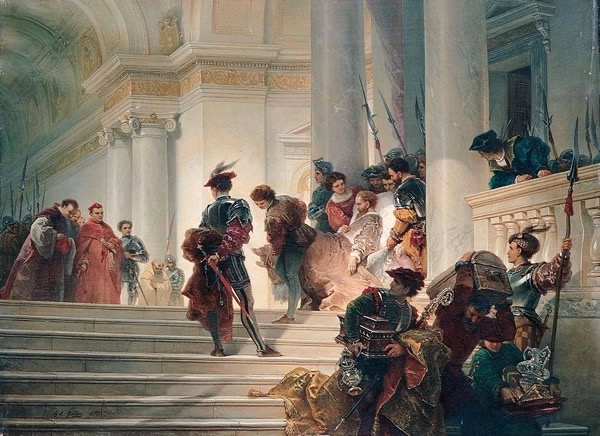
Giuseppe Lorenzo Gatteriː Cesare Borgia leaves the Vatican (1877)
The Collapse of Power
With the support of the new Pope, opposition to Cesare Borgia intensified. Territories that had been brought under his control began to break away, and former allies reconsidered their positions.
The process of decline was rapid. Without the backing of the Papacy and facing growing resistance, Cesare found it increasingly difficult to maintain his authority.
He attempted to negotiate and adapt, but the conditions that had enabled his rise were no longer present. His enemies, once cautious, now acted with greater confidence.
Eventually, Cesare was captured and removed from Italy. His ambitions of establishing a lasting power base in central Italy came to an end.
Exile and Final Years
After his fall from power, Cesare Borgia spent his final years away from the center of Italian politics. He eventually found himself in Spain, the land of his family’s origins, where he entered the service of the Kingdom of Navarre.
His later life lacked the scale and influence that had defined his earlier career. The territories he had once controlled were lost, and the political landscape of Italy continued to evolve without him.
In 1507, Cesare Borgia died during a military engagement. His death marked the end of his personal ambitions and symbolized the final collapse of the Borgia project of power.
The Fate of the Borgia Family
While Cesare’s fall represented the most visible collapse of Borgia power, it was not the end of the family itself.
Lucrezia Borgia continued to live in Ferrara, where she maintained her position as Duchess and remained part of the cultural and political life of the court. Her later years were marked by relative stability compared to the turbulence that had defined her earlier life.
The broader influence of the Borgias, however, had diminished. Without control of the Papacy and without a unified territorial base, the family could no longer exert the same level of power in Italian politics.
The Role of Reputation
The fall of the Borgias was not only a political event, but also a transformation of their image. As their power declined, the narratives surrounding them became more firmly established.
Stories of corruption, ambition, and intrigue were repeated and expanded, shaping how the family would be remembered. Their enemies, no longer constrained by their influence, contributed to the development of a legacy that emphasized their most controversial aspects.
Over time, these narratives became part of a broader cultural memory, blending historical fact with interpretation and myth.
A Fragile Dynasty
The story of the Borgias illustrates the fragile nature of power built on personal authority. Their rise had been rapid, driven by the ambition of Alexander VI and the capabilities of Cesare. Yet this rise depended on conditions that could not be sustained indefinitely.
When those conditions changed, the structures they had created proved vulnerable.
Their experience reflects a broader pattern in Renaissance Italy, where political success often depended on a combination of opportunity, alliance, and individual leadership. Without continuity, such success could quickly unravel.
Conclusion: Power and Its Limits
The fall of the Borgias was as dramatic as their rise. In the span of a few years, a family that had dominated the political landscape of Italy lost its central position and saw its ambitions collapse.
Their story does not offer a simple moral lesson. Instead, it reveals the complexities of power in a world where authority was constantly contested and where success depended on both skill and circumstance.
The Borgias remain a subject of fascination not only because of what they achieved, but also because of how quickly it ended.
Their legacy endures as a reminder that power, no matter how great, is never absolute.
And that in the world of Renaissance politics, even the strongest dynasties could fall.
Вашият коментар