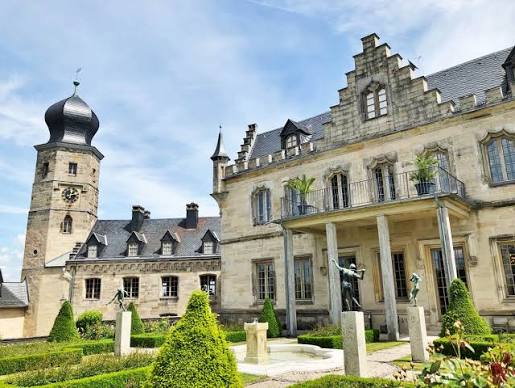
Medieval Origins and Defensive Functions of Callenberg Castle
The origins of Callenberg Castle date back to 1122, when a certain „Thiemo de Chalwinberch“ was first mentioned in official documents. His ennobled family managed the site until 1231, when the last noble freeman residing there, Ulrich III, sold the castle to the Bishopric of Würzburg. Already in the following year, the stronghold passed into the hands of Count Poppo VII of Henneberg. In 1313, the knight Hermann Hunt von Sternberg acquired „Fortress Callenberg“ from Count Berthold VII of Henneberg and maintained it as a hereditary fief. Throughout the medieval centuries, the fortress primarily served defensive and territorial control functions in Upper Franconia. Following the death of the last member of the von Sternberg family in 1588, the property devolved to Duke Johann Casimir of Saxe-Coburg.
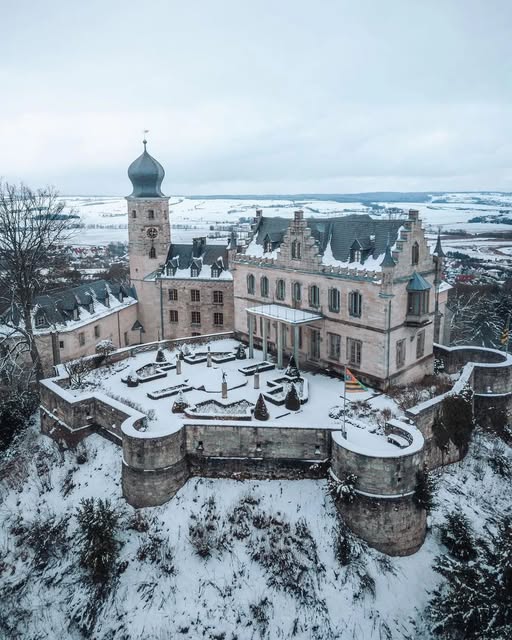
Dynastic Transformations and the Neo-Gothic Golden Age
During the Renaissance, the castle began to function as a hunting lodge and a summer retreat, allowing the rulers to distance themselves from the rigid protocol of the official ducal court. However, the historical destiny of the estate remained dynamic; until 1825, the ducal treasury and Callenberg Castle were the property of the Dukes of Saxe-Meiningen. It was only in 1826 that the Coburg Dukes became the owners of Callenberg Castle again. The true architectural and political golden age of the complex occurred in the 19th century. In line with the romantic historicism of the era, a major reconstruction of the upper castle was concluded in 1831 based on the plans of the renowned architect Carl Alexander von Heideloff. Later, in 1856/57, under the reign of Duke Ernst II, the lower part of the castle complex was also altered in the Neo-Gothic style, featuring its characteristic crenellated towers and filigree stonework.
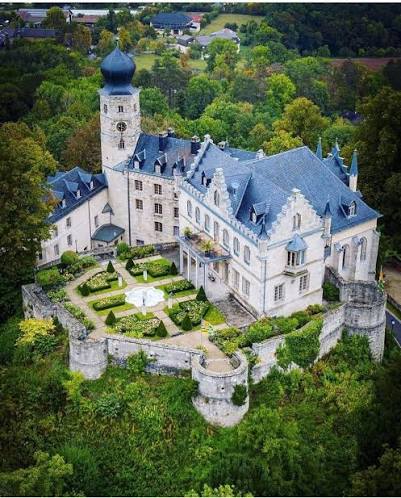
An Informal Hub of Pan-European Diplomacy
This structural transformation coincided with the unprecedented rise of the House of Saxe-Coburg and Gotha on the European political stage. Through a series of strategic dynastic marriages, members of the lineage ascended the thrones of Great Britain, Belgium, Portugal, and Bulgaria. Although Prince Albert (consort to Queen Victoria) was born at the nearby family estate of Schloss Rosenau, Callenberg remained a highly important center for family gatherings. Until 1945, it served as the official summer residence of the Coburg Dukes. Among its most notable historical visitors was Queen Victoria herself, who immortalized her stay in her personal diary with the words: „A little steep, the way up to Callenberg castle, but once you have arrived there, you can enjoy a nice cup of tea in a beautiful surrounding.“
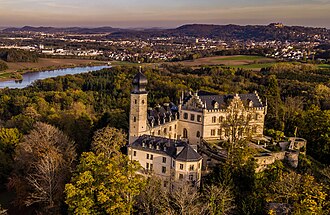
Twentieth-Century Turmoil and Modern Preservation
The century of world wars brought severe disruptions to Callenberg. Following the abolition of the monarchy in Germany in 1918 and the turbulent end of World War II in 1945, the castle ceased to function as a summer residence and entered a period of decline. A modern revival began at the end of the century, and the property remains proudly owned by the family foundation of the Dukes of Saxe-Coburg and Gotha today. Following extensive scholarly conservation efforts, Callenberg Castle has operated as a museum since 1998. It now houses the priceless collection of ducal art treasures—precious pieces of furniture, paintings, porcelain, traditional handicrafts, and a selection of weapons spanning four centuries of history.
Вашият коментар