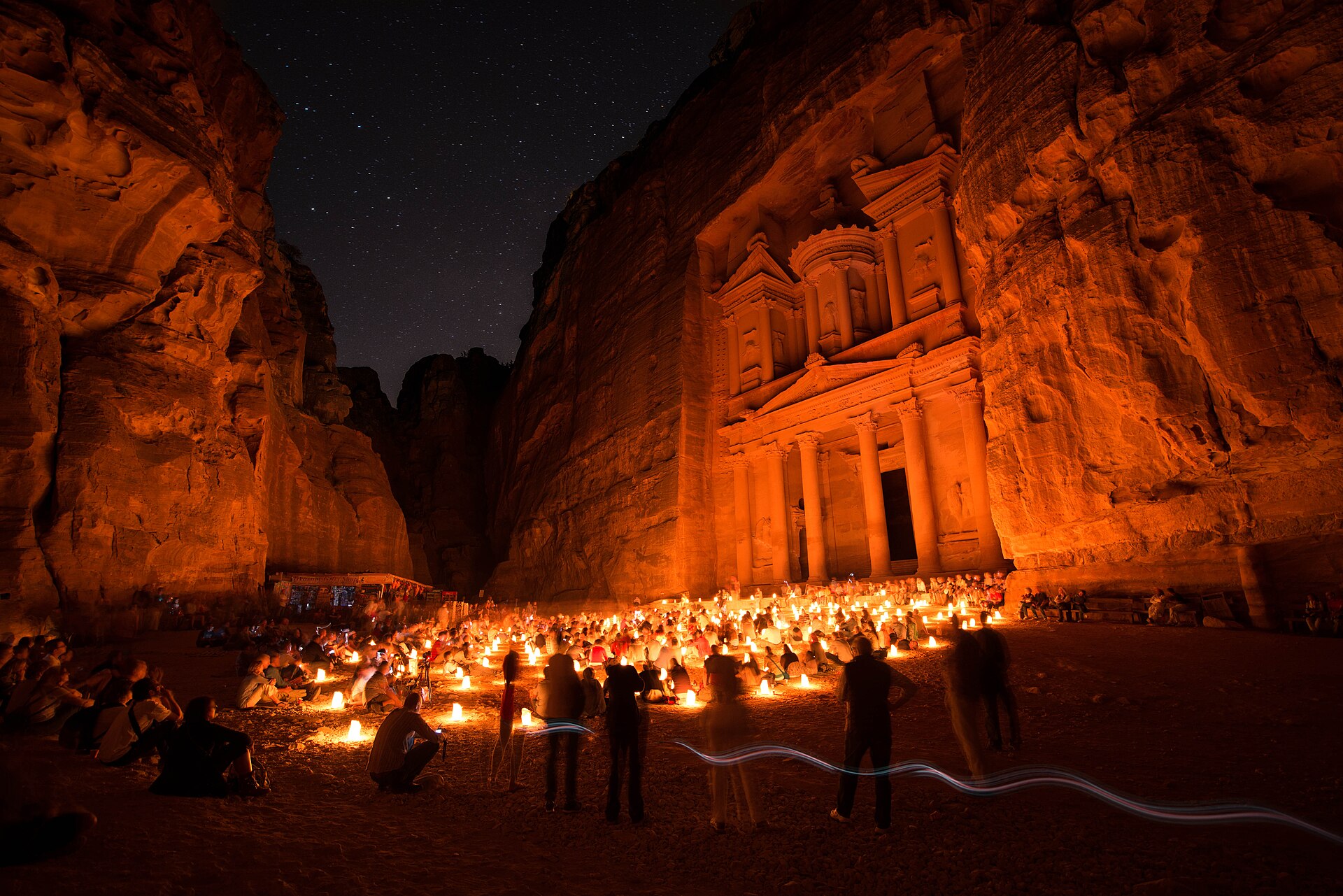
Hidden among the rugged sandstone mountains of southern Jordan lies one of the greatest archaeological treasures ever created. Known today as Petra, this ancient city astonishes visitors with monumental temples, elaborate tombs, towering cliffs, and narrow canyons carved by nature over millions of years. Yet Petra was far more than a spectacular collection of rock-cut monuments. For centuries it served as the thriving capital of the Nabataean Kingdom, controlling some of the most profitable trade routes in the ancient world and transforming a harsh desert landscape into a flourishing oasis.
Often called the „Rose City“ because of the pink, red, and orange hues of its sandstone cliffs, Petra represents one of history’s greatest examples of human ingenuity. Its inhabitants mastered desert engineering, created sophisticated water systems, and built an entire city directly into the surrounding mountains. Although the city eventually disappeared from the Western world for centuries, its rediscovery revealed one of antiquity’s greatest civilizations.
Before Petra: The Land of Edom
Long before Petra became the capital of the Nabataeans, the region had already been inhabited for thousands of years. Archaeological discoveries show that people lived in the surrounding valleys as early as 7000 BC, during the Neolithic period, making this one of the oldest continuously occupied regions in Jordan.
During the Bronze and Iron Ages, the area formed part of the Kingdom of Edom, a civilization frequently mentioned in Egyptian records and the Hebrew Bible. The mountains surrounding Petra provided natural defenses, while seasonal streams supplied precious water in an otherwise arid environment. These advantages made the region an important stop for merchants traveling between Arabia, the Levant, and Egypt.
The Edomites established settlements on the surrounding heights and controlled trade through the valleys. Although relatively little survives from their occupation, they recognized the strategic value of the landscape centuries before Petra reached its greatest prosperity.
The Rise of the Nabataeans
The true story of Petra begins with the arrival of the Nabataeans, an Arab people who gradually settled the region during the fourth century BC. Originally nomadic pastoralists, they possessed an extraordinary understanding of the desert and its scarce resources.
Rather than relying solely on agriculture, the Nabataeans built their wealth through commerce. Their territory occupied a strategic position between southern Arabia, Egypt, Syria, and the Mediterranean. Every caravan carrying valuable goods such as frankincense, myrrh, spices, perfumes, silk, precious stones, and exotic textiles passed through routes controlled by the Nabataeans.
Instead of producing these luxury goods themselves, they became masters of international trade. By protecting caravans, collecting taxes, and supplying travelers, they transformed Petra into one of the wealthiest cities of the ancient Near East.
The Nabataeans originally called the city Raqmu or Rekem, while the Greek name Petra, meaning „rock,“ eventually became the name by which the city is known today.
Why Petra Was Built Here
At first glance, Petra appears to occupy an unlikely location. Surrounded by barren mountains and located far from fertile river valleys, it hardly seems suitable for a major city.
In reality, the site offered remarkable advantages.
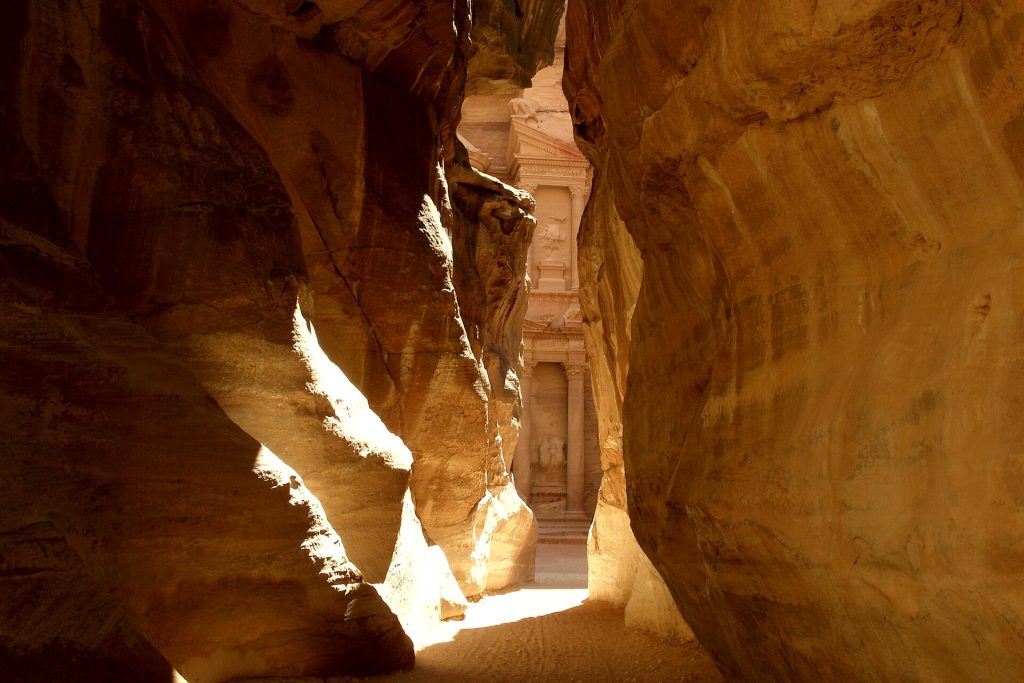
Towering sandstone cliffs formed natural defensive walls, while the narrow entrance known today as the Siq created an almost perfect gateway that could easily be defended by a relatively small force. In some places, the canyon narrows to only a few meters wide, preventing large armies from entering quickly.
Equally important was the region’s hidden water supply. Although annual rainfall is low, winter storms produce powerful flash floods through the surrounding valleys. Most ancient settlements would have been destroyed by these floods, but the Nabataeans developed an ingenious system of dams, reservoirs, underground cisterns, tunnels, and ceramic pipelines that captured and stored every possible drop of water.
Their engineering transformed the desert into an artificial oasis capable of supporting thousands of inhabitants. Modern archaeological studies continue to demonstrate that Petra’s success depended as much on hydraulic engineering as on trade itself.
The Capital of a Desert Kingdom
By the first century BC, Petra had become the magnificent capital of the Nabataean Kingdom. Travelers approaching the city first passed through the winding Siq, where towering sandstone walls rise more than eighty meters above the narrow pathway.
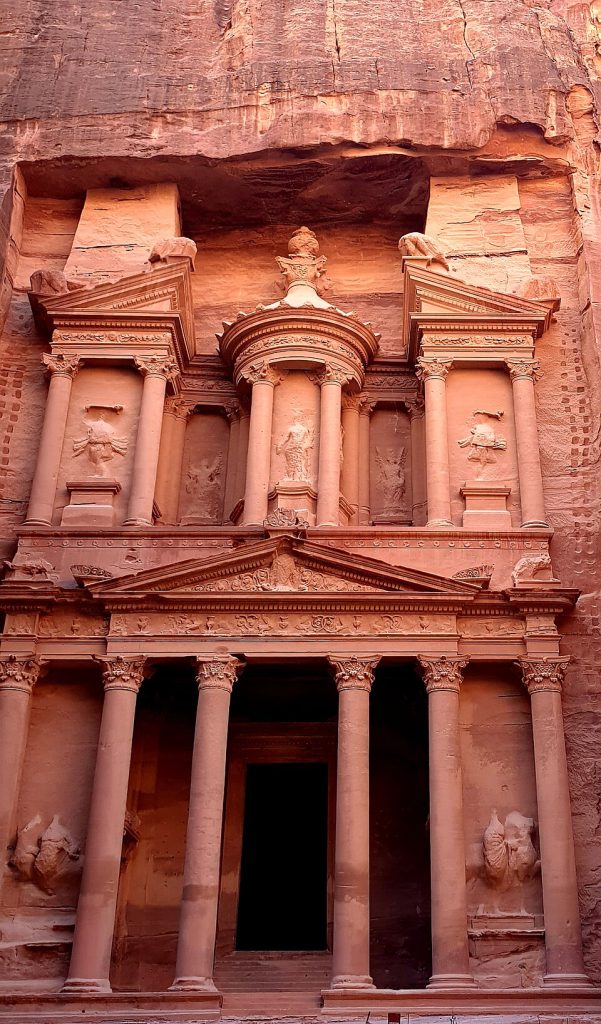
The dramatic entrance was carefully designed to create anticipation. After walking through nearly a kilometer of twisting canyon, visitors suddenly emerged before one of history’s most breathtaking architectural masterpieces: Al-Khazneh, better known today as The Treasury.
This remarkable building, carved directly into a vertical sandstone cliff, stands approximately 39 meters (128 feet) high. Its façade combines local Nabataean craftsmanship with influences borrowed from Greek, Egyptian, and Roman architecture. Corinthian columns, decorative pediments, statues, and elaborate carvings demonstrate the cosmopolitan character of Nabataean culture.
Despite its modern name, the Treasury was almost certainly not used to store treasure. Most scholars believe it served as a royal mausoleum or monumental tomb, probably constructed during the reign of King Aretas IV in the early first century AD.
The popular legend that pirates or pharaohs hid immense riches inside the monument inspired generations of Bedouins to fire bullets at the decorative urn above the entrance, hoping to break it open. Those bullet marks remain visible today.
A City Carved into the Mountains
The Treasury represents only a tiny portion of Petra.
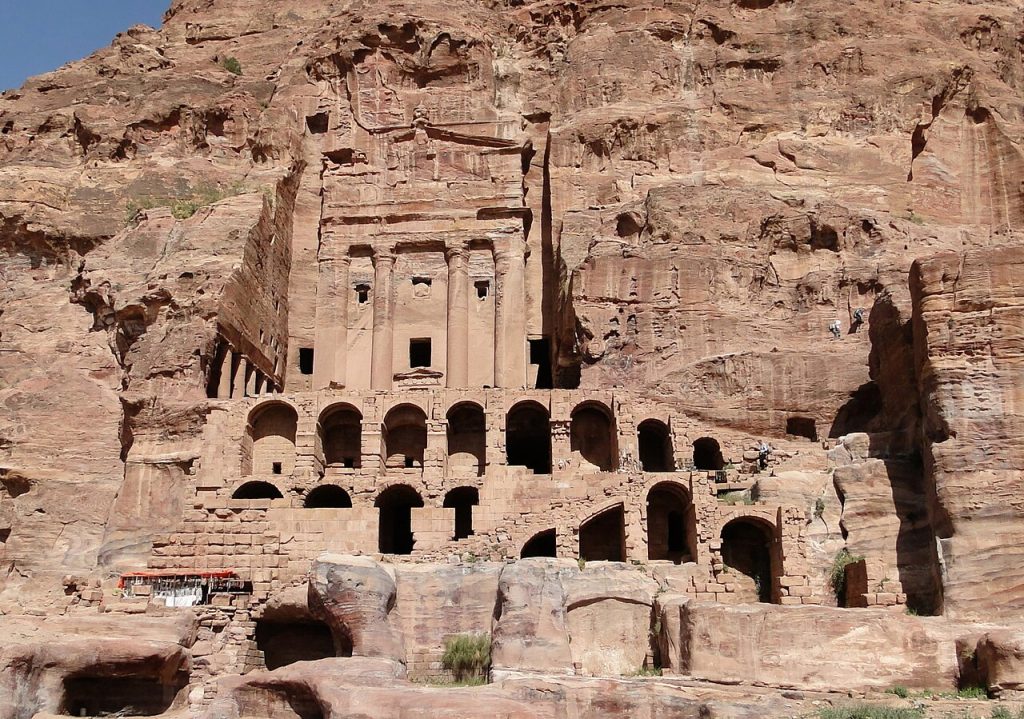
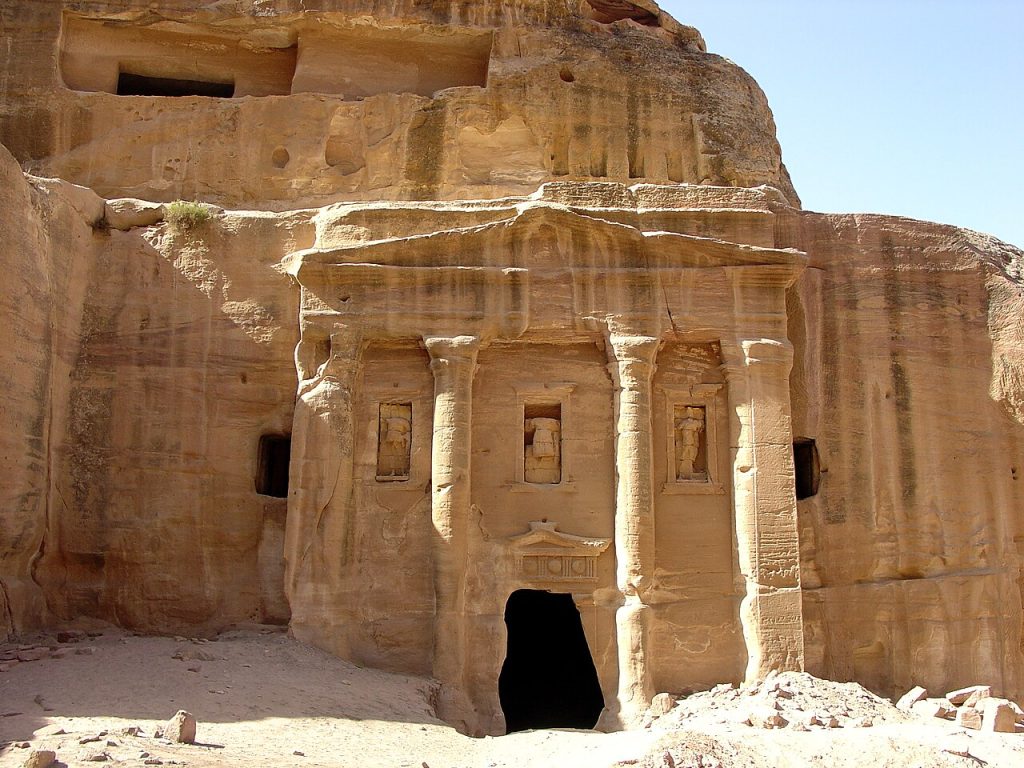
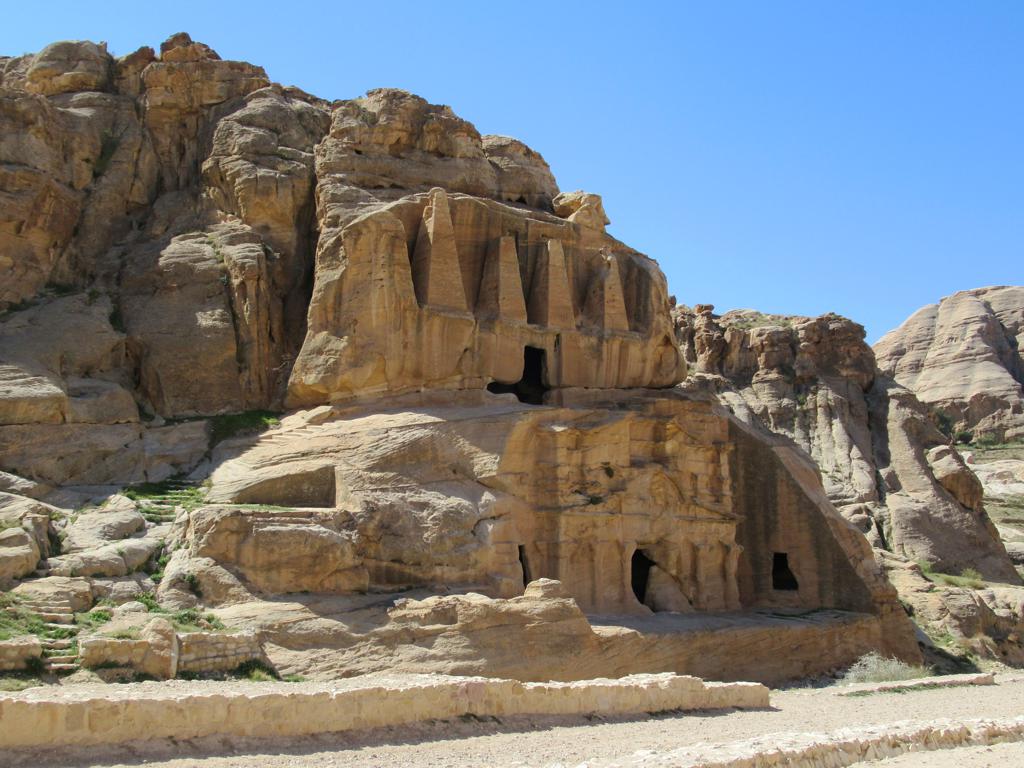
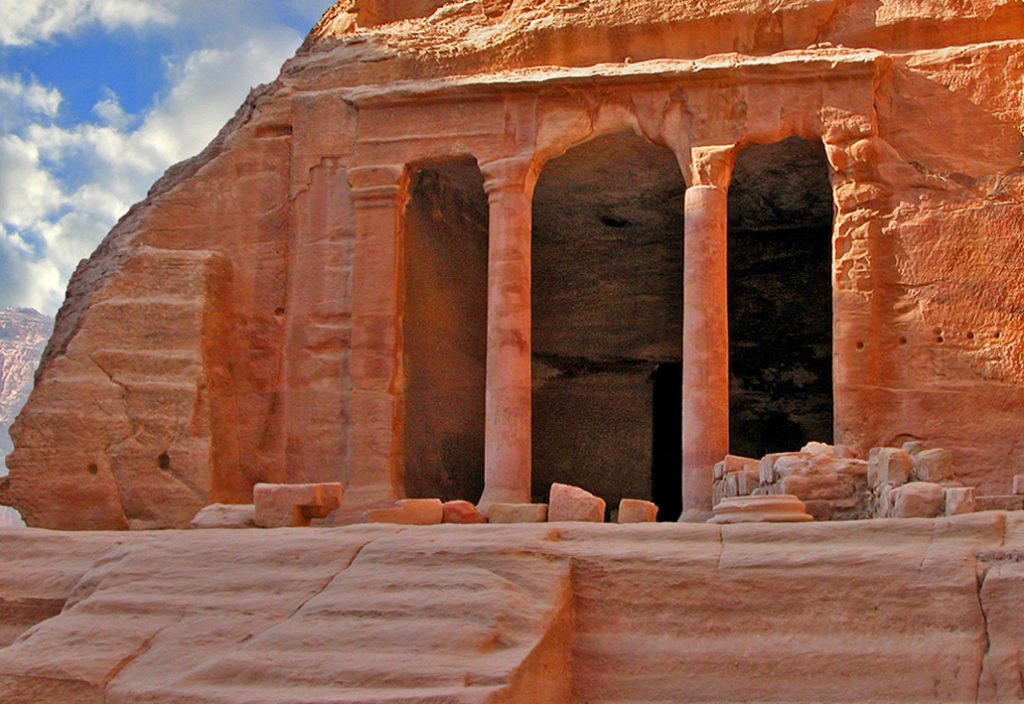
Beyond the Siq stretched a bustling city containing temples, markets, homes, workshops, gardens, administrative buildings, religious sanctuaries, and monumental tombs. Unlike many ancient cities built from blocks of stone, much of Petra was literally carved from the surrounding mountains.
Among its greatest monuments are the Royal Tombs, a series of enormous burial complexes cut into towering cliffs overlooking the city. Their richly decorated façades combine Nabataean traditions with Hellenistic architectural styles inspired by Alexandria and other Mediterranean cities.
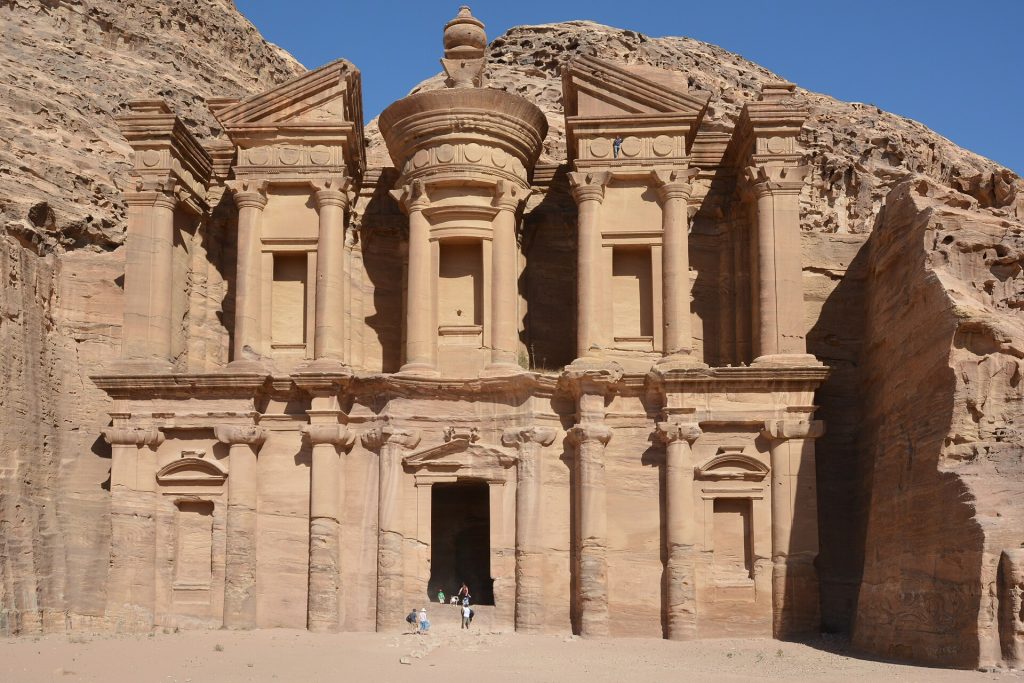
Farther uphill stands Ad Deir, commonly known as The Monastery. Larger than the Treasury, its façade rises almost fifty meters high and dominates the surrounding landscape. Although its modern name reflects its later use by Christian monks during the Byzantine period, it originally served as an important Nabataean religious monument dedicated to the deified king Obodas I.
Petra also contained a massive theater capable of seating approximately 8,500 spectators. Unlike Roman theaters built with masonry, Petra’s theater was carved almost entirely into solid rock, demonstrating once again the extraordinary skill of Nabataean stoneworkers.
Throughout the city stood temples, ceremonial plazas, colonnaded streets, public fountains, baths, and administrative buildings. Together they reveal that Petra was not simply a collection of tombs but a sophisticated urban center that rivaled many of the greatest cities of the ancient world.
Masters of Water Engineering
Petra’s greatest achievement was not its monumental architecture but its remarkable ability to survive in one of the driest regions of the Middle East. Annual rainfall was unpredictable, and flash floods could transform peaceful valleys into violent torrents within minutes. Most ancient settlements would have struggled under such conditions, but the Nabataeans turned nature into an advantage.
They built an extraordinary hydraulic system that collected rainwater from surrounding mountains before it disappeared into the desert. Dams slowed destructive floods, while channels carved into the rock carried water toward reservoirs and underground cisterns. Ceramic pipes distributed fresh water throughout the city, supplying homes, gardens, baths, fountains, and public buildings.
This engineering allowed Petra to support a population estimated at around 20,000 inhabitants during its peak in the first century AD—an astonishing achievement for a city surrounded by desert. Water was so carefully managed that visitors often described Petra as an oasis filled with pools, gardens, fruit trees, and flowing fountains, standing in sharp contrast to the barren landscape outside its walls.
The Nabataeans understood that controlling water meant controlling life itself. Their hydraulic system became one of the greatest engineering accomplishments of the ancient world and played a decisive role in Petra’s prosperity.
Religion and Everyday Life
Religion occupied a central place in Nabataean society. Unlike the Greeks or Romans, who represented their gods through realistic human statues, the Nabataeans often worshipped deities using simple stone blocks known as baetyls, which symbolized divine presence.
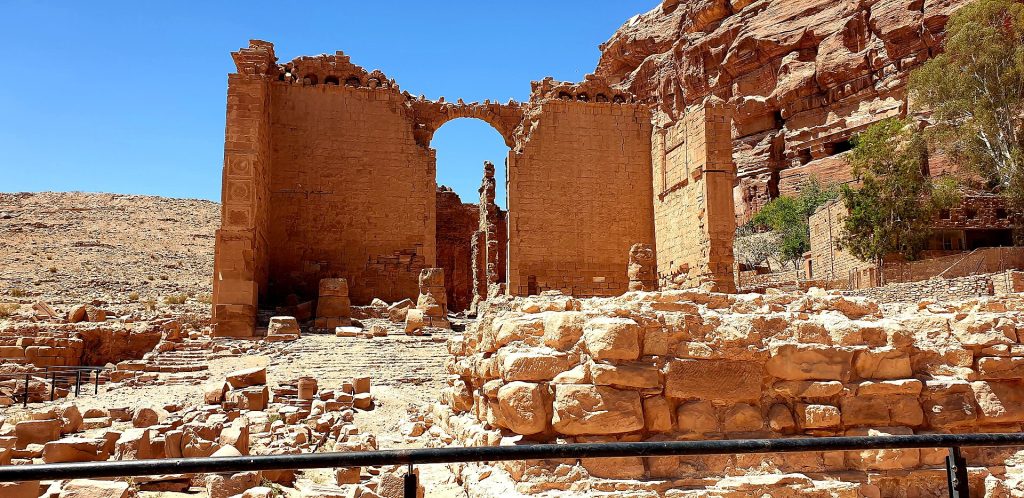
The chief god of Petra was Dushara, protector of the Nabataean kingdom, while important female deities included Al-‘Uzza, Allat, and Manat. Temples dedicated to these gods stood throughout the city, and many religious ceremonies took place on elevated platforms overlooking Petra.
One of the largest religious structures was the Great Temple, located near the city’s central colonnaded street. Although its exact purpose remains debated, archaeological excavations have revealed a monumental complex featuring impressive columns, ceremonial staircases, and richly decorated interiors. Nearby stood the Temple of the Winged Lions, another important sanctuary dating to the reign of King Aretas IV.
Daily life in Petra reflected the city’s cosmopolitan nature. Merchants from Arabia, Egypt, Syria, Mesopotamia, and the Mediterranean regularly visited its markets. Goods from three continents changed hands in its streets, making Petra one of the most international cities of the ancient world. The Nabataeans spoke Arabic but wrote using an Aramaic-derived script, while Greek later became widely used for trade and administration.
Roman Conquest
In AD 106, the independent Nabataean Kingdom came to an end when the Roman Emperor Trajan annexed its territory without significant resistance. Petra became part of the new Roman province of Arabia Petraea, marking a new chapter in the city’s history.
Contrary to what might be expected, Roman rule did not immediately lead to decline. Instead, Petra continued to prosper for several decades. The Romans improved roads, expanded trade connections, and integrated the city into their vast imperial network. The famous Via Traiana Nova, completed during Trajan’s reign, connected Petra with Syria and the Red Sea, strengthening commercial links across the eastern provinces.
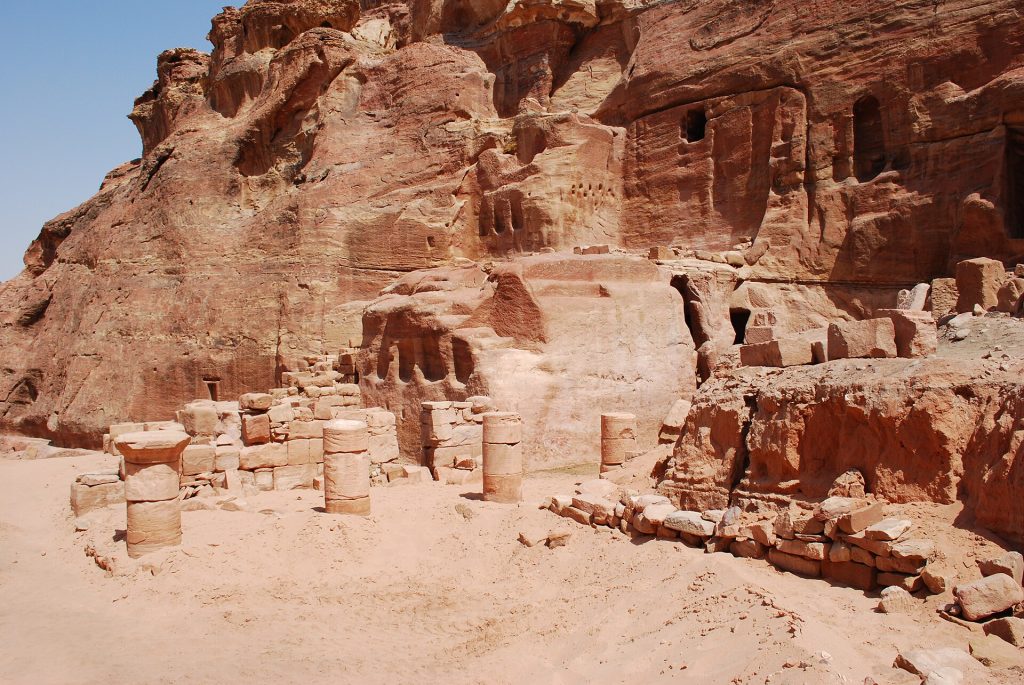
Roman influence introduced new architectural styles while preserving much of the city’s Nabataean character. Temples continued to function, merchants remained active, and monumental construction persisted. Greek and Roman artistic elements blended with traditional Nabataean architecture, producing the distinctive appearance that visitors admire today.
The Beginning of Decline
Petra’s fortunes changed gradually rather than suddenly.
During the third century AD, maritime trade expanded rapidly across the Red Sea. Ships transporting spices and luxury goods increasingly bypassed traditional overland caravan routes, reducing Petra’s importance as a commercial crossroads. As trade shifted toward coastal ports, the city’s economy weakened.
A devastating earthquake in AD 363 accelerated this decline. Many temples, public buildings, roads, and sections of the water management system suffered severe damage. Although parts of Petra were rebuilt, the city never fully recovered its former prosperity.
During the Byzantine period, Christianity gradually replaced the traditional Nabataean religion. Several churches were constructed within the city, and some earlier monuments were adapted for Christian worship. Archaeologists have discovered mosaics, inscriptions, and hundreds of Byzantine papyri that reveal Petra remained inhabited well into the sixth century.
Nevertheless, its population continued to shrink. Political changes, declining trade, and repeated natural disasters slowly transformed the once-flourishing capital into a quiet provincial settlement.
A Lost City Rediscovered
Following the Muslim conquest of the Levant during the seventh century, Petra gradually disappeared from the major trade and political networks of the Middle East. Although small communities continued to live in the surrounding region, the once-great city slowly faded into obscurity. During the Crusader period in the twelfth century, several fortresses were built nearby, but Petra itself never regained its former importance. Eventually, only local Bedouin tribes knew the location of the ancient city, passing its existence down through generations.
For nearly six centuries, Petra remained virtually unknown to the Western world.
Its rediscovery came in 1812, when Swiss explorer Johann Ludwig Burckhardt traveled through the region disguised as an Arab pilgrim. Fluent in Arabic and familiar with local customs, Burckhardt convinced his guide that he wished to sacrifice a goat at the traditional tomb of the Prophet Aaron, located near Petra. During the journey, he was finally led through the narrow Siq and became the first European in modern times to describe the magnificent ruins.
Burckhardt immediately realized he had uncovered one of antiquity’s greatest lost cities. Although he could not remain long without attracting suspicion, his published account introduced Petra to European scholars and explorers. Artists, archaeologists, and travelers soon followed, fascinated by the city’s extraordinary architecture.
Archaeological Discoveries
Scientific excavation of Petra began during the late nineteenth and early twentieth centuries and continues today. Archaeologists have shown that the famous monuments visible to visitors represent only a small portion of the ancient city.
Excavations have uncovered temples, markets, luxurious residences, workshops, public baths, churches, gardens, roads, and sophisticated water systems hidden beneath centuries of sand and debris. Hundreds of inscriptions written in Nabataean, Greek, and Latin have provided valuable insight into the city’s political, economic, and religious life.
One of the most important discoveries occurred in 1993, when hundreds of Byzantine papyri were found inside a church near the Temple of the Winged Lions. These documents revealed that Petra remained an active administrative center well into the sixth century, long after many historians had believed the city was abandoned.
Modern technology continues to transform our understanding of Petra. Satellite imagery, drones, and ground surveys have identified previously unknown monuments, including a massive ceremonial platform discovered in 2016 just outside the city’s central area. Even today, archaeologists believe that significant portions of Petra remain buried beneath the desert.
Petra Today
Today, Petra is Jordan’s most famous historical site and one of the world’s greatest archaeological destinations. In 1985, UNESCO designated Petra a World Heritage Site, recognizing both its exceptional cultural significance and its remarkable relationship with the surrounding natural landscape. More than two decades later, in 2007, Petra was chosen as one of the New Seven Wonders of the World, bringing even greater international attention to the ancient city.
Each year, hundreds of thousands of visitors walk through the Siq, stand before the Treasury, climb to the Monastery, and explore the Royal Tombs. Yet tourism also presents challenges. Constant foot traffic, flash floods, erosion, earthquakes, and weathering threaten the fragile sandstone monuments. Conservation specialists from Jordan and around the world continue to develop new methods to preserve Petra for future generations while balancing the needs of tourism and archaeological research.
Legacy
Petra is far more than an ancient city carved into rock. It is the story of a civilization that transformed one of the harshest environments on Earth into a thriving center of trade, engineering, and culture. The Nabataeans achieved this not through military conquest but through commerce, innovation, and an extraordinary understanding of the desert landscape.
Its monumental façades remain among the finest examples of rock-cut architecture ever created, while its sophisticated water management system continues to impress engineers more than two thousand years later. Greek, Egyptian, Roman, and Arabian influences blended within Petra to create a civilization unlike any other in the ancient world.
Although kingdoms rose and fell, trade routes shifted, and earthquakes reduced much of the city to ruins, Petra never truly disappeared. Hidden for centuries within its rose-colored mountains, it survived as one of history’s greatest lost cities until the modern world rediscovered its extraordinary beauty.
Today, Petra stands not only as the symbol of Jordan but also as one of humanity’s greatest archaeological achievements—a timeless reminder that some of history’s most remarkable civilizations flourished in places where survival itself seemed almost impossible.
Вашият коментар