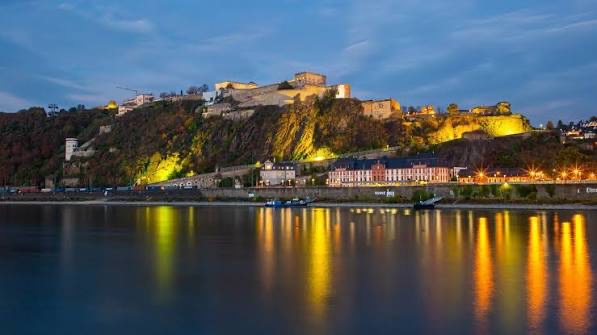
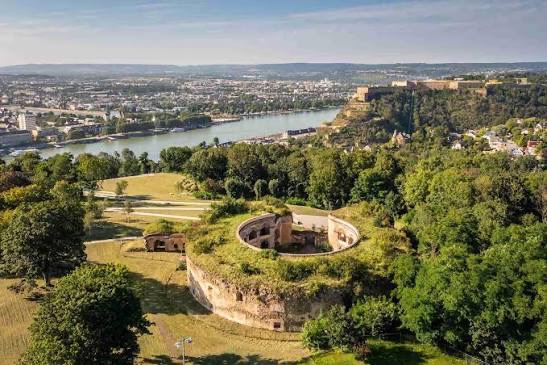
Towering high above the point where the Rhine and Moselle rivers meet, Ehrenbreitstein Fortress dominates the skyline of Koblenz like no other stronghold along the Rhine. Unlike the medieval castles scattered throughout the valley, this enormous fortress was built to control one of Europe’s most important strategic crossroads.
For more than a thousand years, rulers fought to possess this commanding hill. Emperors, archbishops, French armies, Prussian engineers, and even American soldiers all left their mark on Ehrenbreitstein, creating one of Germany’s most remarkable military landmarks.
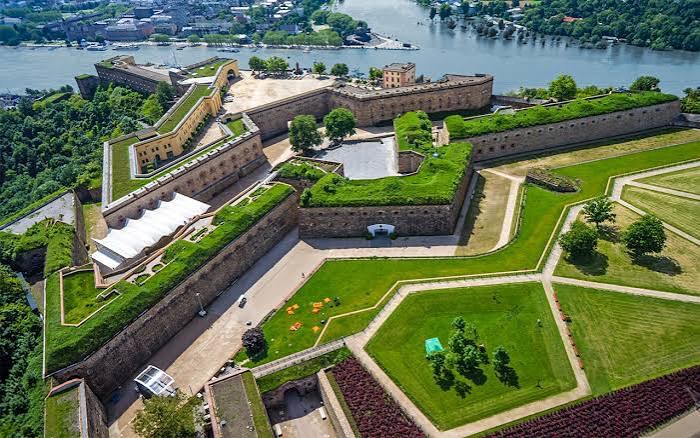
A Fortress with Ancient Roots
Long before the impressive fortress visitors see today existed, people recognized the strategic importance of this hill. Archaeological discoveries show that it was already inhabited during prehistoric times, while Roman forces later built fortifications overlooking the Rhine.
Around the year 1000, the nobleman Ehrenbert constructed the first medieval castle here. Over the following centuries, the powerful Archbishops of Trier expanded it into one of the strongest fortresses along the Rhine, protecting both their territories and one of the most important river crossings in Europe.
The Fortress That Defied Kings
Ehrenbreitstein became famous for its incredible defenses.
In 1688, during the Nine Years’ War, King Louis XIV of France attempted to capture the fortress. Despite the strength of the French army, the defenders successfully resisted the siege, proving why Ehrenbreitstein had earned its reputation as one of Europe’s strongest fortifications.
More than a century later, however, a new enemy arrived.
During the French Revolutionary Wars, Napoleon’s forces gradually surrounded the fortress. After a long siege that brought starvation to its defenders, Ehrenbreitstein finally surrendered in 1799. Rather than leave such a powerful fortress for their enemies, the French deliberately blew it up in 1801 before withdrawing from the east bank of the Rhine.
Prussia Builds a Giant
The destruction of the medieval fortress did not mark the end of Ehrenbreitstein.
Following the Congress of Vienna in 1815, the Rhineland became part of Prussia. Recognizing the strategic importance of Koblenz, the Prussian government decided to build an entirely new fortress on the same hill.
Constructed between 1817 and 1828, the new Ehrenbreitstein became the centerpiece of the vast Fortress Koblenzdefensive system. It was one of the largest military fortifications in Europe outside Gibraltar and could accommodate around 1,200 soldiers.
Remarkably, despite its enormous size and military importance, the Prussian fortress was never attacked.
The American General Who Saved the Fortress
After the First World War, many German fortifications were scheduled for demolition.
Ehrenbreitstein might have disappeared forever if not for General Henry Tureman Allen, commander of the American occupation forces in the Rhineland. Recognizing the fortress’s exceptional historical and architectural value, he successfully opposed its destruction in 1922.
Thanks to his decision, one of Germany’s greatest fortresses survived for future generations.
A Fortress Above Two Rivers
Today, Ehrenbreitstein is one of the highlights of any Rhine River journey.
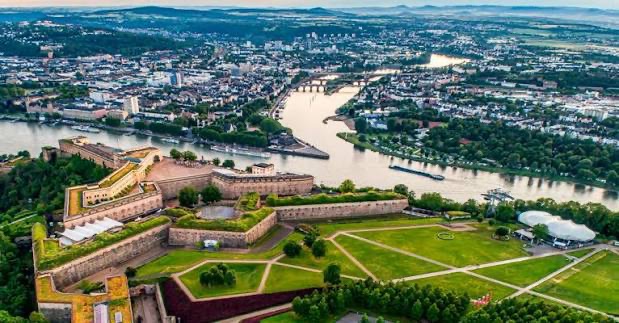
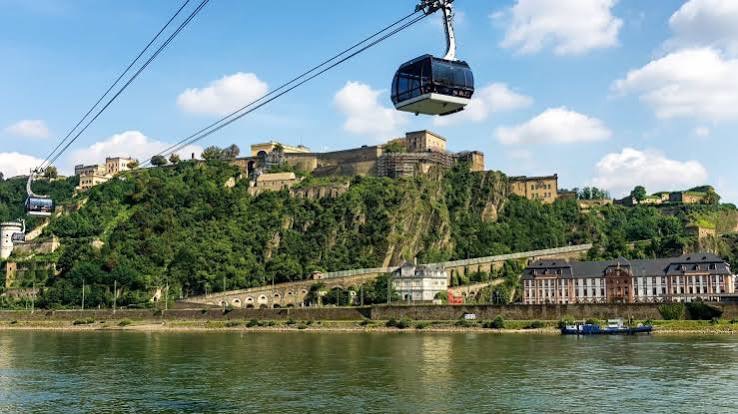
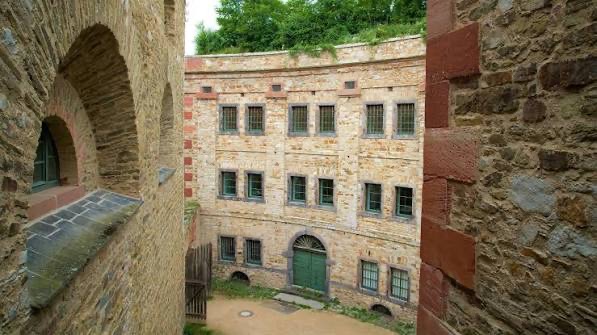
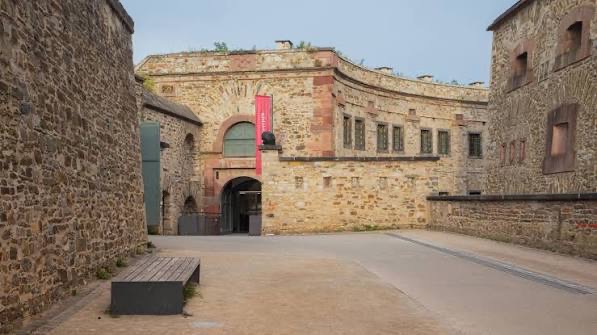
Visitors can reach the fortress by cable car crossing the Rhine from Koblenz or by an inclined lift climbing the hillside. Inside the massive walls are museums, exhibitions, restaurants, and panoramic terraces offering spectacular views of the German Corner, where the Rhine and Moselle rivers meet.
Since 2002, Ehrenbreitstein has been part of the UNESCO World Heritage Site Upper Middle Rhine Valley, preserving more than a thousand years of military history in one extraordinary location.
Unlike many Rhine castles remembered for medieval legends or royal romances, Ehrenbreitstein tells a different story—one of military engineering, international conflict, survival, and preservation. From Roman fortifications and Napoleon’s armies to an American general who helped save it, few places along the Rhine have witnessed so much history.
Вашият коментар