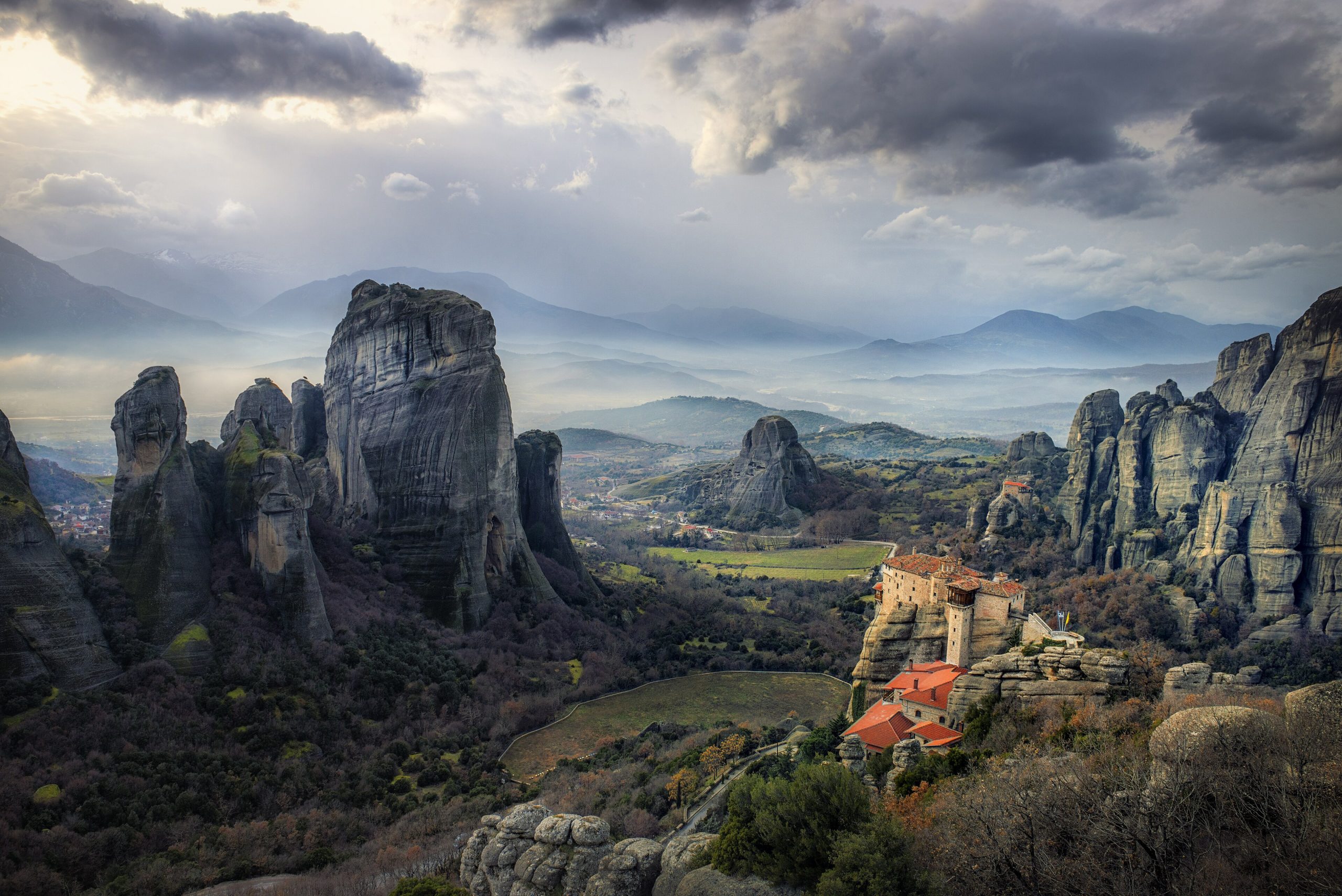
In the northwestern part of the Thessalian Plain, above the Greek towns of Kalabaka and Kastraki, a forest of enormous stone pillars rises abruptly from the earth. Some stand alone like towers, while others form vast walls of grey rock marked by caves, fissures and narrow ledges. On several of their summits appear monasteries that seem almost detached from the landscape below. This is Meteora, one of the most remarkable meeting points of geology, architecture and Orthodox Christian history.
The name comes from the Greek word meteoros, meaning “raised from the ground,” “lofty” or “suspended in the air.” It describes not only the appearance of the rocks but also the spiritual purpose of the communities that settled upon them. For medieval monks seeking silence, discipline and distance from worldly life, the inaccessible heights offered both physical protection and a powerful symbol of ascent toward God.
Meteora was not created in a single period and cannot be understood merely as a group of picturesque buildings. Its history stretches from prehistoric human occupation in the surrounding region to the formation of a major monastic centre during the late Byzantine period. The surviving monasteries are the remains of a much larger religious landscape that once included hermit caves, chapels, wooden ladders, rope systems and dozens of monastic foundations scattered across the rocks.
A Landscape Formed Over Millions of Years
Long before monks reached the summits, natural forces created the extraordinary setting that made their way of life possible. The rocks of Meteora consist mainly of conglomerate: a hardened mixture of pebbles, gravel, sand and finer sediment. These materials were deposited millions of years ago by rivers flowing into an ancient basin or delta.
As geological movements raised the region, the former deposits became exposed. Water entered cracks in the rock, while rain, wind, changes in temperature and erosion gradually removed the softer material. Over immense periods of time, these processes separated the rock mass into the steep pillars visible today.
The formations are often casually described as sandstone cliffs, but this is incomplete. Their composition is more complex and includes thick beds of conglomerate bound together by finer material. Their rounded surfaces, narrow towers and near-vertical walls are the product of erosion acting along natural fractures in the stone.
Some of the peaks rise hundreds of metres above the surrounding plain. Their dramatic isolation gave later inhabitants both security and seclusion. Yet the rocks were never completely separated from human history. The broader region contains evidence of settlement dating back tens of thousands of years.
Human Life Before the Monasteries
A few kilometres from Meteora lies the Cave of Theopetra, one of the most important prehistoric sites in Greece. Archaeological research has uncovered traces of human activity extending from the Middle Palaeolithic into the Neolithic period. The site is especially valuable because it preserves evidence of major transformations in human history, including the transition from hunter-gatherer communities to settled agricultural life.
Among its discoveries is an ancient stone barrier constructed near the cave entrance, probably to reduce exposure to cold winds. Its precise interpretation and dating have attracted considerable attention, but the structure demonstrates that prehistoric people actively modified their environment for protection.
The cave should not be confused with the medieval monastic complex itself. There is no direct continuous line connecting its prehistoric occupants to the later monks. Nevertheless, it proves that the landscape around Meteora provided shelter, water and strategic advantages long before Christian ascetics arrived.
Meteora is largely absent from the famous myths and literary accounts of classical Greece. Its international importance developed much later, during the Christian and Byzantine periods, when withdrawal into isolated places became an established form of religious devotion.
The Arrival of the First Hermits
The earliest monks of Meteora did not begin by constructing large monasteries. They lived as hermits in natural caves, hollows and narrow shelters among the rocks. Greek cultural authorities date the first securely identifiable traces of organised ascetic life in the area to around the eleventh century, although local traditions sometimes place hermits there earlier.
These early ascetics sought hesychia—inner stillness achieved through solitude, prayer and spiritual discipline. They occupied caves that were difficult to reach and possessed few material comforts. Their lives depended partly on the surrounding population, which supplied food and other necessities.
At first, many hermits lived independently. Gradually, however, they formed a loose religious community. By the late eleventh or early twelfth century, a monastic settlement known as the Skete of Stagoi had emerged. Its religious centre was connected with the Church of the Virgin Mary at the foot of the rocks and with the chapel of the Virgin at Doupiani.
A skete represented a form of monastic organisation between complete isolation and communal monastery life. Individual ascetics could remain in separate cells or caves while gathering for worship on Sundays and important feast days. This pattern allowed them to preserve solitude without abandoning a shared religious identity.
Saint Athanasios and the Founding of Great Meteoron
The decisive transformation of Meteora began in the fourteenth century. During this period, the Byzantine world was weakened by civil wars, political fragmentation, economic difficulties and expanding Serbian and Ottoman power in the Balkans. Thessaly passed through the control of competing rulers, while monasteries and local communities searched for stability amid uncertainty.
Around the middle of the century, the monk Athanasios arrived from Mount Athos, the great centre of Orthodox monasticism in northern Greece. He was later known as Athanasios the Meteorite. With a group of followers, he established a community on the largest rock, then called Platys Lithos, or the Broad Rock.
Athanasios is traditionally credited with giving the place the name Meteora. On the summit, he founded the monastery now known as Great Meteoron or the Monastery of the Transfiguration. Its establishment during the fourteenth century marked a transition from scattered hermit life to organised communal monasticism.
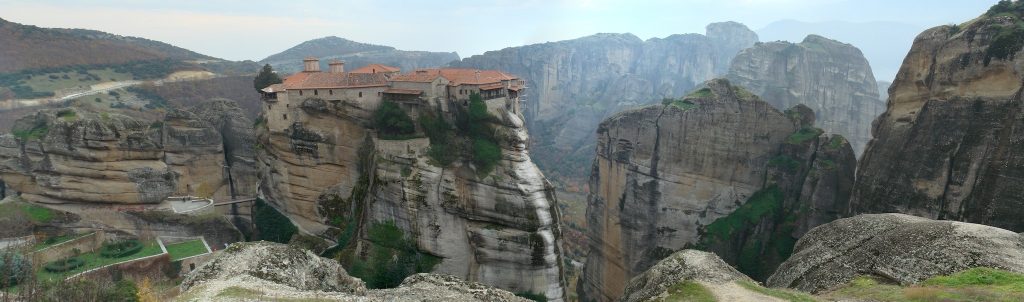
The monastery was not created instantly as the large architectural complex seen today. It began as a small community with basic religious buildings and monastic cells. Later generations expanded it, rebuilt churches, added a refectory, kitchens, storage areas, workshops and facilities for caring for elderly or sick monks.
A major figure in this development was John Uroš, the son of the Thessalian ruler Simeon Uroš. John abandoned political life, became a monk under the name Joasaph and joined the community at Great Meteoron. His status and resources helped strengthen the monastery. Under Athanasios and Joasaph, Great Meteoron became the leading institution of the Meteora complex.
The rise of Meteora was therefore shaped not simply by fear of Ottoman conquest but by several forces at once: an existing ascetic tradition, the influence of Mount Athos, political instability, elite patronage and the desire to establish a disciplined monastic community in an exceptionally isolated environment.
Why the Monasteries Were Built on the Rocks
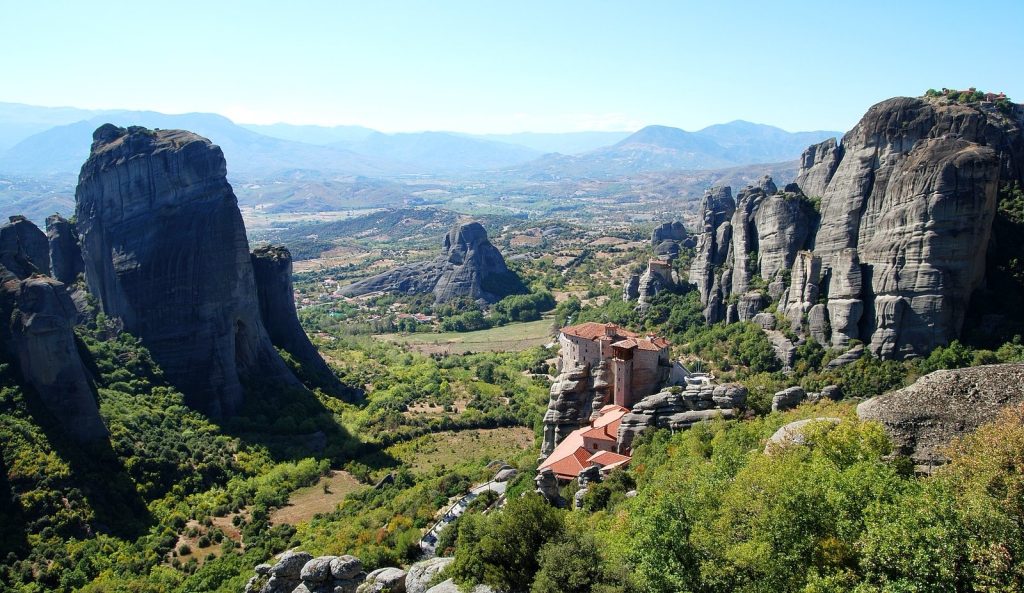
The high summits offered obvious defensive advantages. A monastery accessible only by a ladder or rope could be protected from raiders, robbers and political violence. During periods of instability, the cliffs provided a level of security rarely available to settlements on the open Thessalian Plain.
Yet defence alone does not explain Meteora. In Orthodox monastic thought, separation from ordinary society could serve a spiritual purpose. Difficult access discouraged casual visitors, limited distractions and reinforced the monks’ rejection of material comfort. The physical ascent to the monastery reflected an inward struggle toward spiritual elevation.
The rocks also allowed the monastic communities to control entry. Wooden ladders could be raised, while ropes, nets and baskets were used to transport people, food and building materials. The familiar story that ropes were replaced only when they broke “by the will of God” is widely repeated, but it is better treated as a colourful monastic tradition than as a literal rule supported by firm historical evidence.
Constructing the monasteries required extraordinary effort. Timber, stone, lime, water, food and tools had to be carried or hoisted upward. Workmen and monks operated in confined spaces with steep drops on every side. The buildings were carefully fitted to irregular summits, which explains why many monasteries appear to grow directly from the rocks.
The Growth of a Great Monastic Centre
During the late fourteenth, fifteenth and especially sixteenth centuries, Meteora developed into one of the most important Orthodox monastic centres in Greece. Historical tradition generally identifies about twenty-four monasteries at the height of the community, although not all existed at exactly the same moment or possessed equal size and status.
This was a period of expansion despite the Ottoman conquest of Thessaly. Ottoman rule did not automatically end Orthodox monastic life. In many parts of the empire, monasteries retained property, received donations and continued to function, although their position depended on local conditions, taxation, legal privileges and relations with the authorities.
Meteora benefited from gifts made by rulers, church officials, wealthy families and pilgrims. Its monasteries acquired manuscripts, icons, liturgical vessels, embroidered textiles and sacred relics. They also possessed agricultural property in the surrounding region, which helped support their communities.
The sixteenth century became a period of architectural and artistic renewal. Existing monasteries were enlarged, while churches were rebuilt and decorated with elaborate frescoes. The influence of the monastic traditions of Mount Athos remained strong, but Meteora developed its own distinct landscape and identity.
The monasteries were not merely refuges occupied by frightened men hiding above the plain. They were organised religious institutions with rules, libraries, workshops, estates and connections extending across the Orthodox Balkans.
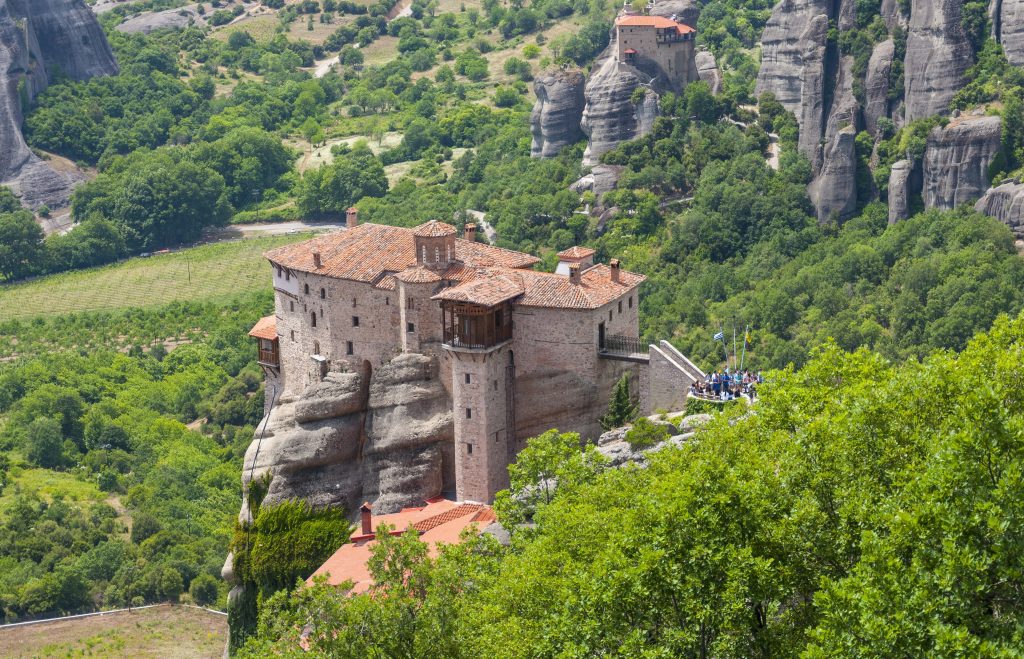
Great Meteoron: The Centre of the Monastic Community
Great Meteoron is the largest and historically most influential of the surviving monasteries. Dedicated to the Transfiguration of Christ, it occupies the Broad Rock and preserves structures representing several phases of construction.
Its principal church, or katholikon, assumed its present form largely during the sixteenth century. The interior contains significant examples of post-Byzantine religious painting. Frescoes depict scenes from the life and Passion of Christ, saints, martyrs and major events in Christian tradition.
The complex also contains a refectory, monastic cells, a kitchen, chapels, storage spaces and rooms that now display manuscripts and ecclesiastical objects. These structures reveal that a monastery was a complete living environment rather than simply a church placed on a cliff.
Great Meteoron’s importance came from its connection with Athanasios and Joasaph, its extensive property and its position at the head of the Meteora community. Its growth helped establish the model followed by later monasteries.
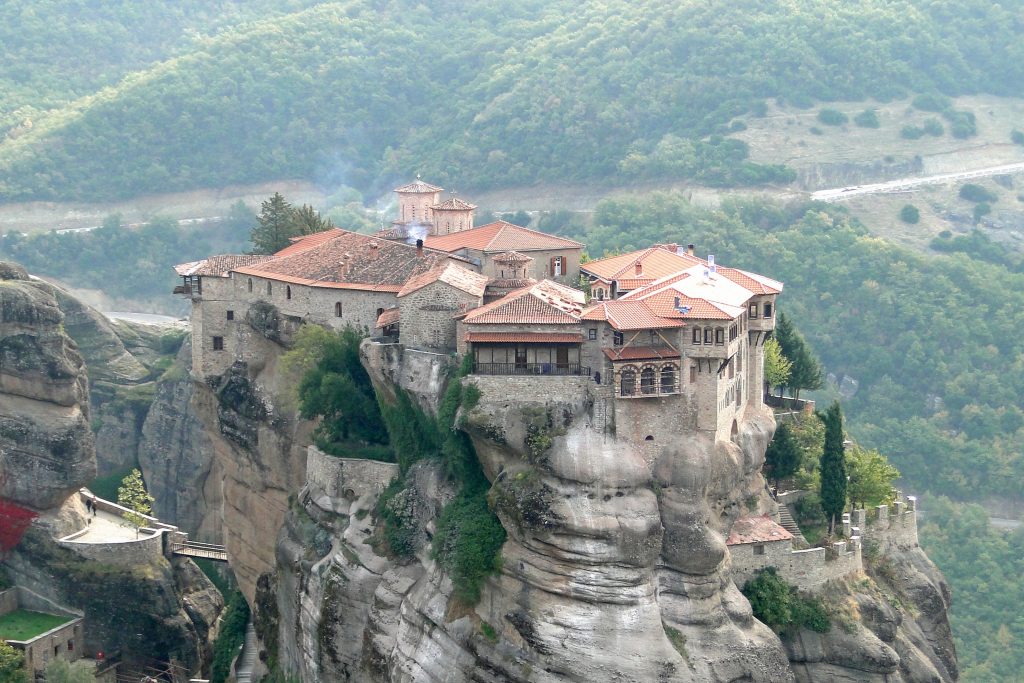
Varlaam and the Achievement of Sixteenth-Century Builders
The Monastery of Varlaam stands on another immense rock near Great Meteoron. According to tradition, the first hermit to occupy the summit was a monk named Varlaam during the fourteenth century. After his death, the site was largely abandoned.
Its revival came in the early sixteenth century through the brothers Theophanes and Nektarios Apsarades, monks from a prominent family of Ioannina. They rebuilt the community and oversaw the construction of major buildings, including the church dedicated to All Saints.
Materials had to be lifted to the summit over many years before large-scale building could begin. Varlaam preserves an old lifting tower and equipment associated with the transportation of supplies. These remains help visitors understand the enormous practical challenges of maintaining life on the rocks.
The monastery became an important centre of art, learning and worship. Its surviving frescoes, manuscripts and religious objects reflect the prosperity of Meteora during the sixteenth century.
Rousanou, Saint Nicholas and the Artistic Flowering of Meteora
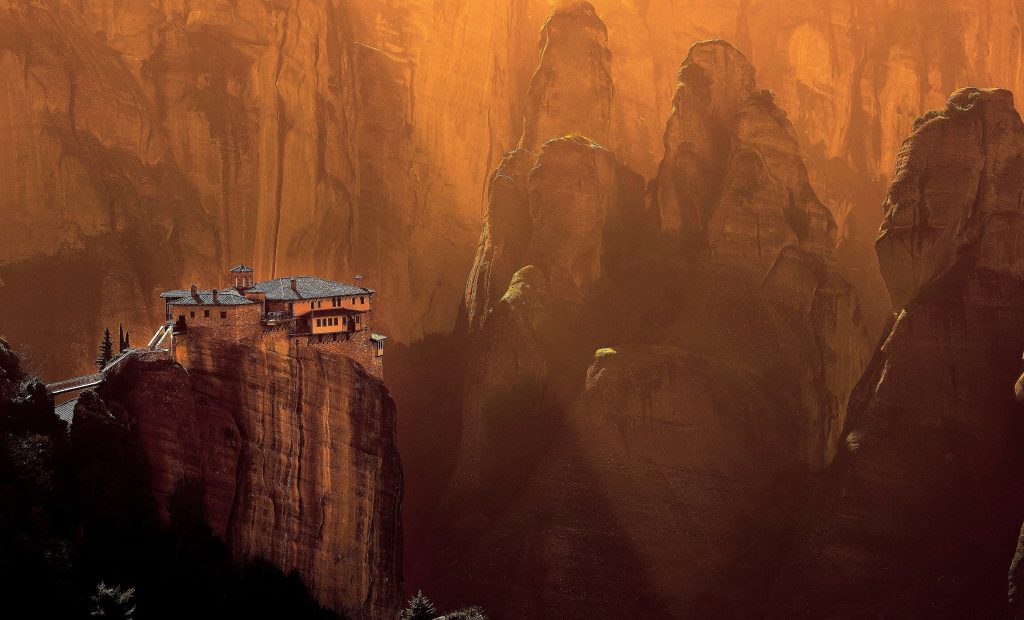
The Monastery of Rousanou occupies almost the entire summit of a relatively narrow rock. Its early history is uncertain, and the origin of its name has never been established conclusively. The present complex was largely developed during the sixteenth century.
Its compact architecture differs from the more spacious layout of Great Meteoron. The limited surface required its buildings to rise in several levels, producing the impression of a single structure balanced above the valley. The monastery is dedicated to the Transfiguration, while Saint Barbara is also particularly honoured there. It is now a convent inhabited by nuns.
The Monastery of Saint Nicholas Anapafsas was also adapted to a very small summit. Because horizontal expansion was impossible, its buildings were arranged vertically. Different functions occupy successive floors connected by internal stairways.
Its artistic importance is exceptional. The church was decorated in 1527 by Theophanes Strelitzas, also known as Theophanes the Cretan, one of the leading painters of the post-Byzantine period. His work at Saint Nicholas helped establish artistic forms that later appeared at Mount Athos and elsewhere in the Orthodox world.
The monastery’s name is sometimes interpreted as referring to rest or refreshment, perhaps because it served as an early stopping place for pilgrims entering the monastic landscape. The explanation is plausible but not completely certain.
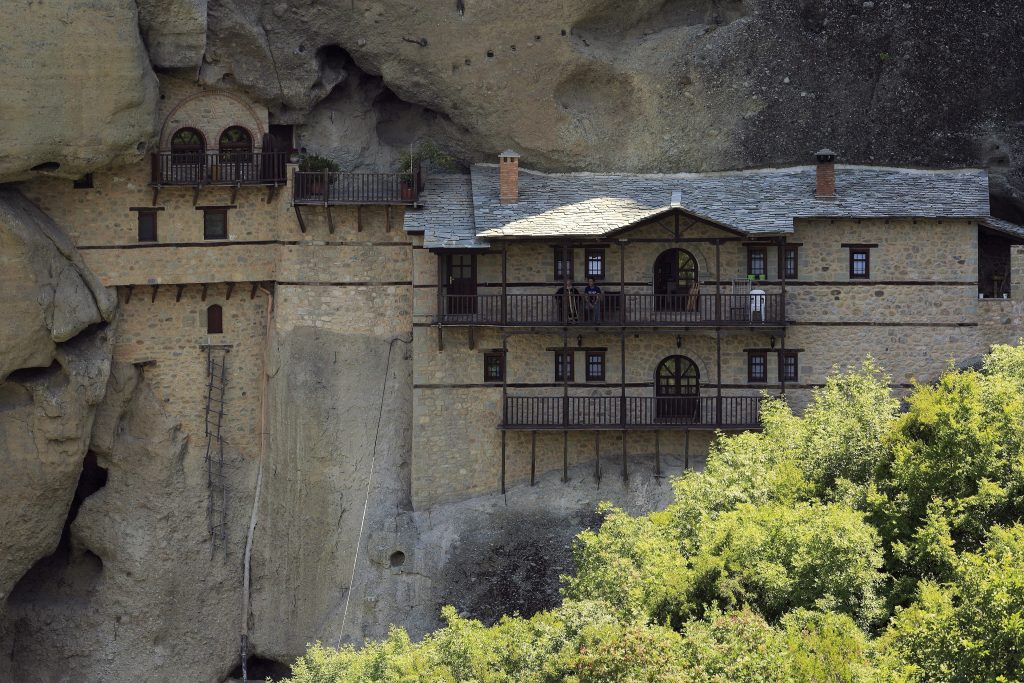
Holy Trinity and Saint Stephen
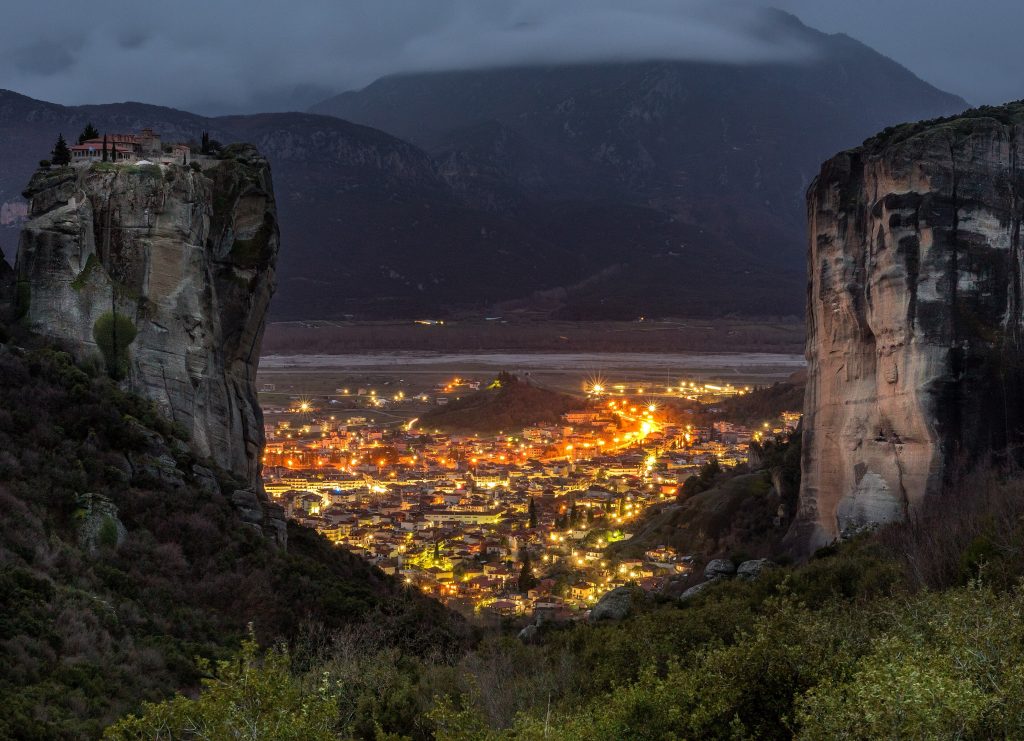
The Monastery of the Holy Trinity occupies one of Meteora’s most dramatic and isolated peaks. Its foundation is generally placed in the later fifteenth century, although earlier ascetic occupation may have existed on the rock.
For centuries, access depended on ladders and lifting devices. A staircase cut into the rock during the early twentieth century made entry less dangerous, but reaching the monastery still requires a demanding ascent. Its isolated appearance has made it one of the most recognisable images of Meteora.
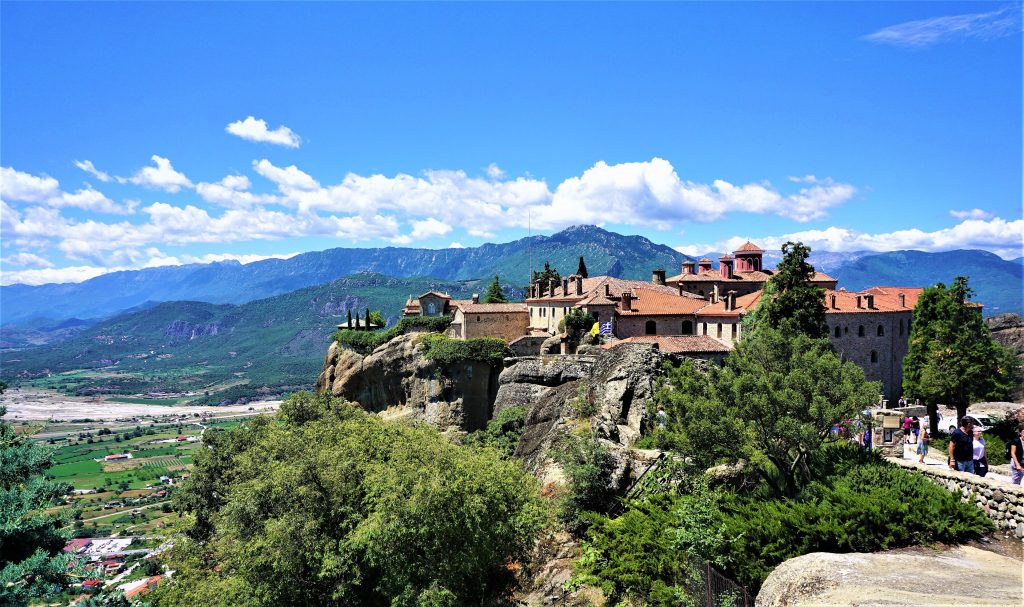
The Monastery of Saint Stephen differs from most of the others because it stands on a broad rock reached today by a small bridge rather than a long staircase. Monastic tradition connects the site with earlier hermits, but its surviving buildings developed over several centuries.
Saint Stephen suffered serious damage and losses during the twentieth century, particularly in wartime and the troubled years that followed. In 1961, it was transformed into a convent. A community of nuns restored the buildings, preserved religious objects and revived spiritual life at the site.
Together with Rousanou, Saint Stephen represents the continuing presence of women’s monasticism at Meteora.
Isolation, Discipline and Daily Life
Life in a Meteora monastery followed the rhythms of Orthodox worship. The day was organised around prayer services, communal meals, manual labour, reading and private contemplation. Monks copied or preserved manuscripts, painted icons, maintained buildings, cultivated property and welcomed pilgrims.
The environment demanded strict cooperation. Water was especially valuable. Rainwater was collected in cisterns cut or constructed within the rock. Food and fuel had to be brought from below, while gardens were limited by the small area available on the summits.
The monasteries were connected to the surrounding towns and villages more closely than their dramatic isolation suggests. Local residents supplied labour, food and transport. Monastic estates in the plain provided agricultural income. Pilgrims, donors and church officials created a regular flow of people and resources between the cliffs and the outside world.
The monks therefore lived apart from society without being completely independent of it. Their survival depended on a carefully maintained relationship between isolation and exchange.
Decline and Abandonment
From the seventeenth century onward, Meteora entered a long period of decline. Several factors contributed to this process. Economic difficulties reduced donations and income. Smaller communities struggled to maintain buildings exposed to storms, earthquakes, moisture and erosion. Some monasteries suffered from fire, looting or violent conflict. Others simply lost their inhabitants.
As populations declined, roofs collapsed and wooden structures decayed. Once a monastery was abandoned, the difficulty of reaching it made repairs almost impossible. Many foundations gradually became ruins, leaving behind fragments of walls, chapels, cisterns and carved steps.
The decline was uneven. Great Meteoron, Varlaam and several other houses continued to function, while smaller monasteries disappeared. The surviving six are therefore not the whole of Meteora but the remains of a much larger sacred landscape.
Political change also affected the region. Thessaly became part of the modern Greek state in 1881. New roads, administrative structures and growing interest in archaeology and national heritage slowly altered the way Meteora was understood.
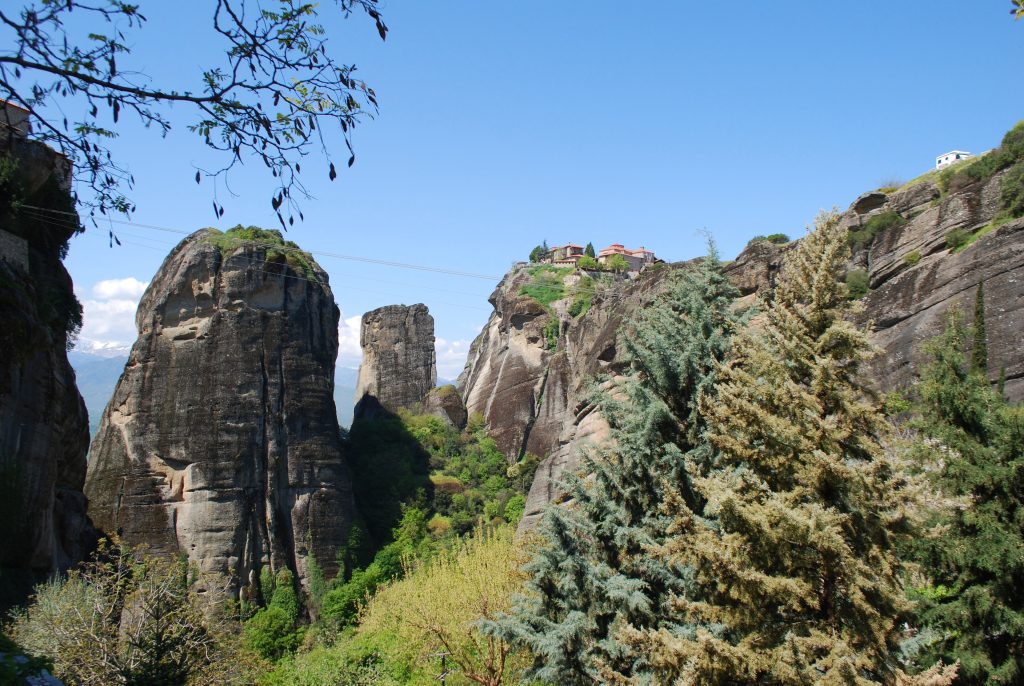
From Ladders and Nets to Roads and Staircases
For centuries, the dangerous methods of access were central to the identity of Meteora. Visitors and supplies were lifted in nets, baskets or wooden platforms controlled by ropes and pulleys. Long removable ladders also connected some summits to the paths below.
During the early twentieth century, especially in the 1920s, staircases and bridges were constructed or improved. These changes made the monasteries safer and more accessible. Roads eventually allowed vehicles to approach the main sites.
Improved access helped save Meteora by making restoration and tourism possible. At the same time, it altered the traditional monastic environment. The cliffs that had once guaranteed silence and separation began receiving growing numbers of visitors.
This tension remains central to Meteora today. The monasteries are living sacred communities, but they are also internationally famous cultural monuments and major tourist destinations.
War, Destruction and Restoration
The twentieth century brought serious dangers. During the Second World War and the occupation of Greece, the region experienced violence, shortages and military activity. Individual monasteries were damaged, looted or deprived of valuable objects. Some monks and local inhabitants became involved in relief efforts or sheltered people endangered by the conflict.
Damage and abandonment continued in the difficult post-war period. Yet the century also saw major restoration campaigns. Monastic communities, the Greek state, archaeologists and conservation specialists worked to stabilise buildings, preserve frescoes and improve access.
Restoration has not meant returning Meteora to a single imagined medieval form. The monasteries contain structures from different centuries, and conservation must protect this complex history while allowing the communities to continue their religious life.
The Six Surviving Monasteries
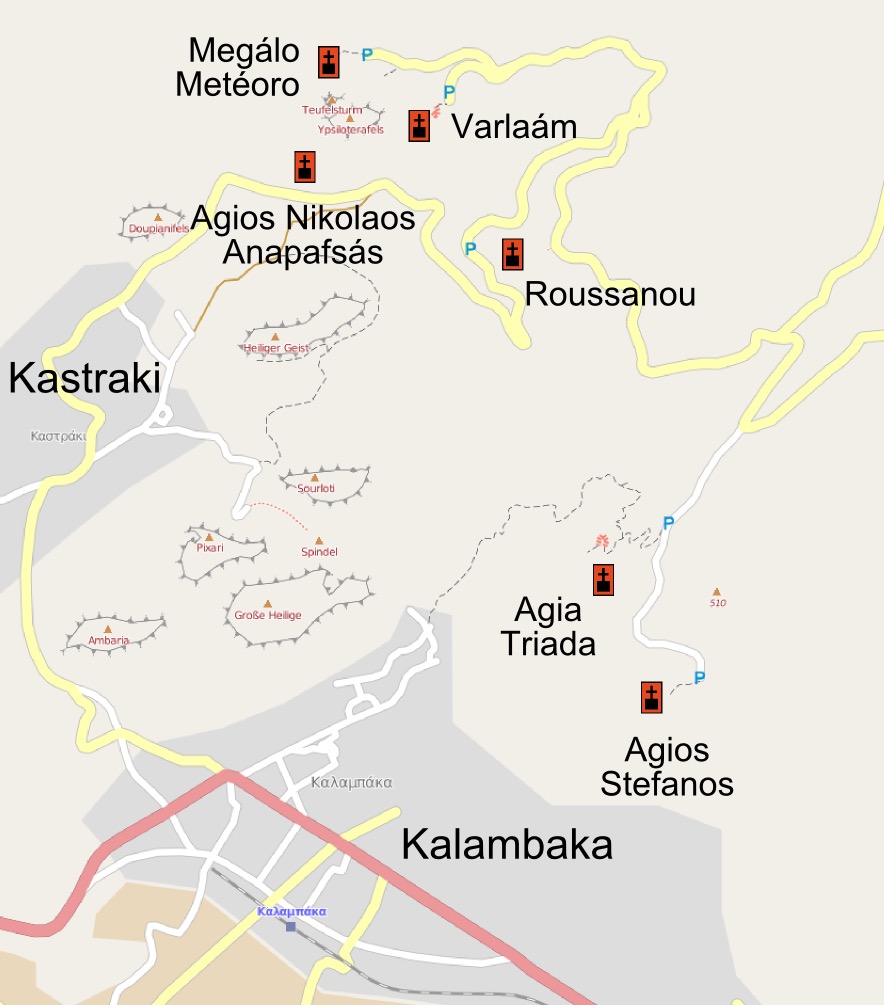
Today, six principal monasteries remain active and accessible: Great Meteoron, Varlaam, Rousanou, Saint Nicholas Anapafsas, Holy Trinity and Saint Stephen. Four are inhabited by monks and two—Rousanou and Saint Stephen—by communities of nuns.
The number of residents is far smaller than during the height of Meteora. Nevertheless, describing the sites as empty monuments would be misleading. Religious services continue, feast days are celebrated and the monasteries remain part of the Greek Orthodox Church.
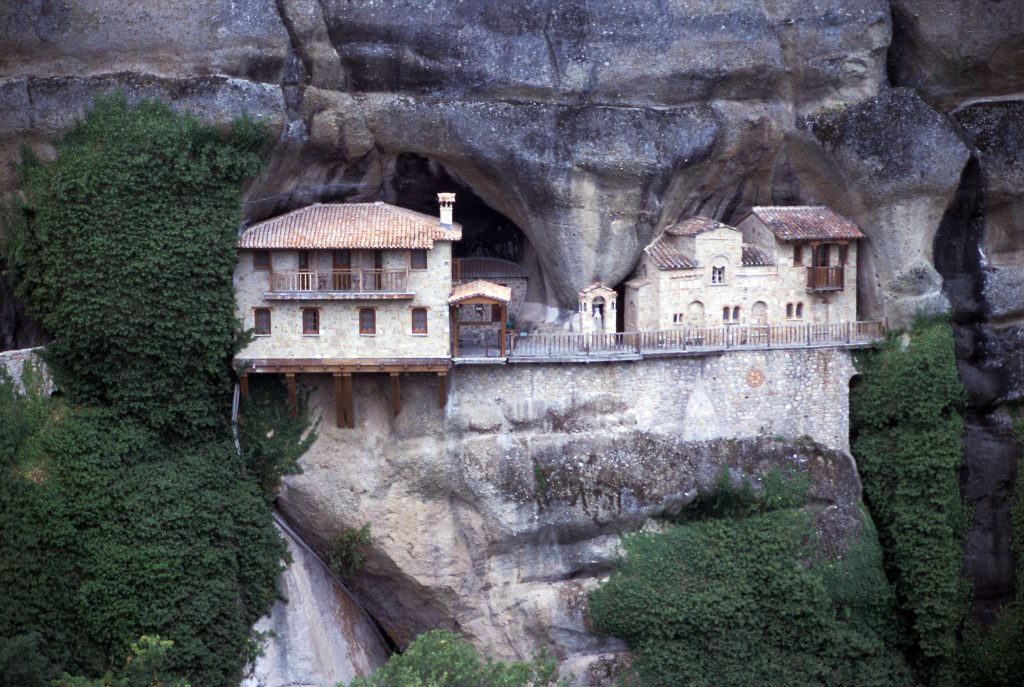
Beyond these six are numerous ruined foundations, caves, hermitages and chapels. Sites such as Ypapanti, Doupiani and the abandoned rock shelters preserve evidence of forms of monastic life that were older, smaller and often more austere than the great surviving monasteries.
Meteora as a UNESCO World Heritage Site
In 1988, Meteora was inscribed on the UNESCO World Heritage List. Its recognition is unusual because it is based on both cultural and natural values.
UNESCO considers the monasteries an outstanding artistic and architectural achievement. Their construction on nearly inaccessible peaks created a union between human design and geological form that has few parallels. The frescoes also contributed to the development of post-Byzantine religious painting.
The natural landscape is equally important. The towering formations, sculpted by geological and climatic processes, possess exceptional beauty. Meteora is therefore not simply a group of historic buildings placed within attractive scenery. The rocks and monasteries form a single cultural landscape in which natural form shaped religious life and human activity transformed the meaning of the environment.
Its protected status also reflects the need to balance conservation, monastic practice, tourism and development. Excessive traffic, erosion, uncontrolled construction, fire and the physical pressure of large visitor numbers can threaten the character of the site.
Myth and Reality at Meteora
Meteora’s appearance has encouraged romantic stories. It is often described as a place where monks fled from Ottoman armies and built monasteries that no enemy could reach. This contains an element of truth but oversimplifies the history.
Political insecurity encouraged settlement on the rocks, and their height offered protection. Yet ascetics had already inhabited the area before the Ottoman conquest. The major communities also survived and sometimes prospered under Ottoman rule. Their development depended on patronage, property and relations with the surrounding society, not merely on isolation.
Another misconception is that the monasteries were built by monks working entirely alone. In reality, such construction required skilled craftsmen, labourers, donors and local support. Stone walls, wooden roofs, churches, frescoes and lifting systems could not have been created without organised resources.
The greatest achievement of Meteora is therefore not that people somehow escaped history by climbing above it. The monasteries survived because they remained connected to changing political, economic and religious worlds while defending a tradition centred on withdrawal and prayer.
Between Earth and Heaven
Meteora is frequently admired for its impossible beauty, but its historical meaning lies in the relationship between landscape and human purpose. The rocks were shaped by natural forces over millions of years. Hermits later transformed their caves into places of prayer. Organised communities converted narrow summits into functioning monasteries. Patrons, artists, builders and local villagers helped sustain them through centuries of political change.
The surviving buildings represent only a fragment of the former monastic world. Ruined walls and empty caves reveal how much has disappeared. Yet the continuing presence of monks and nuns prevents Meteora from becoming merely an archaeological landscape.
Its monasteries remain suspended between apparently opposite realities: isolation and dependence, nature and architecture, danger and refuge, physical labour and spiritual contemplation. Their endurance does not come from standing outside history but from repeatedly adapting to it.
That is why Meteora is more than one of Greece’s most spectacular views. It is a landscape in which stone became shelter, shelter became monastery and monastery became a lasting symbol of humanity’s desire to rise above the ordinary world without ever becoming completely separated from it.
Вашият коментар