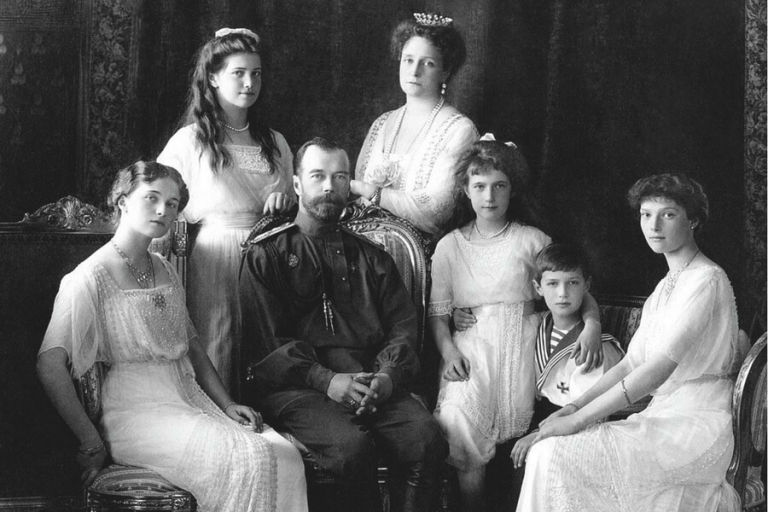
When the Romanov family was executed in July 1918, their story did not end—it was deliberately erased. In the years that followed, the new Soviet state worked not only to eliminate the monarchy, but to remove its memory from public consciousness. The deaths of Nicholas II, Alexandra Feodorovna, and their children were not openly discussed in full detail, and for a long time the official narrative remained incomplete, controlled, and carefully shaped to serve the new political reality.
In this version of history, the Romanovs were not presented as a family, but as a symbol of a failed and oppressive regime. They were reduced to figures of the past whose removal had been necessary for the birth of a new order. The human dimension of their story—the children, the suffering, the final months—was largely absent.
For decades, silence replaced memory.
A Memory Suppressed
Throughout the Soviet period, the place where the Romanovs had died—the Ipatiev House—stood not as a memorial, but as an ordinary building, stripped of meaning. There was no public acknowledgment of what had happened there, no official recognition of its significance.
In 1977, the house itself was demolished on the orders of Soviet authorities. The decision was not accidental. By removing the physical site, the state sought to prevent it from becoming a place of pilgrimage or remembrance. It was an attempt to erase not only a building, but a memory.
And for a time, it seemed to work.
Generations grew up with only fragments of the story, shaped by ideology and distance. The Romanovs existed, but only in a limited and controlled narrative.
The Return of the Past
The collapse of the Soviet Union in 1991 changed everything. Suddenly, the past could be revisited, reexamined, and questioned in ways that had not been possible before.
Historians, investigators, and ordinary citizens began to look again at what had happened in 1918. The discovery and identification of the Romanov remains brought a new level of clarity, but also reopened emotional and moral questions that had long been suppressed.
Who had they really been?
What had they suffered?
How should they be remembered?
The Romanovs were no longer just figures in a political narrative. They were becoming human again.
The Reburial of 1998
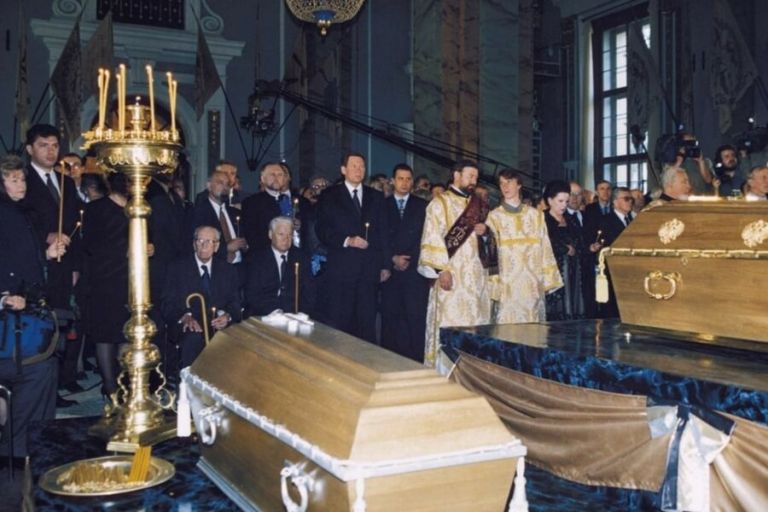
One of the most symbolic moments in this process of rediscovery came in 1998, when the remains of the Romanov family were formally reburied in Saint Petersburg.
The ceremony marked eighty years since their deaths. It was attended by members of the Russian government, representatives of the church, and descendants of European royal families. For the first time in modern Russian history, the Romanovs were publicly acknowledged not as enemies of the state, but as part of the nation’s historical and cultural heritage.
The reburial was not without controversy. Some questioned the identification of the remains, while others debated the meaning of the ceremony itself. Yet despite these disagreements, the event represented something profound: a willingness to confront the past.
It was an act of recognition.
From History to Faith
Perhaps the most significant transformation in the legacy of the Romanovs came not from the state, but from the church.
In 2000, the Russian Orthodox Church canonized Nicholas II, Alexandra Feodorovna, and their children as passion bearers—a specific category of sainthood reserved for those who faced death with humility, faith, and acceptance.
This designation did not claim that they had been perfect rulers or without fault. Instead, it focused on how they had met their end.
In their final days, the Romanovs had shown patience, devotion, and a quiet dignity. They had remained together as a family. They had faced uncertainty without abandoning their beliefs.
For many, this was what defined them.
A New Place of Memory
On the site where the Ipatiev House once stood, a new structure now rises: the Church on the Blood.
Built in the early 2000s, it stands as both a place of worship and a memorial. Its name reflects the events that took place there, acknowledging directly what had once been hidden.
Today, it attracts visitors from across Russia and beyond. Some come out of historical interest. Others come as pilgrims.
Candles are lit. Prayers are said. The story is remembered.
The space that was once erased has been transformed into a place of meaning.
Changing Perspectives
The way the Romanovs are remembered today is complex and, at times, contradictory.
To some, they remain symbols of a flawed and unequal system, representatives of a monarchy that failed to respond to the needs of its people. To others, they are victims—individuals caught in forces far beyond their control, whose deaths represent the excesses of революция and ideological extremism.
Between these perspectives lies a more nuanced understanding.
The Romanovs were both historical figures and human beings. They were shaped by their time, their roles, and their limitations, but they also experienced love, fear, hope, and loss.
It is this duality that makes their story enduring.
Memory Beyond Politics
What is perhaps most striking about the legacy of the Romanovs is how it has moved beyond politics.
While their fall was political, and their deaths were the result of political decisions, their memory today often exists in a different space—one that is emotional, cultural, and even spiritual.
The focus is no longer only on what they represented as rulers, but on who they were as a family.
The father who carried his son.
The mother who refused to leave her children.
The sisters who remained together until the end.
These images have become central to how they are remembered.
Conclusion
The story of the Romanovs did not end in 1918. It continued—quietly, unevenly, and sometimes controversially—through the decades that followed.
From silence to rediscovery, from condemnation to canonization, their legacy has undergone a transformation that reflects not only changes in historical understanding, but changes in society itself.
Today, the Romanovs are remembered in many ways: as rulers, as victims, as saints, as a family.
And perhaps that is what gives their story its lasting power.
It is not fixed.
It evolves—just as memory always does.
Вашият коментар