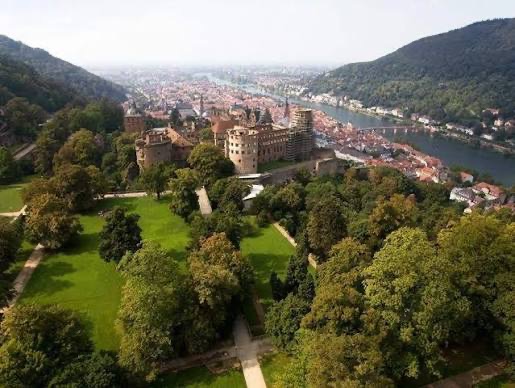
When Mark Twain visited Heidelberg in 1878, he expected to find another historic European city. Instead, he discovered Heidelberg Castle—a place so breathtaking that it inspired some of the most memorable passages in his travel book, A Tramp Abroad. Looking across the Neckar River at its ivy-covered ruins, Twain described Heidelberg as „the last possibility of the beautiful.“ More than a century later, visitors from around the world continue to come for exactly the same reason.
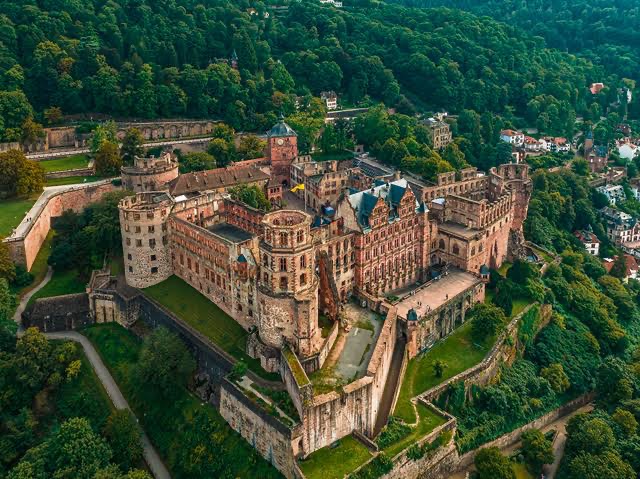
A Castle That Dominated the Palatinate
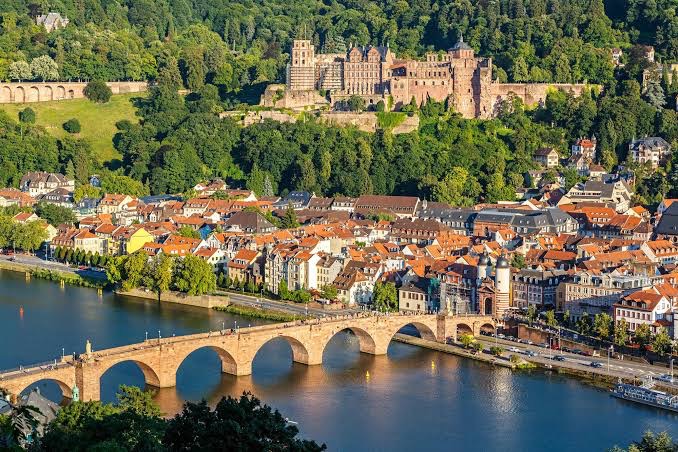
Heidelberg Castle rises high above the Old Town on the slopes of the Königstuhl hill, commanding spectacular views over the Neckar River. The earliest fortress on the site was built before 1214, and over the following centuries it grew into one of the grandest Renaissance castles north of the Alps.
As the residence of the Electors Palatine, some of the most powerful princes of the Holy Roman Empire, the castle became both a political center and an architectural masterpiece. Successive rulers added magnificent palaces, elegant courtyards, and elaborate gardens, transforming it into one of Germany’s most impressive royal residences.
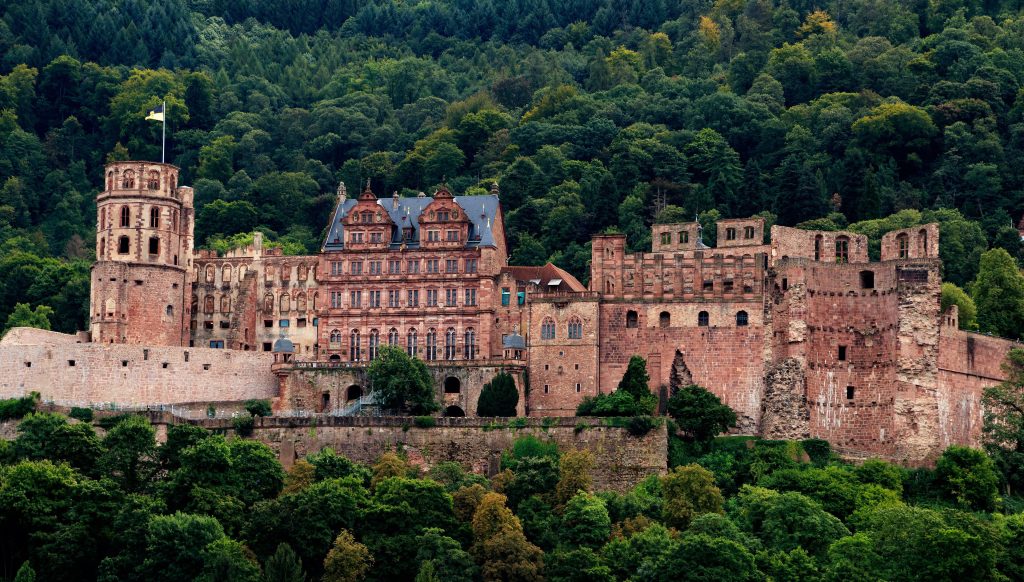
Destroyed by War – and by Nature
The castle’s greatest transformation came through destruction.
During the Thirty Years’ War, Heidelberg was repeatedly attacked, and in the Nine Years’ War, French troops acting under the orders of Louis XIV deliberately devastated the castle and much of the surrounding region. Explosions and fires left many of its buildings in ruins.
Even after peace returned, disaster struck again. In 1764, lightning hit the castle twice, causing another catastrophic fire. Instead of rebuilding it, the rulers abandoned much of the complex. Over time, nature slowly reclaimed the shattered walls, covering them with ivy, trees, and wild vegetation. Ironically, this combination of magnificent architecture and romantic decay would become the castle’s greatest attraction.
Mark Twain’s Unforgettable Impression
When Mark Twain arrived in Heidelberg, he was captivated not by a perfectly preserved palace, but by a ruin that seemed almost too beautiful to be real.
In A Tramp Abroad, he praised the castle’s dramatic setting above the river and wrote that Heidelberg was „the last possibility of the beautiful.“ He admired the broken towers, the ancient stone walls, and the way nature had transformed destruction into something even more spectacular. Rather than seeing a ruined fortress, Twain saw a place where history and landscape had created a masterpiece together.
His travel book introduced generations of American readers to Heidelberg and played an important role in making the castle one of Germany’s best-known landmarks outside Europe.
Saved from Disappearing Forever
Few visitors realize how close Heidelberg Castle came to being lost forever.
During the early 19th century, parts of the ruins were dismantled for building stone, and there were serious discussions about removing what remained. The castle’s future changed thanks largely to the French Count Charles de Graimberg, who dedicated decades of his life to documenting and preserving the ruins. His drawings and publications attracted visitors from across Europe and helped establish Heidelberg as one of the birthplaces of cultural tourism in Germany.
One of Germany’s Most Beloved Castles
Today, Heidelberg Castle welcomes more than a million visitors every year. Its spectacular Renaissance architecture, dramatic ruins, and panoramic views over the Neckar Valley make it one of Germany’s most iconic landmarks.
Yet perhaps its greatest legacy is something less tangible. It is a place where history, art, literature, and nature come together so perfectly that one of America’s greatest writers struggled to find words worthy of describing it.
More than 140 years after Mark Twain stood beneath its ancient walls, Heidelberg Castle continues to inspire everyone who visits—proving that even a ruined castle can become one of the most beautiful places in the world.
Вашият коментар