The ship has already slowed down. Someone on deck points ahead. There is no need for anyone to tell you what you are seeing—you know. The Statue. She does not wave, she does not speak, she makes no promises out loud. She simply stands there. And yet the people around you begin to cry. Some fall to their knees. Others clutch their hats, as if the wind itself might carry them back. After weeks in dark holds, amid the smell of sea and fear, America feels close. Almost reached. But not yet yours. The ship does not stop in Manhattan. It turns instead. Toward a small island in New York Harbor — Ellis Island. There are no fanfares here. No welcomes. Only lines, stairs, doors, and one vast hall where time seems to stop.
This is the place where America decides who you are.
The hall of silence
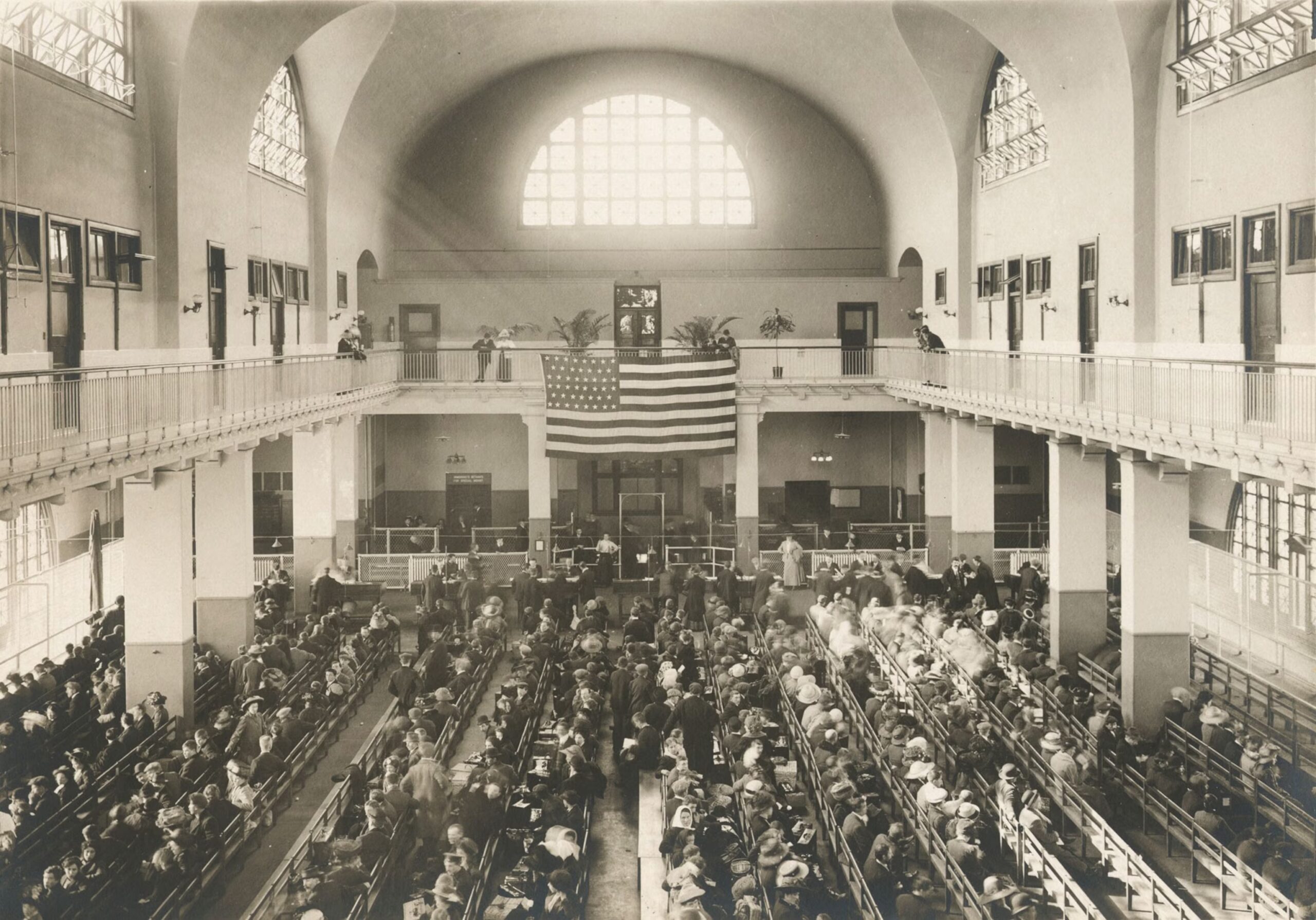
The great room is noisy, yet no one speaks loudly. Footsteps echo. Children are pressed against their mothers. Men stand straight, documents in hand that they do not fully understand. Most do not speak English. Some speak no language the officials recognize. And yet everyone knows one thing: every movement is being watched.
Doctors do not wait for the examination to begin. They observe as you walk. The eyes. The posture. The breathing. The gait. A moment of dizziness, a cough, an uncertain step—and their attention fixes on you. There is no malice. There is speed. Thousands pass through every day. Decisions must be instant.
The chalk is white. Small. But it weighs more than all your luggage combined.
The mark you cannot erase
A single letter on the back of your coat. A symbol you do not understand. But you see how people around you react. Someone turns pale. Another begins to cry. The letter means further inspection. It means detention. It means doubt.
For many, this is the first time they feel voiceless. All their lives they have been sons, daughters, craftsmen, farmers, teachers. Here they are merely bodies in motion. Here no one knows their names. Sometimes names change. Sometimes they are lost forever.
A mother grips her child’s hand so tightly her nails leave marks. The child coughs. She forces a smile. The smile does not help.
Thirty seconds for a lifetime
The interview is not a conversation. It is a check. The questions come fast, often through an interpreter who speaks another dialect, another language, another world.
“Where will you live?”
“Do you have a job?”
“Do you have money?”
“Who is waiting for you?”
Some are prepared. In their pocket is an address, written in someone else’s handwriting. The name of a brother, an uncle, a friend. Others have nothing but hope. And sometimes that is not enough.
The official looks up. The decision has already been made. He does not explain it. He only gestures—forward or aside. Forward is America. Aside is the unknown.
The room where time stops
Those who are set aside wait. Sometimes for hours. Sometimes for days. Sometimes for weeks. The island has its own dormitories, hospital rooms, windowless corridors. Some never leave Ellis Island as free people.
The separations are the hardest. A child admitted, the mother not. A father held for inspection while his family is already on the mainland. Letters that never arrive. Meetings that never happen.
America does not begin with “welcome.” It begins with waiting.
Doctors without faces
Many of those who decide fates never thought of themselves as judges. They are doctors, clerks, officials. They work by rules, by laws, by lists of illnesses and criteria. Fear of epidemics, poverty, and “undesirable” people is part of the era.
And yet sometimes a doctor hesitates. Sometimes he sees not disease, but exhaustion. Sometimes he takes a second look. Stories tell of people admitted because of one extra minute of humanity. But there are other stories too—of those sent back across the ocean. Without explanation. Without a chance to appeal.
America as an idea, and as a gate
For those who pass, America begins not with streets and skyscrapers, but with relief. With the first step out of the hall. With the stamp. With the ferry ticket. With air that somehow already feels different.
But Ellis Island stays with them. In memory. In their children’s stories. In family myths.
“Your grandfather passed through the island.”
That sentence carries more weight than it seems. It means someone’s fate once hung by a thread. That America was a choice—but also a test.
Those who never reach the mainland
Little is said about those who are returned. About those who board the ships again. With the same suitcases. With less hope. Sometimes shame is heavier than failure. How do you return to your village and say that America rejected you?
Some try again. Others never do. History rarely remembers their names. But Ellis Island remembers them.
The legacy of a single hall
Today, Ellis Island is a museum. Tourists walk where frightened people once stood. They listen to recordings. Look at photographs. Read plaques. But the hall still carries echoes. If you fall silent, you can imagine the footsteps. The coughing. The whispers. The silence before the decision.
America was built from these moments. Not only from victories and declarations, but from human fear, hope, and endurance. From people who did not know whether they would have a home tomorrow, yet moved forward anyway.
The day America was decided—every day
Ellis Island is not just a place. It is a process. Repeated again and again. Day after day. Year after year. Every morning America had to answer one question:
“Whom do we admit?”
And every evening someone fell asleep with a new life—or with a broken dream.
This is the human story of Ellis Island. A story without heroes or villains. Only people. And one door—not everyone passed through it, but everyone remembers it.
Вашият коментар