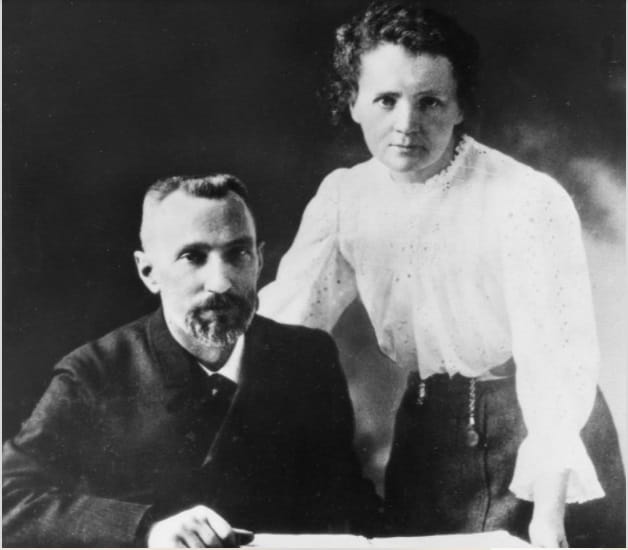
Marie Skłodowska-Curie is remembered across the world as a groundbreaking scientist, a pioneer of radioactivity and the first person ever to win two Nobel Prizes in different scientific fields. Yet one of the most extraordinary chapters of her life is often overlooked. During the First World War, Curie transformed her scientific knowledge into a powerful instrument of medical rescue, saving thousands of soldiers in the darkest hours of the conflict. Her story is not only one of genius, but of bravery, compassion and an unwavering belief that science must serve humanity.
A Relentless Journey Toward Knowledge
Marie grew up in a family of teachers who valued education deeply, but the opportunities available to her were limited. In her native Poland, women were not allowed to attend university, forcing her to pursue her dreams elsewhere. Determined to learn and unwilling to accept society’s restrictions, she left for Paris to begin her studies at the Sorbonne. Life there was harsh. Marie spent her days in cold rooms, studying by candlelight, often skipping meals because she could not afford them. Her dedication, however, never wavered. She graduated with top honors in physics and mathematics, proving that talent and determination could overcome any boundary.
A Scientific Partnership That Changed the World
Her life took a decisive turn when she met Pierre Curie, a respected physicist who immediately recognized Marie’s extraordinary intellect. Their professional collaboration soon evolved into a partnership that reshaped the scientific landscape. Together they discovered two new chemical elements — polonium, named in honor of her homeland, and radium, whose strange and beautiful glow fascinated the scientific world. It was Marie who introduced the term “radioactivity,” laying the foundation for future research in nuclear physics and medical technology. In 1903, she became the first woman to receive a Nobel Prize, sharing it with Pierre and Henri Becquerel for their groundbreaking work.
Tragedy and the Strength to Carry On
In 1906, tragedy struck when Pierre died in a sudden accident. His death left Marie devastated, yet she refused to abandon their scientific mission. She took over his teaching position at the Sorbonne, becoming the first woman to lecture there, and immersed herself in research. Her persistence and brilliance were rewarded in 1911, when she received a second Nobel Prize — this time in chemistry — for her discoveries of polonium and radium. To this day, she remains the only person in history to win Nobel Prizes in two different scientific fields.
But the greatest test of her courage would come not from the world of academia, but from the chaos of war.
When War Begins, Science Goes to the Frontline
In 1914, the First World War engulfed Europe, bringing destruction on an unprecedented scale. Field hospitals quickly filled with wounded soldiers, and surgeons often had to operate blindly, unable to determine the exact location of bullets or shrapnel lodged deep inside the body. These uncertainties cost countless lives.
Marie Curie understood that X-ray technology could offer something invaluable: the ability to see inside the human body at a moment when every second mattered. But instead of remaining in Paris or contributing from a distance, she made a bold decision. She would take science directly to the battlefield.
The Revolution Known as the “Little Curies”
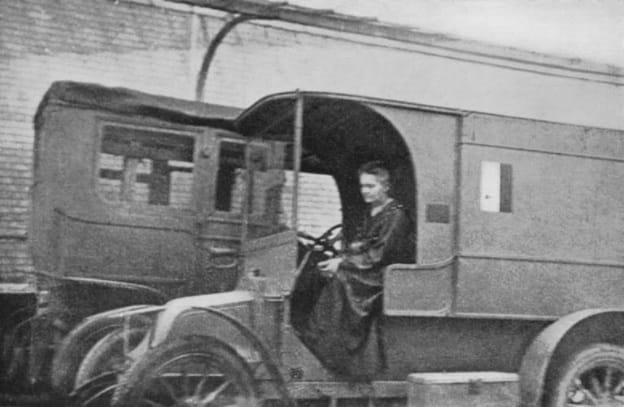
From this idea emerged one of her most remarkable achievements — the creation of mobile X-ray units that could be brought right to the front lines. Marie designed vehicles equipped with X-ray machines and electricity generators, allowing doctors to perform life-saving imaging practically in the trenches. These vehicles soon became known as the “Little Curies.”
Marie herself drove the cars, adjusted the machines and examined wounded soldiers. She trained doctors and nurses in the new technology, ensuring that the service could be relied on across multiple fronts. Under her direction, more than twenty mobile X-ray units were built, along with over two hundred stationary radiology rooms in military hospitals.
The impact was enormous. Surgeons could now locate bullets and shrapnel with precision, reducing the need for amputations and dramatically increasing survival rates. Historians estimate that the work of Marie Curie saved the lives of more than one million wounded soldiers. On the battlefield, the soldiers called her “the woman who sees through flesh,” a title that captured the essence of her mission more truthfully than any academic award.
The Final Years and the Price of Genius
In an era when the dangers of radiation were still unknown, Marie handled radioactive materials with no protective equipment. She carried glass vials of radium in her pockets and kept samples on her desk simply because their glow comforted her on dark evenings. The consequences were inevitable. In 1934, she died from aplastic anemia, a condition caused by prolonged exposure to radiation.
She paid the ultimate price for her devotion to science and humanity. Yet her legacy lived on not only through her discoveries, but also through her daughter Irène Joliot-Curie, who went on to earn a Nobel Prize of her own.
A Legacy That Transcends Science
Marie Skłodowska-Curie is remembered not only as a scientific pioneer, but as a symbol of courage, integrity and compassion. She proved that knowledge can be a force for good, that determination can break every barrier, and that a single person — armed with conviction and brilliance — can change the course of history. Her work continues to influence medicine, physics and life-saving technologies more than a century later.
Marie Curie’s story remains a reminder that science is not just about understanding the world, but also about healing it, protecting it and making it better for those who come after us.
Вашият коментар