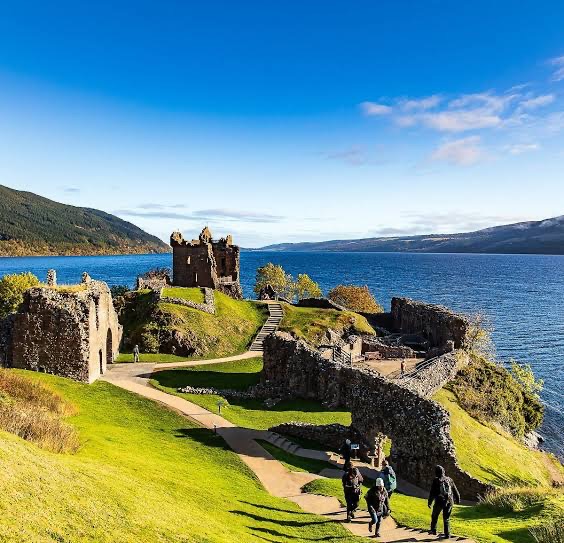
Everyone knows Loch Ness for its monster. But on its shore stand the ruins of something very real—a castle fought over for centuries by English kings, Scottish warriors and powerful Highland clans. Urquhart Castle has watched over Loch Ness for hundreds of years. Edward I of England captured it, Robert the Bruce took it back, the powerful Lords of the Isles fought for it, and Highland raiders stripped it of cattle, weapons, furniture and even its gates.
When another enemy threatened to occupy the fortress at the end of the 17th century, its own defenders made an extraordinary decision: rather than allow their enemies to use Urquhart, they destroyed part of their own castle.That explosion helped turn Urquhart into the romantic ruin millions recognize today. But the story of the castle begins long before medieval Scotland—and long before anyone began searching the dark waters of Loch Ness for a monster.
Urquhart Castle: The Real Fortress on Loch Ness
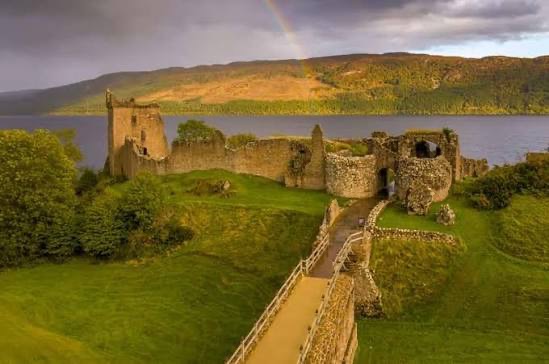
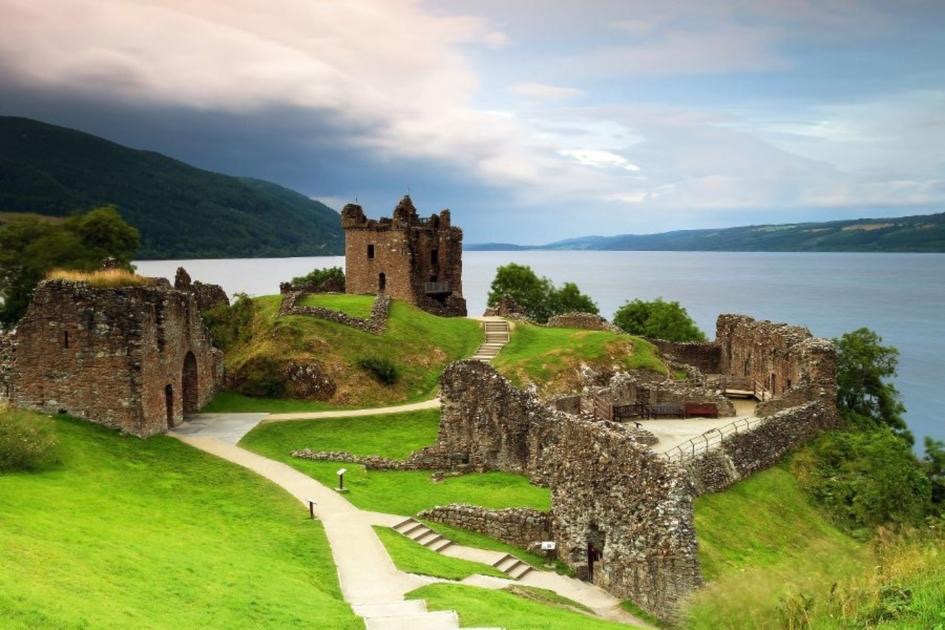
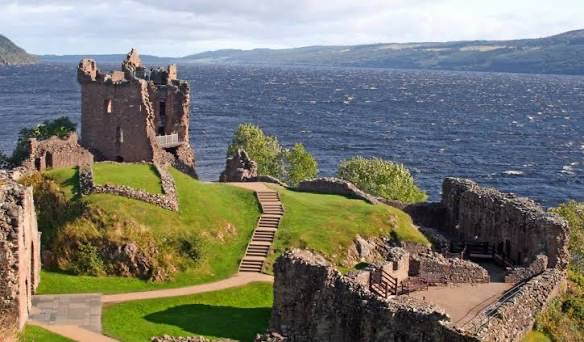
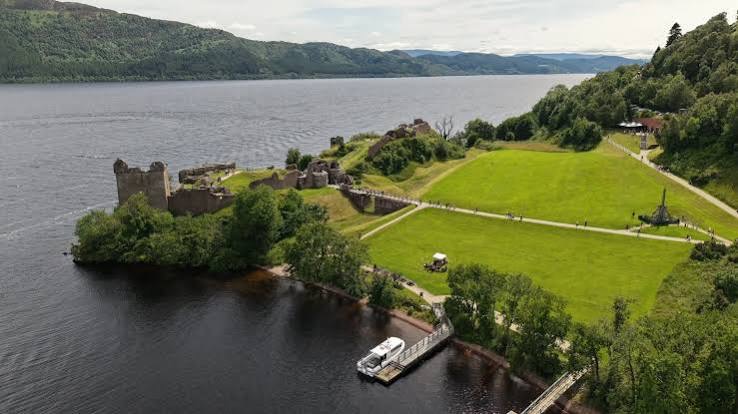
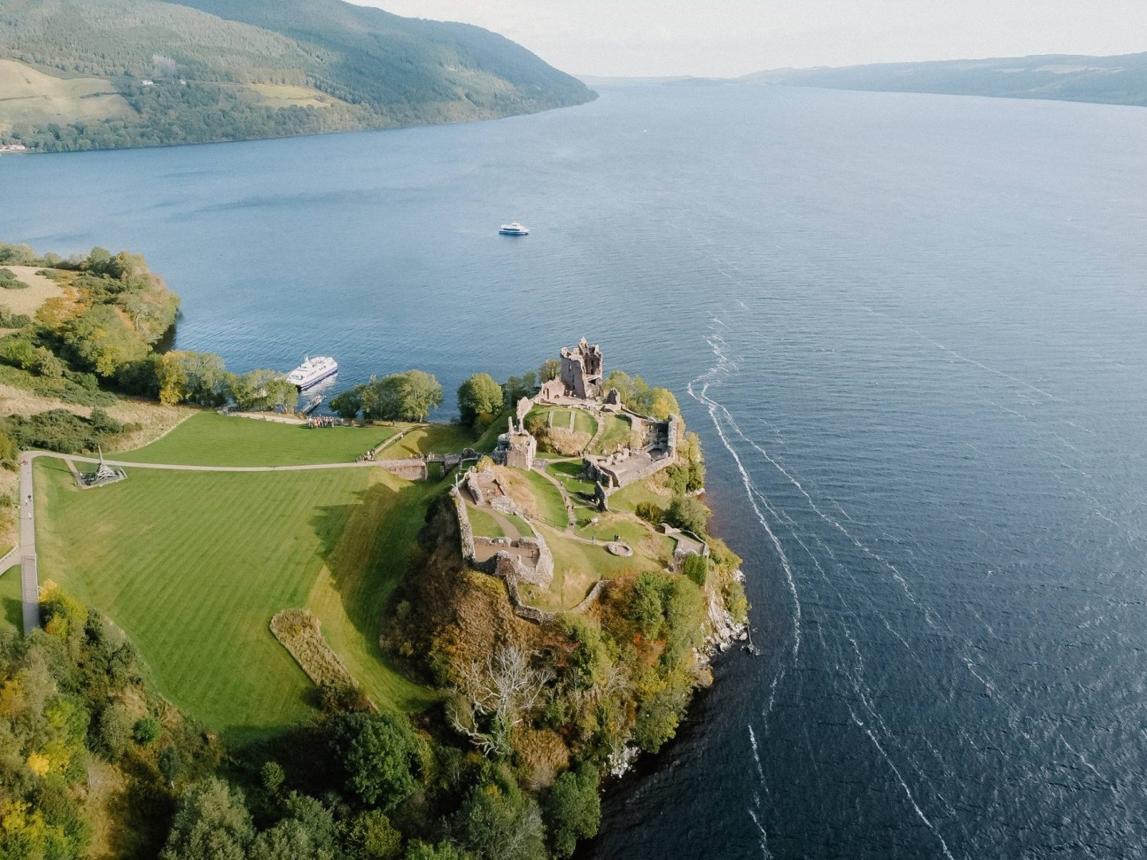
Urquhart Castle stands on Strone Point, a rocky promontory projecting into Loch Ness in the Scottish Highlands. Its position allowed whoever controlled it to watch the route through the Great Glen as well as the entrance to Glen Urquhart. The castle was protected on its landward side by a large dry ditch and drawbridge, while its walls enclosed two main areas along the shore.
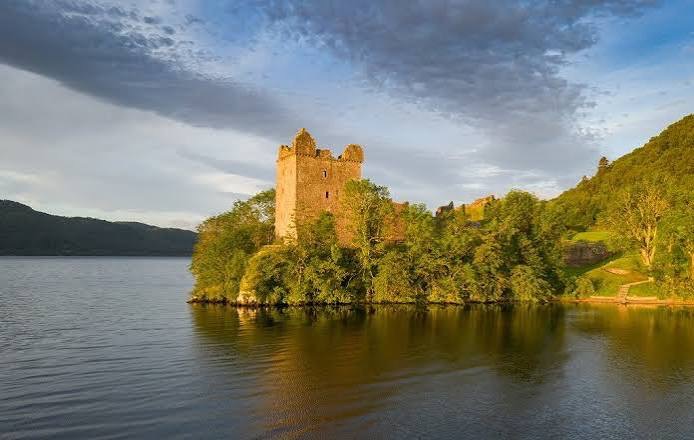
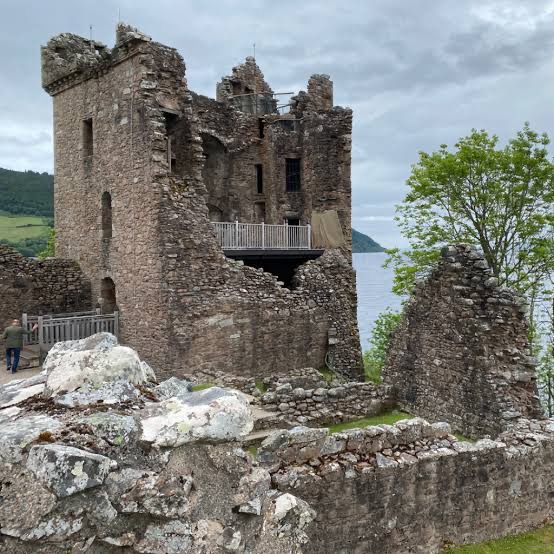
It was not a small outpost. By area, Urquhart became one of the largest castles in Scotland. Among its most impressive structures was the five-storey Grant Tower, whose walls reached around three metres—10 feet—in thickness. From its windows, inhabitants could look directly across the waters of Loch Ness.
Urquhart Before There Was a Medieval Castle
Archaeologists discovered pieces of vitrified stone at Urquhart—stone subjected to intense heat and characteristic of some early medieval fortifications. Excavations in 1983, supported by radiocarbon dating, established that the rocky mound at the southwestern end of the later castle had been occupied by a substantial fortified site between approximately the 5th and 11th centuries.
There is even a possible connection with St Columba, one of the most important figures in early Scottish Christianity. Adomnán’s Life of Columba records that during the 6th century Columba visited a place called Airdchartdan, where he converted a dying Pictish nobleman named Emchath, his son and their household. Archaeologist Leslie Alcock concluded that Urquhart was most likely the site of Emchath’s residence, although not, as had sometimes been suggested, the principal fortress of the Pictish king Bridei.
The stone castle itself appears centuries later. It was probably established during the 13th century, after Alexander II granted Urquhart to Thomas de Lundin and the property subsequently passed to his son Alan Durward. Then, in 1296, Urquhart suddenly appears clearly in the written record. The reason was war.
Edward I Captures Urquhart Castle
In 1296, Edward I of England invaded Scotland, beginning the long conflict known as the Wars of Scottish Independence. Urquhart Castle was captured, and Edward appointed Sir William Fitz Warin to hold the fortress for England. English control of the Highlands, however, was far from secure.
In 1297, while Fitz Warin was returning from Inverness, his party was ambushed by Scottish forces under Andrew de Moray. Moray then turned his attention to Urquhart itself. His men besieged the castle and attempted a night attack. The assault failed, but English possession did not last much longer. By 1298, Urquhart was once again controlled by the Scots.
The struggle was not over. Edward’s forces returned and captured the castle again in 1303. Then another name entered the story: Robert the Bruce.
Robert the Bruce Takes Urquhart Castle
The powerful Comyn family had supported the English against Robert Bruce. But in 1306, Bruce killed John Comyn—the famous Red Comyn—and was crowned King of Scots. The following year, Bruce moved through the Great Glen as he consolidated his position in northern Scotland.
One by one, important strongholds fell: Inverlochy, Inverness and Urquhart Castle. After Bruce’s campaign of 1307, Urquhart became a royal castle held for the Scottish Crown by a succession of constables. Its importance soon became particularly clear. Following the disastrous Scottish defeat at Halidon Hill in 1333, Urquhart was recorded as one of only five castles in Scotland still held by the Scots.
For a fortress on the distant shore of Loch Ness, this was an extraordinary position to occupy. But England would not remain Urquhart’s greatest threat. The next struggle came from the west.
Urquhart Castle and the Lords of the Isles
For roughly two centuries, the Great Glen was repeatedly threatened by the MacDonald Lords of the Isles. These were no ordinary local raiders. The Lords of the Isles controlled a powerful semi-independent maritime lordship across western Scotland and the Hebrides, and their ambitions frequently brought them into conflict with the Scottish Crown.
Urquhart stood directly in their path. In 1395, Domhnall of Islay, Lord of the Isles, seized Urquhart Castle and managed to retain control for more than 15 years. The Crown eventually recovered it, but the struggle continued through subsequent generations.
In 1452, John of Islay, Earl of Ross, again raided through the Great Glen and seized Urquhart. Later he secretly entered an agreement with Edward IV of England against James III of Scotland. When the Scottish king discovered the arrangement, John was stripped of his titles and Urquhart was transferred to a royal ally. Eventually another family was brought in to impose order. Their name would become permanently attached to the castle.
Clan Grant Comes to Urquhart Castle
In 1509, James IV granted Urquhart Castle and surrounding lands to John Grant of Freuchie, on the condition that he repair and rebuild the fortress. The Grants now had a castle on Loch Ness, but owning it did not mean they could live peacefully inside it.
In 1513, Scotland suffered a catastrophic defeat against England at the Battle of Flodden. In the resulting political disorder, Sir Donald MacDonald of Lochalsh moved against Urquhart and occupied the castle. The MacDonalds did not leave empty-handed: they drove away 300 cattle and 1,000 sheep and stripped provisions from the fortress. John Grant eventually recovered Urquhart and attempted to obtain compensation for his losses, but he was unsuccessful.
Compared with what happened three decades later, however, the raid of 1513 was almost modest.
The Great Raid of Urquhart Castle
In 1545, the MacDonalds and their Cameron allies returned in an attack that became known as the Great Raid. They captured Urquhart Castle and stripped it on an extraordinary scale. According to the surviving record, the raiders took 2,000 cattle, hundreds of other animals, furniture and provisions. They took the castle’s cannon—and then they took something that perfectly illustrates just how thoroughly Urquhart had been looted: they even took the gates.
The Grants eventually regained the castle, and the Great Raid proved to be the last major MacDonald attack on Urquhart. By the end of the 16th century, the family had rebuilt and strengthened the fortress. The imposing Grant Tower became the dominant structure at the northern end of the complex. Although based on earlier foundations, much of the tower resulted from 16th-century rebuilding. It originally rose five storeys above Loch Ness, with defensive openings from which objects could be dropped on attackers and pistol holes beneath its larger windows.
Yet there was a strange irony in all this rebuilding. Just as Urquhart became stronger, castles like it were becoming less important as aristocratic residences.
Urquhart Castle Begins to Empty
By the 17th century, Urquhart was no longer a favoured home of the Grants. Repairs continued, but an inventory taken in 1647 found the castle virtually empty. Three years later, Oliver Cromwell invaded Scotland.
One might expect Urquhart to have become a major military objective. Instead, Cromwell largely ignored it, choosing to construct new forts at either end of the Great Glen rather than rely on the old medieval stronghold. For a castle that had been fought over repeatedly for centuries, being ignored was almost a sign that its military age was ending.
But Urquhart had one final siege ahead of it—and that siege would ultimately explain why so much of the castle is ruined today.
500 Jacobites Come for Urquhart Castle
In 1688, King James VII of Scotland and II of England was overthrown during the Glorious Revolution. William of Orange took power, but supporters of the exiled James—the Jacobites—continued to fight for his restoration. Ludovic Grant supported William and placed 200 of his own soldiers inside Urquhart Castle. They had a problem: according to the surviving account, the garrison was short of weapons. But it had plenty of provisions.
Then approximately 500 Jacobites laid siege to the castle. Despite being heavily outnumbered, Urquhart’s defenders held out. They remained inside until after the main Jacobite force was defeated at Cromdale in May 1690.
The immediate danger had passed and the soldiers could leave. But before they did, they made sure the Jacobites would never be able to use Urquhart against them.
Why Urquhart Castle’s Own Soldiers Blew It Up
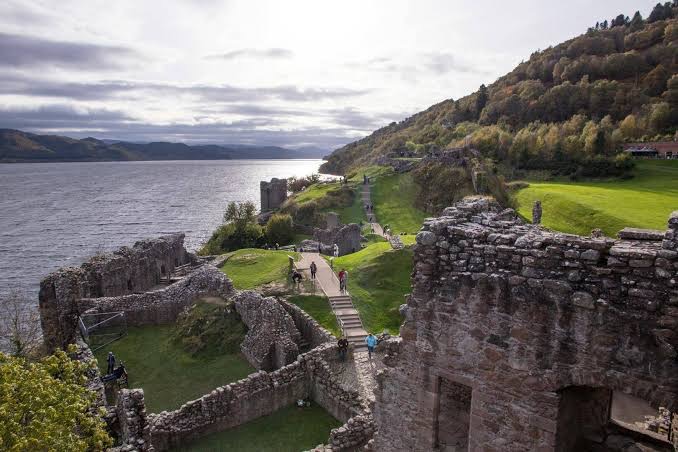
The garrison deliberately blew up the gatehouse. The idea was simple: if the Jacobites returned, they would not find an intact fortress waiting for them. Huge blocks of masonry collapsed around the entrance—and they are still there. More than three centuries later, visitors walking through Urquhart Castle can see the broken stone left by the deliberate destruction of its own defences.
Parliament ordered £2,000 in compensation for Grant, but Urquhart was never repaired. Local people subsequently removed stone and other materials for reuse, accelerating the castle’s decay. Then nature joined in: a storm in 1715 caused part of the great Grant Tower to collapse.
The castle that English kings, Scottish warriors and Highland lords had fought to possess was becoming a ruin.
From Fortress to Romantic Ruin
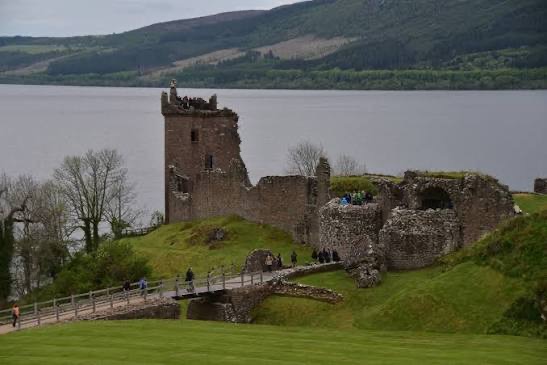
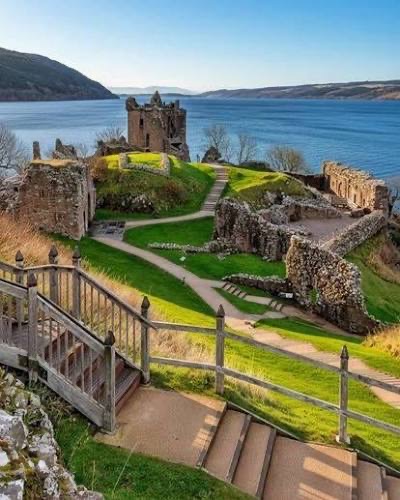
By the 1770s, Urquhart Castle had lost its roof. During the 19th century, artists and travellers increasingly saw it not as a military stronghold but as something very different—a picturesque ruin overlooking one of Scotland’s most dramatic landscapes. In 1913, the castle was formally placed into state care. Today it is protected as a monument of national significance.
The surviving ruins still reveal just how substantial the fortress once was. The castle stretched along the shore in two main enclosures. There was a gatehouse defended by a portcullis and double doors, a Great Hall, private apartments, kitchens, a possible chapel, a water gate and the towering Grant Tower. And beyond every wall lies Loch Ness.
That has inevitably connected Urquhart with another story.
Urquhart Castle and the Loch Ness Monster
Today, millions of people around the world know the name Loch Ness because of Nessie, the legendary creature said to inhabit its dark waters. Urquhart Castle has consequently become part of the visual world surrounding the legend. Photographs of the ruined Grant Tower with Loch Ness stretching into the distance combine two of the Highlands’ most recognizable images.
But there is an interesting contrast here. People come to Loch Ness searching for something whose existence remains unproven. Meanwhile, standing directly beside the water is something unquestionably real—and its history is arguably just as extraordinary. The ruins preserve traces of centuries of conflict involving English kings, Scottish monarchs, Highland clans and Jacobite rebels.
Urquhart does not need a monster to have a remarkable story.
Urquhart Castle: The Fortress Its Defenders Chose to Destroy
Stand among the ruins today and it can be difficult to imagine Urquhart as one of Scotland’s great strongholds. But Edward I captured it, Andrew de Moray tried to storm it at night, Robert the Bruce brought it back under Scottish control, and for a time it was one of only five Scottish castles still held against the English. The Lords of the Isles repeatedly fought for it, MacDonald raiders once carried away 2,000 cattle and even the castle gates, and 500 Jacobites later tried to take it.
Finally, after centuries of fighting over Urquhart, its own defenders decided that there was only one certain way to stop their enemies from possessing it: they destroyed part of it themselves. The shattered gatehouse was never rebuilt. The Grant Tower partially collapsed. Grass slowly covered what had once been courtyards filled with soldiers and servants, and the fortress became the ruin we know today.
Now it stands quietly beside the most famous loch in Scotland, its broken tower reflected in waters better known for a legendary monster. Everyone comes to Loch Ness looking for a mystery. But one of its greatest stories has been standing on the shore all along.
Така вече е статия, а не поредица от отделни реплики. Точно този формат бих държал и за следващите замъци — подзаглавия за четимост и SEO, но под тях нормални, плътни абзаци.
Вашият коментар