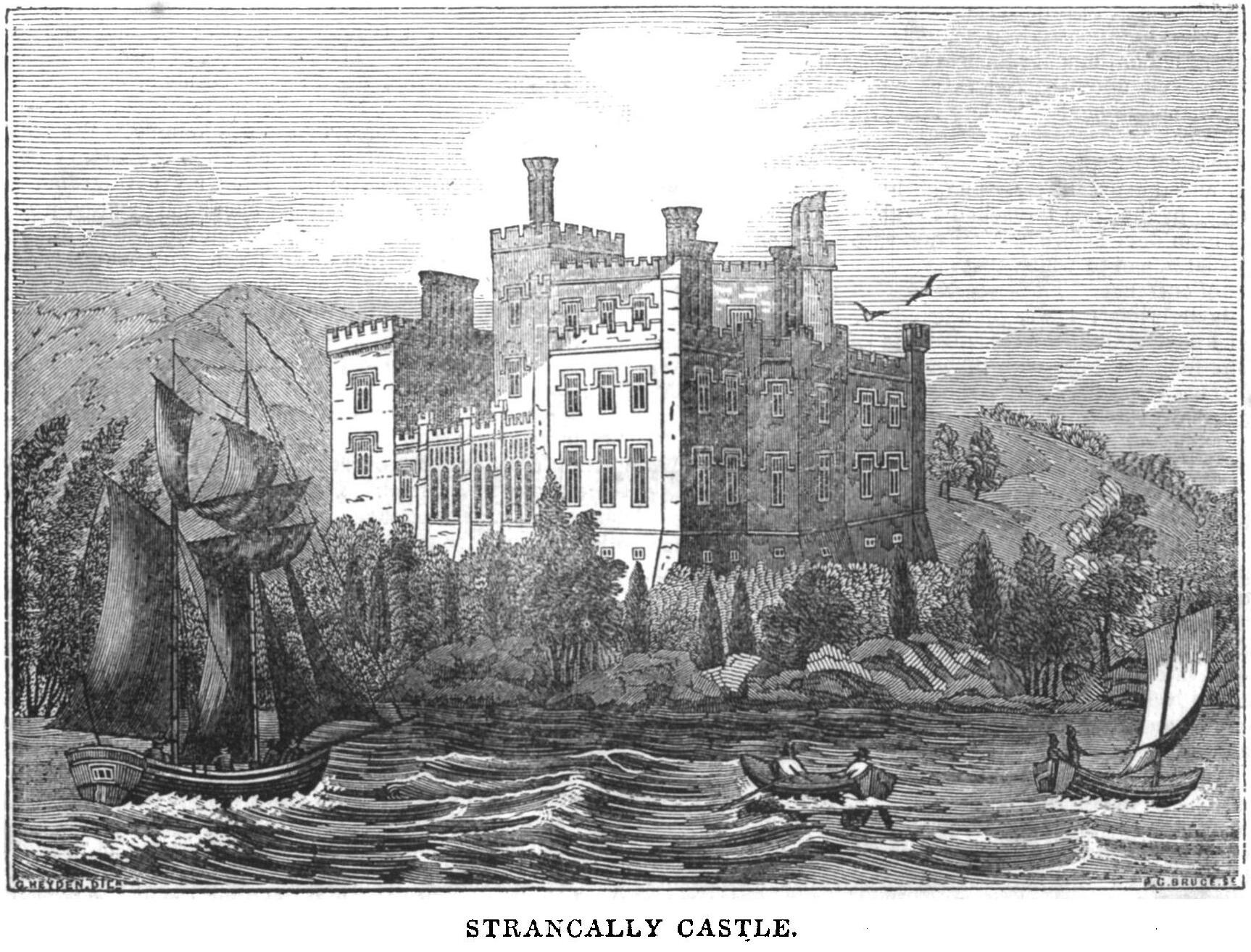
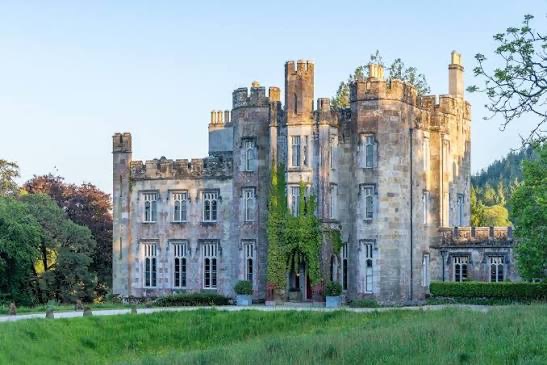
At first glance, Strancally Castle looks like something from a romantic Irish story. Turrets rise above a wooded estate beside the River Blackwater in County Waterford, surrounded by a landscape that seems far removed from violence or intrigue. But the name Strancally Castle is connected with a much older fortress—and a story so dark that an 18th-century writer claimed the authorities eventually ordered part of the castle blown apart. There is an important distinction, however. The beautiful Strancally Castle standing today is not the medieval castle associated with that story. The present building dates from around 1827 and stands several kilometres upriver from the site of the original fortress. To find the beginnings of Strancally’s history, we have to go back more than six centuries earlier.
The First Strancally Castle
The name Strancally comes from the Irish Srón Chaillí, generally translated as “nose of the hag.” The original castle is traditionally said to have been built by the Anglo-Norman knight Raymond “le Gros” FitzGerald during the Anglo-Norman invasion of Ireland in the late 12th century. Raymond was one of the prominent military figures involved in the conquest, and the castle attributed to him occupied a dramatic defensive position directly above the River Blackwater. Whether every detail of the traditional foundation story can be established with certainty is another question, but by the later medieval period Strancally was firmly associated with one of Ireland’s most powerful dynasties: the FitzGeralds of Desmond.
By the 16th century, the lands around Strancally were controlled by the FitzGerald dynasty, Earls of Desmond. Their relationship with the Crown deteriorated dramatically during the Desmond Rebellions, a series of conflicts that devastated large parts of Munster. The last FitzGerald owner associated with Strancally, James Fitzjohn FitzGerald, was executed following the rebellion of 1579, and the FitzGerald lands were subsequently confiscated by the Crown. But political rebellion is not what made the old Strancally Castle infamous. That reputation came from a much darker story.
The Terrifying Legend of Strancally Castle
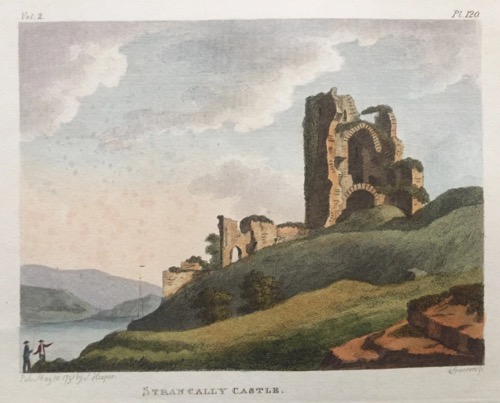
In 1791, antiquarian Francis Grose published an illustration and description of the ruins of the old Strancally Castle in his Antiquities of Ireland. By then the medieval fortress was already a ruin, but Grose recorded a disturbing tradition associated with the site. He described the old castle as standing “on a rock directly over the river.” According to the story he recorded, one of the Earls of Desmond used the fortress as a prison—and prisoners who entered Strancally supposedly did not always leave alive.
Grose wrote of a hole cut through the rock beneath the castle. According to the tradition, the bodies of prisoners were thrown through it toward the river below. The account becomes darker still: Grose claimed that because of the “horrible practices committed here,” the government eventually ordered both the cave and castle to be demolished. Gunpowder was supposedly used against the fortress, splitting part of the structure from top to bottom.
It is a spectacular story, but there is an important reason to be cautious. The tale of prisoners being murdered at Strancally comes from a source published centuries after the medieval period it describes, so we cannot simply treat every detail as established historical fact. That does not make the story unimportant. By the late 18th century, the legend was clearly associated strongly enough with Strancally for Francis Grose to record it alongside his illustration of the ruins. It had become part of the identity of the place: an abandoned castle above the Blackwater remembered not merely for battles or noble families, but for what supposedly happened to prisoners inside it.
And the ruins Grose illustrated are especially important for another reason. They are not the castle people usually see when they search for Strancally today.
A New Strancally Castle Appears
Around 1827, a completely new Strancally Castle was constructed for John Kiely, who had served as MP for Clonmel and High Sheriff of County Waterford. The architects were brothers James and George Richard Pain, figures associated with several important Gothic Revival buildings in Ireland. The new residence was not built directly on the ruins of the medieval castle. Instead, it rose approximately 4.5 kilometres upriver from the older site.
Its architecture deliberately evoked the appearance of a castle. Towers, battlements and Gothic details gave the country house the romantic character that was fashionable among wealthy landowners during the 19th century. In 1837, Samuel Lewis described Strancally as “a large gothic building” standing within a richly planted estate of more than 1,000 acres. The contrast with the old Strancally could hardly have been greater: one was remembered as a grim medieval fortress overlooking the river, while the other was an elegant 19th-century country residence designed to look medieval. Yet they shared the same name.
From a Great Estate to a New Century
During the 19th century, the estate grew considerably. In 1856, Strancally Castle was sold together with an estate reported to contain around 5,000 acres. It was acquired by George Whitelocke Lloyd, a member of a wealthy Anglo-Irish manufacturing family who later served as High Sheriff of County Waterford. His son, William Whitelocke Lloyd, followed a very different path, becoming both an artist and an army officer and serving during the Anglo-Zulu War of 1879. The Lloyd family remained associated with Strancally into the early decades of the 20th century, with census records from 1901, 1911 and 1926 still recording the family at the estate.
During the 20th century, however, the great Irish estates were changing. Strancally eventually came into the possession of the Irish Land Commission, and much of the surrounding land was gradually broken up and sold. The castle itself eventually remained with around 160 acres, a fraction of the thousands of acres that had once surrounded it. Ownership changed several times during the century, including a period associated with Edward Parke Seaton after the Second World War and later with Friedrich Billensteiner and his family.
Around 2000, the property was acquired by Giancarla Forte, daughter of hotelier Charles Forte, Baron Forte, and Michael Alen-Buckley. A major restoration followed. Over approximately two decades, the 19th-century Gothic house and estate were restored, preserving the dramatic appearance that makes the modern Strancally look much older than it actually is.
Two Castles, One Name
Look at a photograph of Strancally Castle today and it is easy to imagine medieval knights walking beneath its towers. But that building did not witness the Anglo-Norman invasion. It was not the fortress controlled by the Earls of Desmond, and it was not the castle associated with Francis Grose’s gruesome story of prisoners disappearing through a hole in the rock. That Strancally stood somewhere else.
The castle we see today was constructed in the 19th century, centuries after the medieval fortress had fallen into ruin. Its battlements and towers belong to the Gothic Revival, an age fascinated by romantic visions of the Middle Ages. Yet the old name followed it, and with the name came the stories.
The Dark Legend Behind Strancally Castle
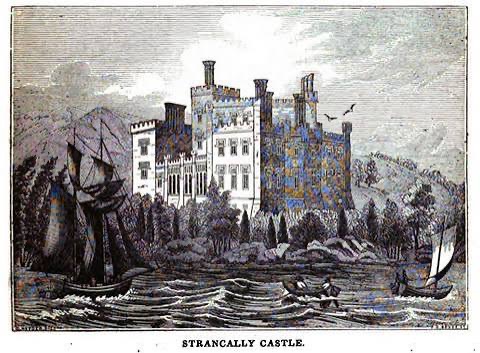
Some castles become famous because kings lived in them. Others are remembered because great battles were fought beneath their walls. Strancally is more complicated. There is the old Strancally Castle: a medieval fortress above the River Blackwater, connected with the FitzGeralds and remembered through a disturbing centuries-old tale of prisoners, a mysterious opening through the rock and a castle supposedly damaged with gunpowder. Then there is the new Strancally Castle: an imposing Gothic country house built around 1827, several kilometres away, designed in an age when Ireland’s ruined medieval castles had themselves become objects of fascination and romance.
Today, it is the second castle whose towers dominate photographs of the estate. But behind that beautiful façade lies a name inherited from a much older place. And perhaps that is what makes Strancally particularly intriguing: the castle everyone sees is not the castle behind the legend.
Вашият коментар