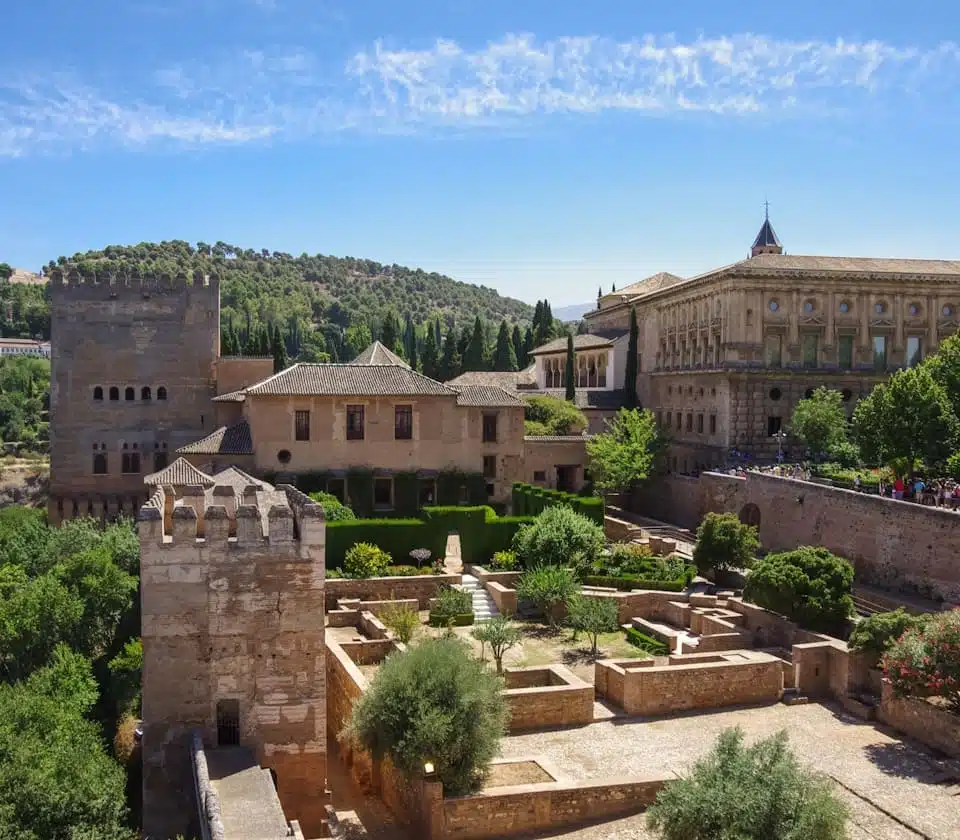
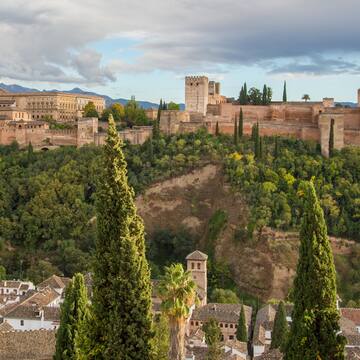
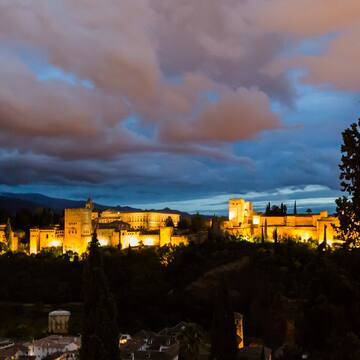
High above the city of Granada, overlooking the Darro River and backed by the Sierra Nevada mountains, stands one of the greatest architectural masterpieces ever created. The Alhambra is more than a palace or a fortress—it is an entire royal city built to serve as the political, military, and cultural heart of the last Muslim kingdom in Western Europe. For over seven centuries, it has witnessed the rise and fall of empires, the end of Islamic rule in Spain, and the birth of a new era under the Spanish Crown. Today, it remains one of the world’s most celebrated historical monuments and a UNESCO World Heritage Site.
The Origins of the Red Fortress
The name Alhambra comes from the Arabic Al-Qal’a al-Hamra, meaning „The Red Fortress.“ Most historians believe the name refers to the reddish color of the walls and towers, which glow golden-red under the Andalusian sun. Medieval Muslim chroniclers also described the fortress being built at night by torchlight, giving rise to the poetic tradition that the walls themselves appeared red from the flames.
Although the Alhambra became famous during the Middle Ages, the hill on which it stands had strategic importance centuries earlier. Historical records first mention a fortress on the Sabika Hill during the ninth century, when local leader Sawwar ibn Hamdun repaired its defenses during civil conflicts within the Emirate of Córdoba. At this stage, however, the site was simply a military stronghold rather than a royal residence.
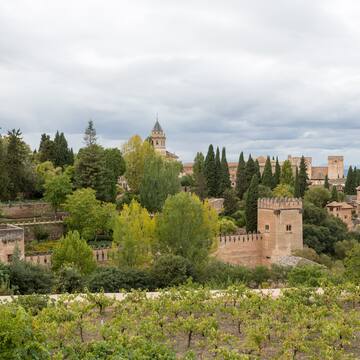
During the eleventh century, the Zirid dynasty ruled Granada and strengthened the existing fortifications. The Alcazaba—the military citadel that still dominates the western end of the complex—became the principal defensive structure protecting the city. Even then, the Alhambra was primarily a fortress rather than the magnificent palace known today.
The Birth of the Nasrid Kingdom
The history of the Alhambra changed forever in 1238 when Muhammad I ibn Nasr, better known as Al-Ahmar („The Red One“), founded the Nasrid Kingdom of Granada. After establishing his new kingdom, he selected the Alhambra as his royal residence and began transforming the old fortress into a magnificent palace city.
Construction continued throughout his reign as walls, towers, gates, reservoirs, and residential buildings expanded across the hill. Unlike many medieval castles that served only military purposes, the Alhambra was designed as a complete city. Behind its massive walls stood government offices, noble residences, workshops, baths, mosques, gardens, streets, and luxurious palaces that reflected the wealth and sophistication of the Nasrid dynasty.
Its elevated position offered both security and symbolic power. Anyone approaching Granada could immediately see the royal city rising above the landscape, demonstrating the authority of the Nasrid rulers over their kingdom.
The Golden Age of the Alhambra
The fourteenth century marked the greatest period in the Alhambra’s history. Under Yusuf I (1333–1354) and his son Muhammad V (1354–1391), the palace complex reached its artistic and architectural peak.
Yusuf I commissioned many of the Alhambra’s most important buildings, including the monumental Comares Palace, the Hall of the Ambassadors, the famous Gate of Justice, and extensive improvements to the city’s walls and towers. His reign transformed the Alhambra into one of the most sophisticated royal courts in medieval Europe.
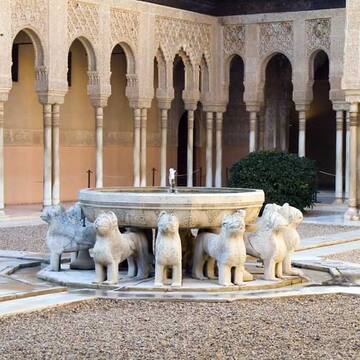
Muhammad V completed many of his father’s projects and added what is now considered the masterpiece of Nasrid architecture—the Court of the Lions. Supported by twelve marble lions surrounding an elegant fountain, the courtyard represents one of the finest achievements of Islamic art. Around it stand richly decorated halls whose walls are covered with intricate geometric patterns, Arabic calligraphy, carved stucco, colorful tiles, and delicate wooden ceilings.
Unlike European Gothic castles of the same period, the Alhambra emphasized harmony rather than monumentality. Flowing water, carefully planned gardens, light-filled courtyards, and elegant proportions created an atmosphere intended to evoke the Islamic vision of paradise on Earth.
A Royal City Powered by Water
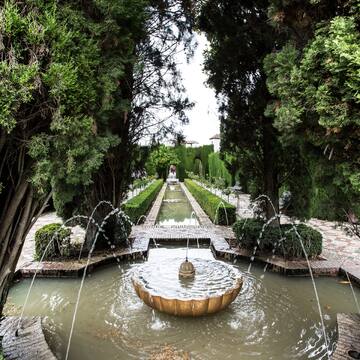
One of the greatest engineering achievements of the Alhambra was its hydraulic system. Water was transported several kilometers from the Darro River through canals built by Nasrid engineers. This constant supply fed fountains, baths, pools, gardens, and irrigation channels throughout the complex.
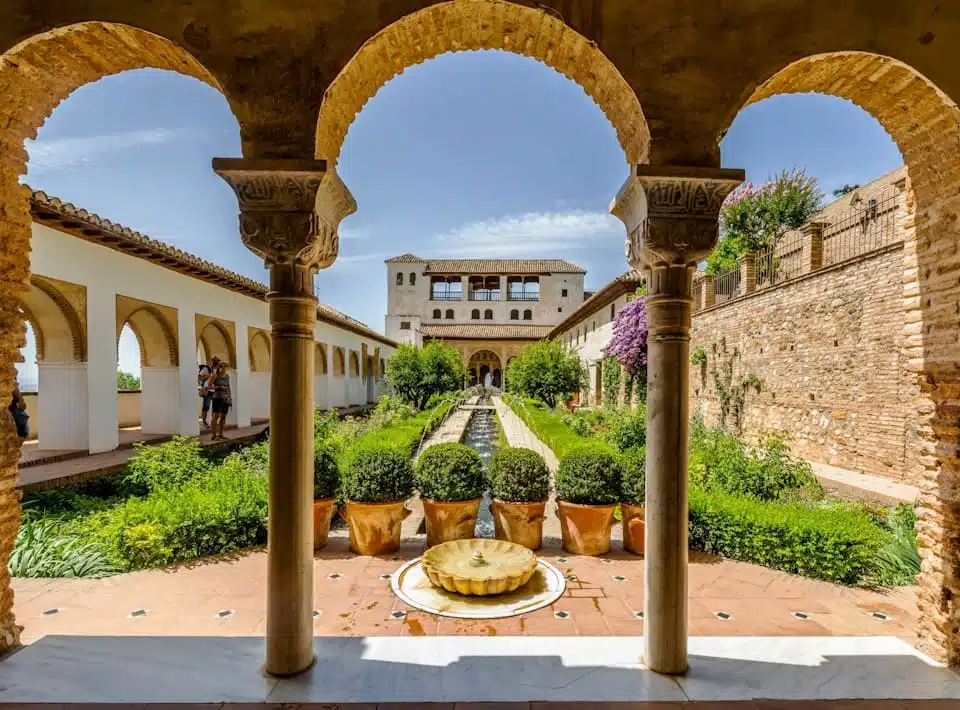
Water served practical purposes but also carried deep symbolic meaning in Islamic culture. Flowing water represented purity, life, and paradise. The famous reflecting pools of the Court of the Myrtles and the fountains of the Court of the Lions demonstrate how engineering and artistic beauty were combined into a single design.
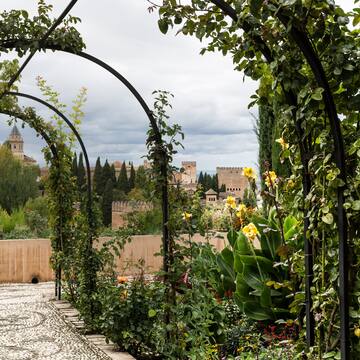
Outside the fortress walls lay the Generalife, the summer palace of the Nasrid rulers. Surrounded by orchards, terraces, and gardens, it provided a peaceful retreat from court life while remaining closely connected to the Alhambra through sophisticated irrigation systems.
The Fall of Granada
By the late fifteenth century, the Christian kingdoms of Castile and Aragon had conquered nearly all Muslim territories on the Iberian Peninsula. Granada remained the final independent Muslim state.
After years of war, Sultan Muhammad XII, known in Spanish as Boabdil, surrendered Granada to King Ferdinand II of Aragon and Queen Isabella I of Castile on 2 January 1492. This event ended almost eight centuries of Muslim political rule in Spain and completed the Reconquista.
Unlike many medieval cities captured through warfare, the Alhambra survived largely intact. The Catholic Monarchs recognized its extraordinary beauty and chose to preserve it as a royal residence rather than destroy it. Christian symbols were introduced, but much of the original Islamic architecture remained untouched.
The surrender of Granada was one of the most significant turning points in European history. Remarkably, it occurred during the same year that Christopher Columbus reached the Americas, forever changing the course of world history.
The Renaissance and Emperor Charles V
During the sixteenth century, Emperor Charles V sought to leave his own mark on the Alhambra. In 1527 he ordered the construction of a magnificent Renaissance palace within the medieval Islamic complex.
The Palace of Charles V contrasts sharply with the surrounding Nasrid architecture. Its massive square exterior encloses an elegant circular courtyard inspired by classical Roman design. Although some contemporaries criticized the palace for interrupting the medieval landscape, it represents one of Spain’s finest Renaissance buildings and reflects the political transition from Islamic Granada to Habsburg Spain.
Despite these additions, much of the original Nasrid palace city survived, allowing visitors today to experience both Islamic and Renaissance architecture within the same complex.
Decline and Rediscovery
After the Spanish royal court moved elsewhere, the Alhambra gradually lost its importance. During the seventeenth and eighteenth centuries, sections of the complex fell into disrepair. Earthquakes caused structural damage, while some buildings were abandoned or occupied by soldiers.
The situation worsened during the Peninsular War (1808–1814), when Napoleon’s troops occupied Granada. As they retreated, French forces attempted to destroy parts of the fortress with explosives. Local intervention prevented the complete destruction of the monument, although some sections were damaged.
The Alhambra’s fortunes changed dramatically in the nineteenth century. In 1832, American writer Washington Irving published Tales of the Alhambra, a collection of stories inspired by his stay inside the palace. His romantic descriptions introduced millions of readers to the forgotten monument and sparked international interest in its preservation.
Throughout the nineteenth and twentieth centuries, extensive restoration projects stabilized damaged buildings, uncovered original decorations, and helped preserve one of Europe’s greatest architectural treasures.
The Alhambra Today
In 1984, UNESCO inscribed the Alhambra, the Generalife, and the historic Albaicín district of Granada as a World Heritage Site. UNESCO describes the Alhambra as the only fully preserved medieval Islamic palatine city and one of the finest surviving examples of Nasrid art, where architecture, landscape, gardens, and hydraulic engineering form a single cultural masterpiece.
Today, millions of visitors walk through the same courtyards once occupied by Nasrid sultans, Catholic monarchs, Renaissance emperors, scholars, diplomats, artists, and travelers. The walls still display thousands of Arabic inscriptions praising God and the Nasrid rulers, while fountains continue to flow through channels engineered more than six centuries ago.
Legacy
The Alhambra represents far more than the final chapter of Muslim Spain. It is a monument where Islamic, Christian, and Renaissance traditions coexist within a single architectural landscape. Few places in the world illustrate so clearly how civilizations can leave lasting cultural legacies that transcend political change.
Its graceful courtyards, intricate decoration, remarkable engineering, and extraordinary history have inspired architects, artists, writers, and historians for generations. More than seven hundred years after its greatest expansion, the Alhambra remains not only the symbol of Granada but one of humanity’s greatest achievements in architecture and urban design.
Вашият коментар